


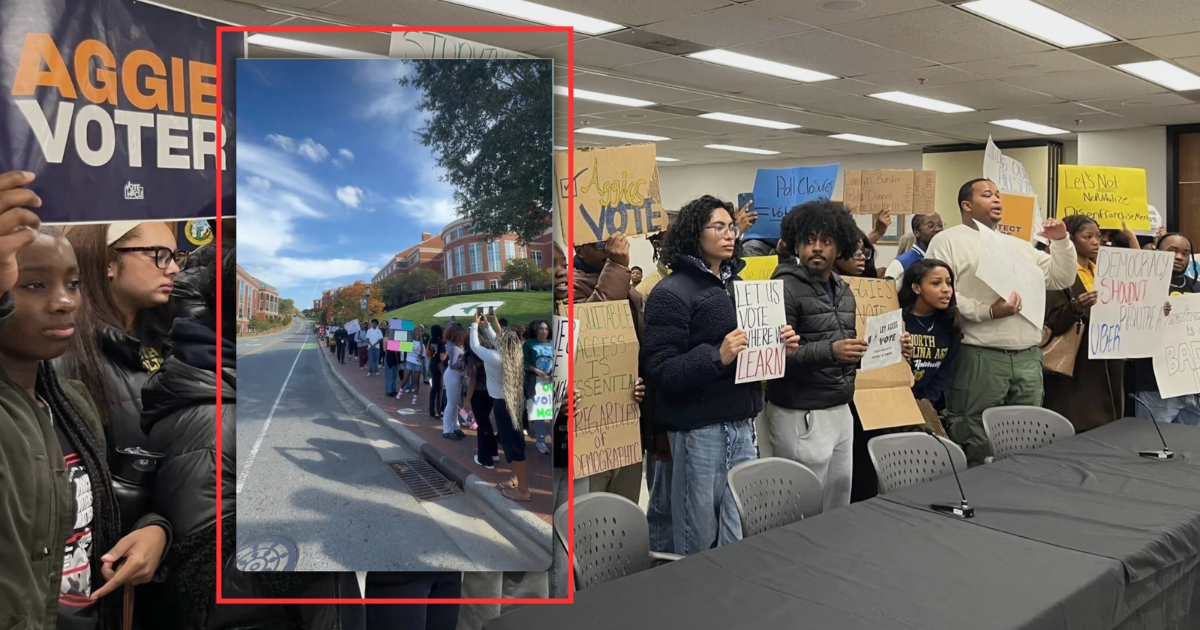
Hundreds of students at a historically Black university turned a long walk to the ballot box into a demonstration of civic participation, raising questions about voting access ahead of the November 3 elections.
GREENSBORO, NORTH CAROLINA — October 29, 2026 — Hundreds of college students in North Carolina have taken to the streets, walking approximately 40 to 45 minutes to cast their ballots after election officials declined to establish early voting locations on their campuses.
The marches, held on October 15 and October 22, brought national attention to a dispute over voting access at North Carolina A&T State University, the nation’s largest historically Black university, and the University of North Carolina at Greensboro.
Rather than allowing the absence of on-campus voting locations to prevent them from participating, students organized marches to the Union Square polling site in Greensboro.
What began as a journey to vote became a public demonstration about the importance of democratic participation.
Why Were Students Walking So Far?
Both North Carolina A&T and UNC Greensboro hosted early voting sites during the 2024 presidential election. However, election officials did not approve campus locations for the 2026 midterm elections.
Republican-majority election boards rejected proposals to include the locations in this year’s early voting plans.
Election officials cited considerations including previous voter turnout, while students and voting-rights advocates argued that the absence of campus polling sites creates additional obstacles for young voters, particularly those without cars.
There is an important distinction in the dispute: although the universities hosted early voting in 2024, county election officials say they had not previously hosted such sites during midterm elections.
Nevertheless, students argue that accessible polling locations should be encouraged, not made more difficult to reach.
During the October 15 march, participants encountered sections of missing or obstructed sidewalks, forcing some to walk along the street.
A Second March Draws Hundreds
On October 22, hundreds of North Carolina A&T students marched again.
This time, the university’s Blue and Gold Marching Machine helped lead the procession through Greensboro as part of the V-OTEC-O-MING event, organized in cooperation with When We All Vote, the nonpartisan civic participation initiative founded by former First Lady Michelle Obama.
Actress Marsai Martin and television personality Trinity Tatum joined the event.
As the students approached their destination, they chanted for the return of campus voting locations.
The march carried particular historical significance in Greensboro, a city associated with the civil rights movement and the 1960 sit-in protests against racial segregation.
What Does This Mean Politically?
The demonstrations come at a politically sensitive moment, just days before the November 3 midterm elections.
North Carolina is hosting a closely watched U.S. Senate race between Democrat Roy Cooper, the state’s former governor, and Republican Michael Whatley.
Black voters have historically supported Democratic candidates by substantial margins, making their electoral participation an important factor in American politics.
However, the students’ participation in the marches does not establish which candidates they support. Voting choices remain individual and confidential.
The political significance of the demonstrations lies in something broader: young voters who encountered obstacles to convenient voting access chose to organize collectively rather than abandon the process.
For election officials, the marches also raise a practical question: how should polling locations be distributed to balance administrative considerations with accessibility for voters?
More Than a Walk to the Polls
The images circulating on social media show long lines of students moving together through Greensboro.
For some observers, the march represents determination. For others, it highlights the continuing debate over election administration and equal access to voting.
The students themselves have made their central message clear through their actions: participating in elections matters enough to organize, travel and encourage others to vote.
North Carolina’s early voting period ends October 31, with Election Day scheduled for November 3.
Whether these demonstrations translate into greater youth turnout remains to be seen.
But one thing is already evident: in Greensboro, a 45-minute walk to a polling station has become a national conversation about voting rights, civic engagement and the role of young Americans in shaping their country’s future.
Sources: WFDD/WFAE Public Radio (October 16); NC Newsline (October 22); North Carolina A&T State University (October 20); WUNC News (October 22); PolitiFact (September 11); Stateline (October 28).
By NJ RADAR Team