


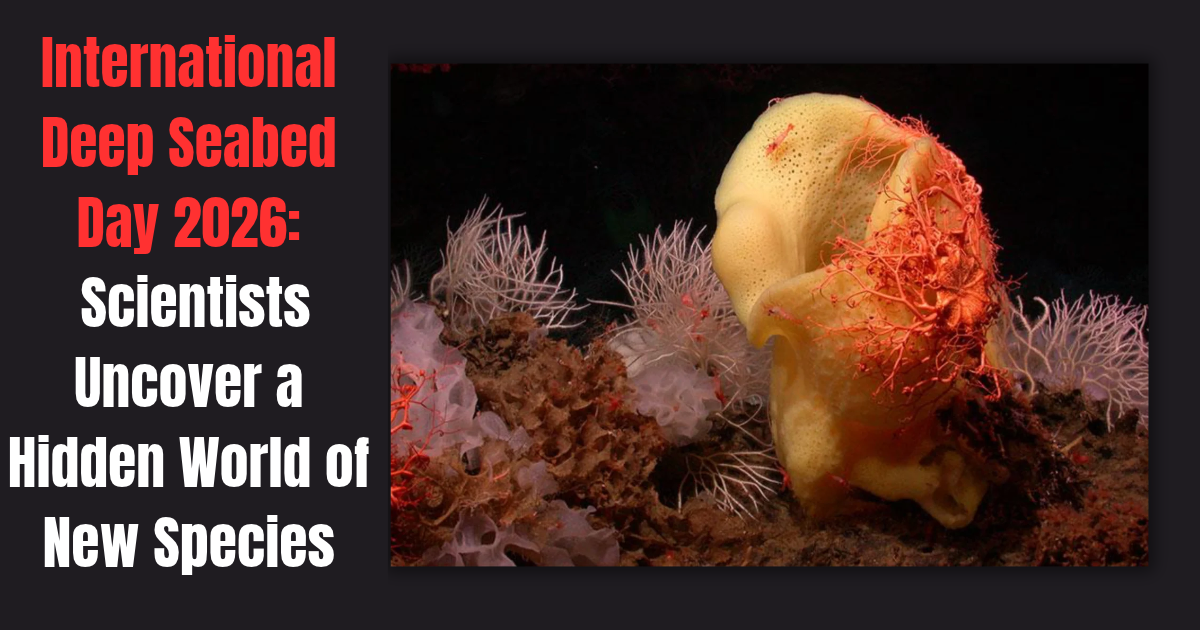
November 1, 2026 — Today marks the International Day of the Deep Seabed, an annual observance highlighting one of the least explored environments on Earth and the extraordinary life hidden thousands of meters beneath the ocean’s surface.
Established by the International Seabed Authority (ISA), the observance draws attention to the scientific importance of the deep ocean, the need to protect its biodiversity, and the international responsibility to manage seabed resources beyond national jurisdiction.
The date commemorates a historic speech delivered to the United Nations on November 1, 1967, by Maltese diplomat Arvid Pardo, who proposed that the deep seabed and its resources beyond national jurisdiction should be considered the common heritage of humanity.
The International Day of the Deep Seabed was first observed in 2025, making this year’s celebration its second annual observance.
A World We Have Barely Explored
Despite decades of scientific research, vast areas of the deep ocean remain unexplored.
Far below the surface, where sunlight never penetrates and water pressure reaches extreme levels, scientists are discovering previously unknown organisms with extraordinary adaptations.
To accelerate these discoveries, the International Seabed Authority supports an initiative called One Thousand Reasons, which aims to identify and formally describe at least 1,000 new deep-sea species by 2030.
Research supported by the initiative contributed to the description of 90 new species during 2024 and 2025.
Recent discoveries provide a remarkable glimpse into the diversity of life that remains hidden beneath the oceans.
What Have Scientists Discovered?
Among the most important discoveries reported in 2026 are 24 previously undescribed species of amphipods, small crustaceans related to shrimp, found in the Clarion–Clipperton Zone of the Pacific Ocean.
The discoveries included an entirely new biological family, Mirabestiidae, and a new superfamily, Mirabestioidea.
These findings suggest that scientists are uncovering not only individual species but also previously unknown branches of evolutionary history.
Researchers have also described two new species of deep-sea starfish, Caymanostella persephone and Caymanostella hades, discovered living on the same piece of sunken wood.
Another unusual discovery is Deltocyathus zoemetallicus, a coral found more than four kilometers beneath the ocean surface.
Unlike many other corals, this species lives attached to mineral-rich nodules on the seabed.
These formations contain metals such as manganese, nickel, cobalt, and copper, which are increasingly attracting interest for potential deep-sea mining.
Why Protecting the Deep Seabed Matters
The deep seabed is not an empty landscape. It contains complex ecosystems that scientists are only beginning to understand.
Many deep-sea organisms depend on highly specialized habitats and may be particularly vulnerable to environmental disturbance.
One major concern is the potential impact of deep-sea mining.
Removing mineral deposits could destroy habitats before researchers have identified the species that depend on them.
Scientists emphasize that documenting marine biodiversity is essential for understanding these ecosystems and evaluating the possible consequences of industrial activities.
The International Seabed Authority plays a central role in regulating mineral-related activities in international seabed areas under the framework of the United Nations Convention on the Law of the Sea.
Why November 1 Is Important
The International Day of the Deep Seabed also reminds the world of an important principle established through decades of international negotiations: the seabed beyond national jurisdiction and its resources are part of humanity’s common heritage.
This principle recognizes that areas beyond national jurisdiction should not simply be treated as resources belonging to whichever country or company can reach them first.
Instead, their management requires international cooperation, scientific knowledge, and consideration of the interests of humanity as a whole.
The Ocean’s Greatest Mysteries Remain Unsolved
With advanced underwater robots, remotely operated vehicles, and modern genetic technologies, scientists can now examine environments that were once almost impossible to reach.
Yet every new expedition reveals how little is known about the deep ocean.
From previously unknown crustaceans and starfish to corals surviving on mineral deposits kilometers beneath the surface, discoveries continue to challenge our understanding of life on Earth.
On International Deep Seabed Day, the message is clear: before humanity can responsibly decide how to use the resources of the deep ocean, it must first understand the extraordinary living world that already exists there.
Sources: International Seabed Authority; United Nations; National Oceanography Centre; Scientific Reports; World Register of Marine Species.
By NJ RADAR Team