


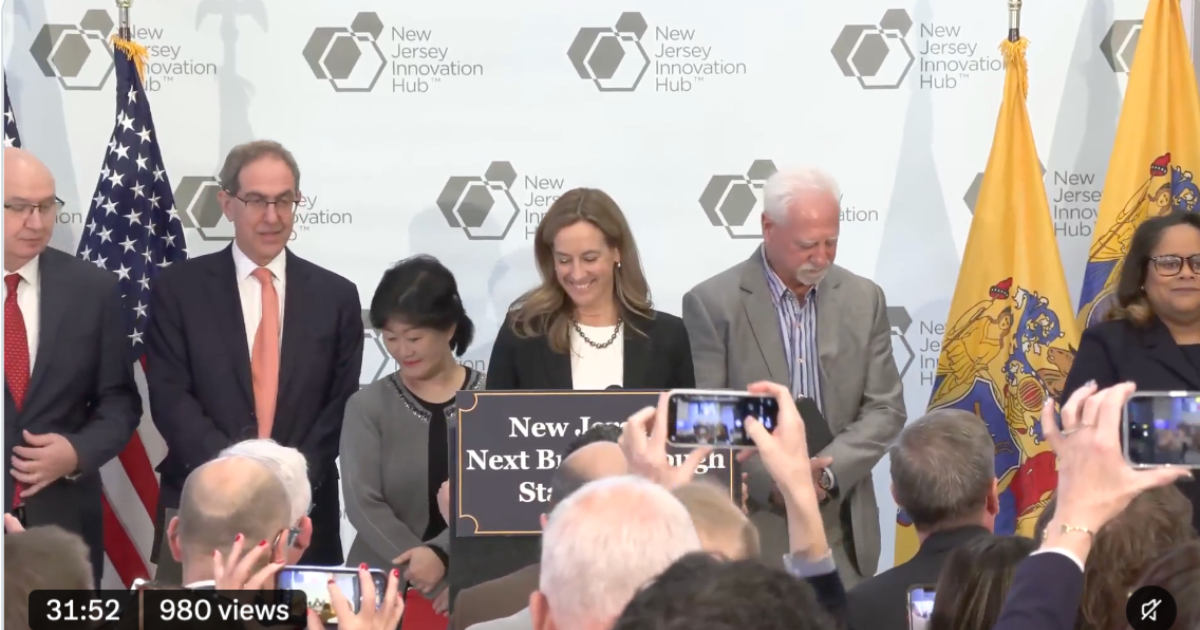
New Jersey Governor Mikie Sherrill announced the launch of the New Jersey Supercomputer Initiative on October 20, advancing the state’s efforts to expand high-performance computing, artificial intelligence research, and technological innovation.
The governor announced the event through her official social media account, inviting residents to watch the launch live.
The initiative builds on an earlier partnership involving the state government, NVIDIA, leading New Jersey universities, and the New Jersey AI Hub.
What Is the New Jersey Supercomputer Initiative?
The initiative is designed to expand access to advanced computing resources for researchers, students, and educational institutions throughout New Jersey.
Unlike ordinary computers, supercomputers can perform enormous numbers of calculations simultaneously, allowing scientists to study complex problems that would otherwise require months or years of conventional computing.
These systems are particularly valuable in artificial intelligence, physics, engineering, climate modeling, medical research, and materials science.
The initiative aims to strengthen New Jersey’s research infrastructure while preparing students and workers for an increasingly technology-driven economy.
Universities and NVIDIA Join Forces
The statewide project was originally announced in January 2026, under former Governor Phil Murphy.
The partnership brings together NVIDIA, one of the world’s leading developers of AI computing technology, and several major higher education institutions, including Princeton University, Rutgers University, New Jersey Institute of Technology, Stevens Institute of Technology, and Rowan University.
The New Jersey Council of County Colleges and the New Jersey AI Hub are also involved.
The collaboration is intended to provide shared computing infrastructure, strengthen research partnerships, and expand educational opportunities.
An earlier announcement outlined approximately $25 million in state support through the New Jersey Economic Development Authority for supercomputing infrastructure at participating universities.
What Can Supercomputers Be Used For?
High-performance computing has applications across numerous scientific and industrial fields.
In physics, supercomputers can simulate complex systems, including the behavior of particles, materials, and energy processes.
In medicine, researchers can use advanced computing to analyze biological data, study molecular interactions, and accelerate drug discovery.
Climate scientists can model weather patterns and environmental changes at a much higher level of detail.
Artificial intelligence researchers depend on powerful computing systems to train and evaluate sophisticated machine-learning models.
For New Jersey, broader access to this technology could help universities attract research projects, encourage collaboration with private companies, and support new scientific discoveries.
Preparing Students for the AI Economy
An important part of the initiative is education and workforce development.
New Jersey’s participating institutions are expected to collaborate on AI training, research opportunities, academic programs, and professional development.
Expanding access to high-performance computing could help students gain practical experience with technologies increasingly used in science, finance, healthcare, engineering, and manufacturing.
Community colleges are also part of the broader partnership, reflecting an effort to extend opportunities beyond major research universities.
Balancing Innovation With Energy Costs
The expansion of high-performance computing also raises questions about electricity consumption and infrastructure.
Powerful computing systems require substantial energy, making electricity supply and operating costs important considerations.
New Jersey has already introduced policies requiring large data centers to take greater responsibility for their energy demands and to report electricity and water consumption.
Governor Sherrill’s administration has emphasized that technological development should not shift excessive infrastructure costs onto residential customers.
What Happens Next?
The October 20 announcement represents a new public milestone for an initiative that began earlier in 2026.
The state has not yet established, in the information publicly confirmed for this article, a complete timetable for statewide researcher access or the final operating arrangements for the planned computing infrastructure.
Those details will be important in determining when students, faculty members, and research organizations can begin using the new resources.
The initiative reflects New Jersey’s ambition to strengthen its position in advanced computing, scientific research, and artificial intelligence while expanding opportunities for its universities and technology workforce.
Sources: Governor Mikie Sherrill on X | NJ Spotlight News/PBS | NJ AI Hub | New Jersey Governor’s Office
By NJ RADAR Team