


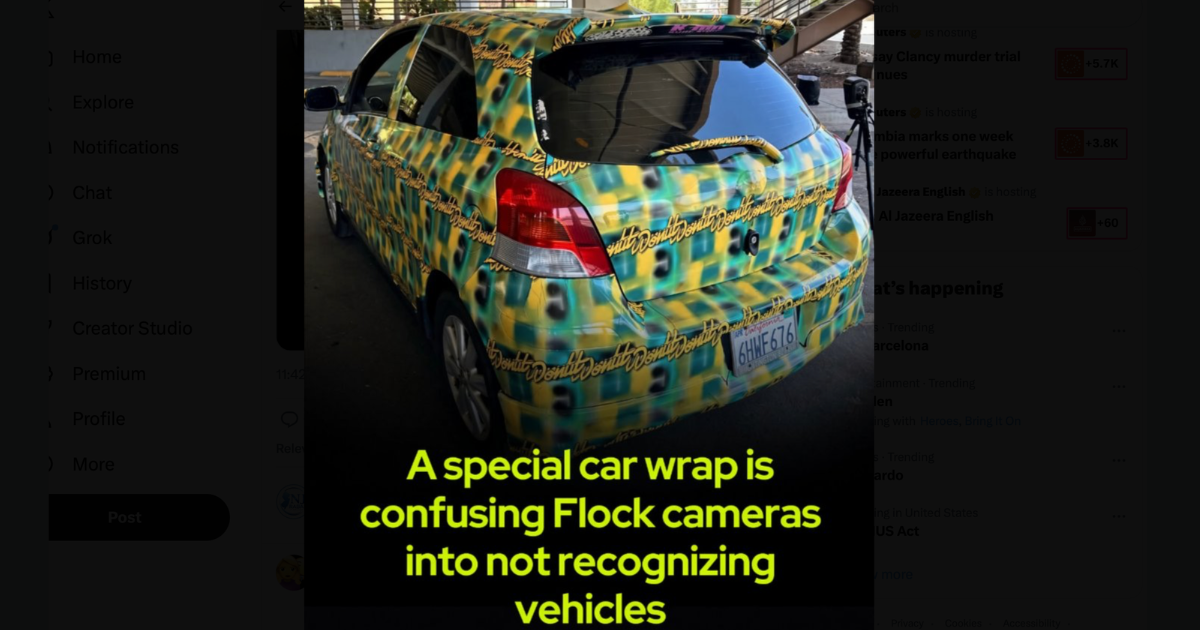
A cybersecurity researcher says a specially designed visual pattern was able to confuse the artificial intelligence used by a Flock surveillance camera, allowing a car to remain visible on video while escaping normal automated detection. The demonstration, presented at DEF CON in Las Vegas, highlights an important weakness in modern computer-vision systems: a camera can record something clearly while the software analyzing the image may fail to understand what it is seeing.
Modern surveillance systems do much more than simply record video.
Flock cameras and similar systems rely on computer vision to automatically detect vehicles, license plates and other objects. That automation makes it possible to search huge amounts of footage quickly without requiring a person to watch every recording.
But what happens when the camera sees a car and the AI does not recognize it as one?
That is exactly what cybersecurity researcher Bill Swearingen set out to test.
Millions of tests to confuse a machine
According to Swearingen’s account of the project, he spent roughly a year developing so-called adversarial patternsdesigned specifically to confuse AI object-detection systems.
His system reportedly ran approximately 31 million tests while searching for visual patterns that were most effective.
The resulting designs do not make a vehicle invisible.
To a human observer, the car is still plainly there.
Instead, the goal is to exploit weaknesses in computer vision so that the software examining the camera feed becomes less certain about what it is looking at.
At DEF CON, Swearingen applied one of the designs to a 2009 Toyota Yaris and tested it against a Flock camera in a real-world setting. According to TechCrunch, the public demonstration succeeded in preventing the system from properly detecting the vehicle.
The camera still saw the car
That distinction is important.
This was not a case of blocking a camera lens, hiding a license plate or making the vehicle physically disappear.
The camera could still capture the scene.
The weakness was in the AI layer interpreting the footage.
Computer-vision systems are trained to recognize patterns in pixels that correspond to objects such as cars or people. Carefully engineered visual inputs can sometimes interfere with those patterns enough to make the model misclassify an object or fail to detect it at all.
Researchers call these adversarial examples or adversarial patches.
The concept has been studied for years. Academic researchers have previously demonstrated printed patterns capable of significantly reducing the ability of object-detection systems to recognize people.
More recent research has shown that physical adversarial designs can also interfere with vehicle and pedestrian detectors under some real-world or simulated conditions.
Why does AI get confused?
Humans and artificial intelligence do not “see” in the same way.
A person looking at a strangely wrapped Toyota still immediately understands that it is a car.
An AI vision model instead analyzes numerical patterns in an image and compares them with patterns learned during training.
That difference creates an unusual vulnerability.
A design that looks like meaningless decoration to us may alter the visual information entering the model just enough to interfere with its classification.
Scientists have repeatedly found that object detectors can be vulnerable to carefully constructed physical patterns, although effectiveness can vary substantially depending on camera angle, distance, lighting and the model being used.
So one successful demonstration does not mean that any printed pattern can make any vehicle invisible to every Flock camera.
It does show, however, that automated detection is not infallible.
A bigger question about surveillance
The experiment arrives as automated camera networks are expanding across the United States.
Their usefulness depends not just on the cameras themselves but on the software that turns millions of images into searchable information.
If the software fails to recognize an object, that footage may become much harder to find automatically even though the image itself still exists.
That makes adversarial research important for more than privacy debates.
It is also a cybersecurity problem.
Research into adversarial attacks is used to identify vulnerabilities so developers can make AI systems more robust. Scientists are actively studying ways of detecting adversarial patches and protecting computer-vision systems against them.
The car did not disappear. The AI made a mistake.
That may be the most interesting lesson from Swearingen’s demonstration.
Artificial intelligence can process visual information at a scale humans never could, but it does not understand the physical world in exactly the same way we do.
A person sees a car covered with a strange design.
The camera records a car covered with a strange design.
And under the right circumstances, the computer analyzing that image may effectively say:
I don’t see a car at all.
For communities increasingly surrounded by AI-powered surveillance, that is a reminder that these systems may be extraordinarily powerful, but they are not necessarily immune to being fooled.
Sources: TechCrunch; Bill Swearingen’s DEF CON demonstration; academic research on physical adversarial attacks and object detection.
By NJ RADAR Team