

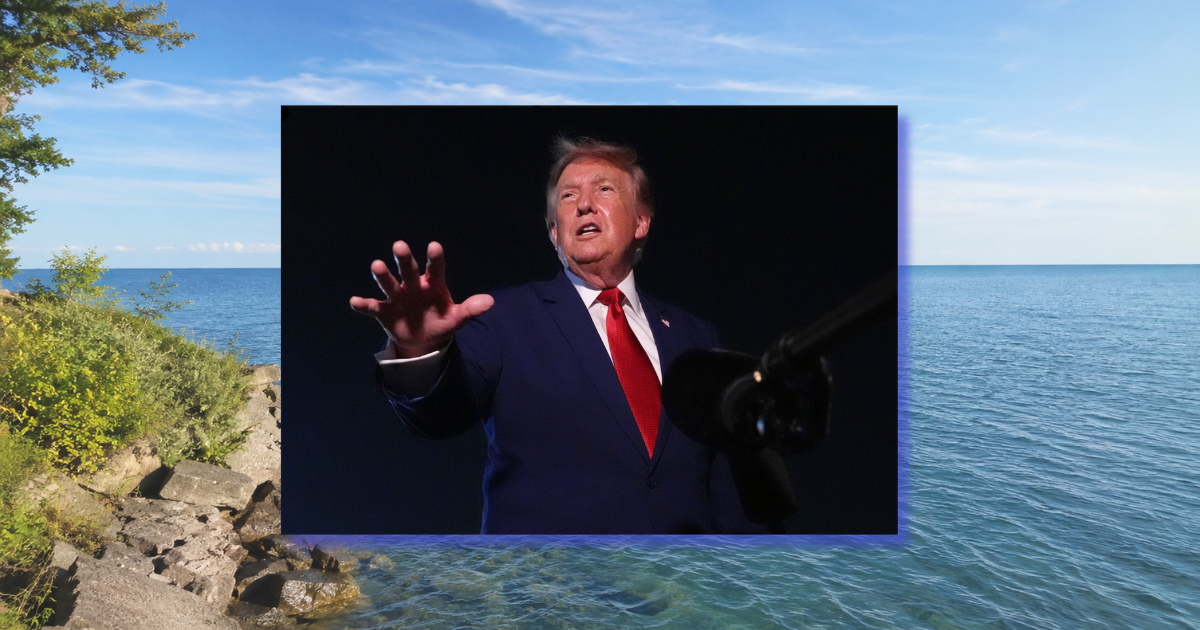
President Donald Trump says he is considering changing the name of Lake Ontario to “Lake America,” injecting a new symbolic dispute into an already escalating trade war between the United States and Canada.
Trump raised the idea Tuesday on Truth Social as relations between Washington and Ottawa deteriorated over tariffs and trade negotiations. Reuters reported that Trump tied the proposed name change directly to his frustration with Canada and, in particular, the province of Ontario.
At first glance, renaming a lake may sound like an unusual side story in a dispute centered on tariffs, factories and billions of dollars in cross-border trade.
But in this case, the name itself appears to be part of the political message.
Lake Ontario is not simply an American lake. It is one of the five Great Lakes and forms part of the international boundary between the United States and Canada. New York lies along its southern and eastern shores, while the Canadian province of Ontario occupies much of the northern and western shoreline.
That makes the proposed name “Lake America” particularly provocative: the body of water is physically shared by two countries whose economies, infrastructure and communities have been deeply connected for generations.
From Tariffs to Geography
The remark comes during one of the sharpest deteriorations in U.S.-Canada relations in decades.
The United States recently imposed 50% tariffs on roughly $20 billion worth of Canadian goods, covering hundreds of products. Canada has responded with retaliatory tariffs on American goods, with new measures scheduled to take effect September 8.
The dispute has moved well beyond technical disagreements about individual products.
Both governments are now framing the conflict in terms of sovereignty, economic independence and national interest.
Canadian Prime Minister Mark Carney has accused Washington of attempting to weaken key Canadian industries, while Trump has repeatedly argued that Canada benefits unfairly from its economic relationship with the United States.
Against that background, changing the name of Lake Ontario would carry far more symbolic weight than economic consequence.
It would effectively take a geographic feature shared by two countries and give it a distinctly American identity, at least in U.S. terminology.
Can the United States Simply Rename It?
That question is more complicated than the political statement itself.
Within the United States, official federal geographic names are standardized through the U.S. Board on Geographic Names, working with the Department of the Interior. Its decisions determine terminology used across federal maps, agencies and government documents.
The U.S. government could therefore potentially change how the lake is referred to in American federal usage.
But that would not force Canada to adopt the same name.
Lake Ontario crosses an international border, and Canada maintains its own geographic terminology. Even if Washington officially adopted “Lake America” for U.S. federal purposes, Canadians could continue calling it Lake Ontario, as could international organizations, map companies and much of the public.
That means a unilateral American change could produce something unusual: one internationally shared lake carrying different official names depending on which side of the border is speaking.
It is also worth noting that the U.S. Board on Geographic Names normally discourages changing established geographic names without a compelling reason and considers local usage and acceptance when reviewing proposals.
There Is a Recent Precedent
Trump has already shown an interest in using geographic names as expressions of national identity.
During his second presidency, his administration moved to use “Gulf of America” instead of Gulf of Mexico in U.S. federal usage, a change Reuters referenced in reporting on the Lake Ontario proposal.
The Lake Ontario idea is different, however.
The Gulf naming dispute involves an international body of water bordered by several nations, but Lake Ontario quite literally divides territory between the United States and Canada.
Its name also has centuries of history. “Ontario” is derived from an Indigenous name associated with the lake, long predating the modern political dispute now surrounding it.
So changing the name would not merely alter a line on a federal map. It would touch history, geography and the identity of a Canadian province that itself takes its name from the lake.
Canada Is Not Taking the Bait
Canada’s government so far appears reluctant to turn Trump’s comment into another direct political confrontation.
Canadian Trade Minister Dominic LeBlanc said the government would not engage with social media statements from Trump or members of his administration, according to Reuters.
That response may itself be strategic.
Every new verbal clash risks pushing an already serious trade dispute further away from negotiations and deeper into questions of national pride.
And the economic stakes are considerable.
The United States and Canada have some of the world’s most integrated supply chains. Cars and auto parts can cross the border repeatedly during production, while agriculture, energy, steel, lumber and manufacturing depend heavily on cross-border trade.
Tariffs imposed by either country therefore do not remain neatly on one side of the border. They can raise costs for companies and consumers in both.
More Than a Name
Whether “Lake America” ever appears on an official U.S. map remains uncertain.
Trump said he is considering the change; he did not announce that the lake had already been renamed.
But the suggestion illustrates how far the U.S.-Canada dispute has moved beyond customs duties.
Trade wars usually begin with numbers: tariff percentages, import totals and trade deficits.
This one is increasingly being fought through language, symbolism and competing ideas about sovereignty.
Lake Ontario has remained in the same place for thousands of years.
What governments choose to call it may now become another measure of just how far relations between two of the world’s closest neighbors have changed.
Sources: Reuters, U.S. Geological Survey, U.S. Environmental Protection Agency; Al Jazeera X
By NJ RADAR Team
[…] posted a video showing himself crossing out the name “Lake Ontario” on a map and writing “Lake America” in its […]
[…] birds are shown marching along the shoreline of what is labeled “Lake America,” carrying rifles as American flags appear in the background. The video ends with the geese […]