


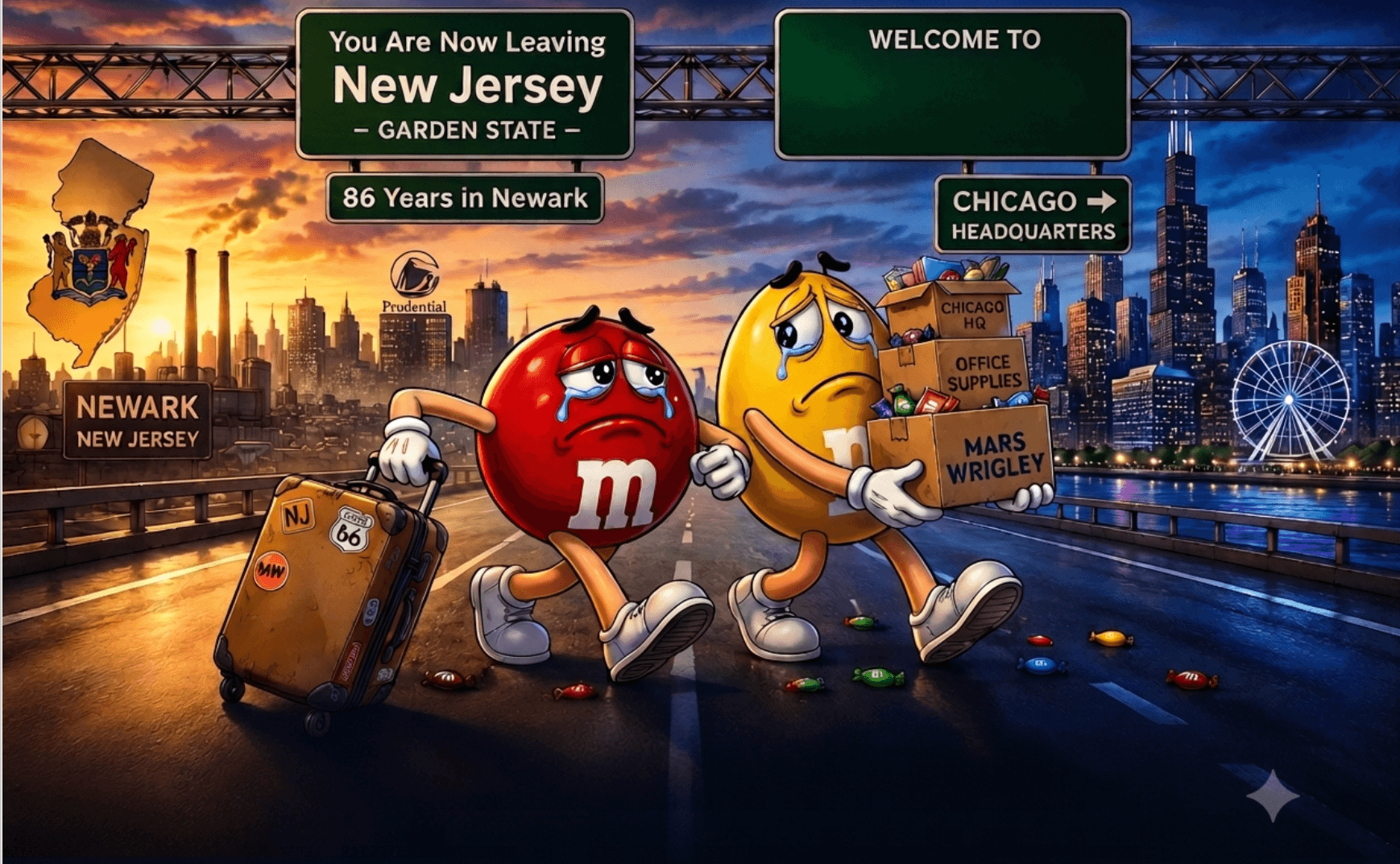
Mars Wrigley, the company behind popular brands such as M&M’S and Snickers, has relocated its headquarters from Newark, New Jersey, to Chicago, Illinois, after decades of presence in the state. According to a July 2026 WARN filing, the move will eliminate 307 jobs at the Newark office, with the facility closing entirely by December 2027. The move has renewed a broader discussion about New Jersey’s business climate and the reasons why some major companies are choosing different locations.
Official company information:
The relocation follows a $100 million expansion Mars announced earlier this year for its Chicago headquarters — meaning the move was already signaled well before the layoffs became official. NJBIA CEO Michele Siekerka called it “another unfortunate exodus of a job creator in New Jersey,” adding that the state “need[s] to wrap our arms around this.”
Business leaders have warned for years about the high cost of operating in New Jersey, including high property taxes, labor costs, real estate expenses, and other challenges affecting companies.
New Jersey has some of the highest property taxes in the United States, which has led some businesses to consider relocating to states with a more favorable business environment. Illinois, Texas, Florida, and other states have attracted companies in recent years by offering different economic incentives and lower operating costs.
For employees and local communities, the relocation of a corporate headquarters after decades in the state represents more than a business decision — it highlights a larger challenge facing New Jersey: how to retain major companies, jobs, and investment while maintaining competitiveness in a high-cost environment.
Why Are Some Companies Leaving New Jersey? A Look at the Changing Business Landscape
In recent years, New Jersey has experienced several high-profile corporate relocations and business changes. Mars Wrigley is one of the most visible examples, moving its headquarters from Newark to Chicago, Illinois, after decades of operations in the state.
According to analyses from 2025 and 2026, several major corporate moves have affected thousands of jobs and created significant economic impacts.
Main Reasons Behind the Trend
1. High Business Taxes
New Jersey has one of the highest corporate tax rates in the United States. Business organizations often point to the state’s overall tax burden — including some of the highest property taxes in the country — as a challenge to competitiveness.
2. High Cost of Living and Energy
High real estate costs, expensive office space, higher wages needed to attract workers, and rising energy costs contribute to the overall expense of doing business in New Jersey.
Some companies say it has become more difficult to attract and retain employees because housing and living costs remain among the highest in the nation.
3. Regulatory Challenges and Changing Rules
Frequent changes in regulations, bureaucracy, and administrative requirements can make long-term planning more difficult.
4. Competition From Other States
States such as Texas and Florida actively compete for companies by offering lower taxes, faster permitting processes, lower energy costs, and economic incentives.
Chicago, for example, provides Mars Wrigley with a central location, strong infrastructure, and access to a major business market.
5. Business Climate Rankings
New Jersey has often ranked near the bottom in national business climate surveys. The number of Fortune 500 companies headquartered in New Jersey has declined from 22 in 2018 to 15 in 2026.
Impact on the State
When companies leave or reduce operations, the effects extend beyond direct job losses. Communities may experience:
- Reduced tax revenue
- Less investment in local schools, infrastructure, and public services
- Fewer high-paying job opportunities
- A weaker economic presence
The connection to education is also part of the broader financial discussion. Several New Jersey school districts have faced significant budget challenges in 2026, leading to staff reductions and difficult financial decisions. Rising costs and pressure on local budgets continue to raise questions about how communities can maintain essential services while managing economic challenges. As major employers like Mars Wrigley reduce their footprint in the state, some economists warn that these pressures could continue to affect local budgets and public services.
The discussion about businesses leaving is also connected to broader population trends. Some analyses have pointed to residents moving out of New Jersey because of housing costs, taxes, and affordability concerns.
Examples of Corporate Changes
- Mars Wrigley — Newark, New Jersey, to Chicago, Illinois
- Samsung — expansion and relocation of U.S. operations to Texas
- ExxonMobil, Honeywell, and other major companies have changed or reduced their presence in New Jersey According to a June 2026 Focus NJ report, these corporate moves have shifted more than 7,200 jobs out of the state altogether — part of a pattern that also includes nearly 10,000 jobs listed in WARN notices statewide so far in 2026.
What Happens Next?
The departure or relocation of companies creates broader economic questions for New Jersey.
Less business activity can affect tax revenue, local investment, and employment opportunities. The state must compete with locations offering different cost structures and incentives.
Some officials emphasize New Jersey’s advantages, including its location near New York City, educated workforce, and strong infrastructure. Others argue that reducing costs and improving the business environment will be necessary to keep companies investing in the state.
Conclusion
The relocation of Mars Wrigley and other corporate changes reflect a larger conversation about the future of business in New Jersey.
High operating costs, taxes, and regulatory challenges are frequently mentioned as factors influencing corporate decisions. The challenge for New Jersey will be finding a balance between maintaining public services and creating an environment where companies continue to invest, grow, and create jobs.