


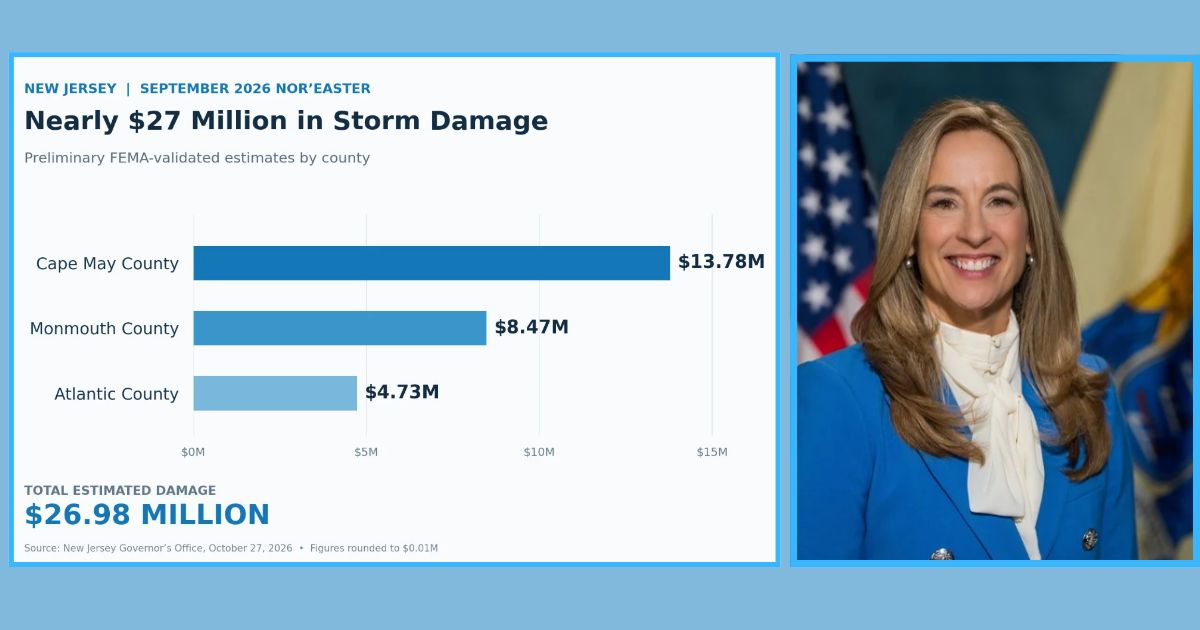
TRENTON, New Jersey — October 27, 2026 — New Jersey Governor Mikie Sherrill has requested a federal major disaster declaration from President Donald Trump following a powerful nor’easter that struck the state in September, causing nearly $27 million in preliminary damage across three coastal counties.
The request, submitted on October 26, seeks federal assistance for Monmouth, Atlantic, and Cape May counties, where the storm caused severe coastal flooding, beach erosion, and damage to public infrastructure.
The federal government has not yet approved the request.
Nearly $27 Million in Storm Damage
According to the Governor’s Office, preliminary damage assessments validated by the Federal Emergency Management Agency (FEMA) identified the following losses:
- Cape May County: $13.78 million
- Monmouth County: $8.47 million
- Atlantic County: $4.73 million
The combined preliminary damage estimate is approximately $26.98 million.
Cape May County reported the highest losses, accounting for more than half of the total estimated damage across the three counties.
All three counties significantly exceeded FEMA’s per-capita damage indicators. Cape May County’s losses reached approximately 30 times its threshold, while Monmouth County’s damages were nearly three times its threshold.
Governor Requests Federal Disaster Declaration
Governor Sherrill sent a letter to President Trump requesting a Major Disaster Declaration, which would allow eligible state and local governments to seek reimbursement through FEMA’s Public Assistance Program.
The request also includes funding through the Hazard Mitigation Grant Program, designed to help communities strengthen infrastructure and reduce damage from future storms.
In her announcement, Sherrill emphasized the importance of securing resources for coastal communities still recovering from the September storm.
The governor also noted that New Jersey contributes billions of dollars more in federal taxes than it receives in federal funding and expressed hope that the federal government would support the state’s recovery efforts.
Storm Severely Damaged New Jersey’s Coastline
The powerful nor’easter struck New Jersey between September 25 and September 28, bringing strong winds, heavy rainfall, significant coastal flooding, and widespread beach erosion.
The storm affected communities throughout the Jersey Shore, damaging beaches and dunes that serve as natural barriers against coastal flooding.
New Jersey declared a state of emergency in eight counties during the storm. That emergency declaration was lifted on September 29, although recovery and damage assessments continued.
The New Jersey Department of Environmental Protection has warned that some damaged beach protection projects remain vulnerable to future severe weather without timely repairs.
Additional Federal Assistance Requested
The latest request follows an earlier application by the Sherrill administration for emergency federal assistance to restore coastal protection projects maintained by the U.S. Army Corps of Engineers.
That earlier request focused on replenishing damaged beaches and dunes and repairing federally managed coastal storm protection projects.
The new FEMA request would help address eligible storm-related costs in areas not covered by the Army Corps’ authority.
Federal assistance, if approved, could help local governments recover some of their expenses and invest in projects designed to reduce risks from future storms.
Decision Now Rests With Washington
The September nor’easter has highlighted the continuing challenges facing New Jersey’s coastal communities, where flooding, erosion, and increasingly costly storm recovery efforts place pressure on municipal and county budgets.
For communities that depend on beaches and coastal infrastructure for tourism, economic activity, and property protection, timely restoration is particularly important.
However, the request does not guarantee that federal financial assistance will be granted.
New Jersey is now awaiting a federal decision on whether Monmouth, Atlantic, and Cape May counties will receive disaster assistance for the nearly $27 million in preliminary storm damage.
Sources: New Jersey Governor’s Office, October 27, 2026; New Jersey Department of Environmental Protection; News 12 New Jersey.
By NJ RADAR Team