


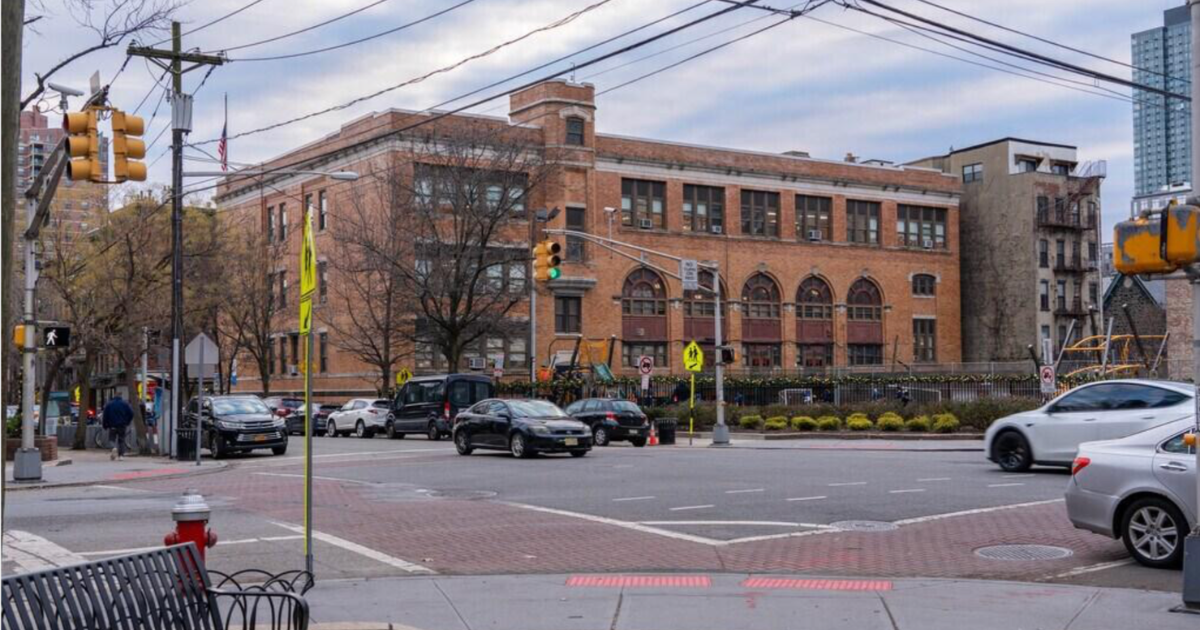
JERSEY CITY, NJ — November 2, 2026 — Rapid residential development in downtown Jersey City has created a growing education crisis, with one elementary school experiencing nearly three times as many students as it had a decade ago.
P.S. 16, also known as the Cornelia F. Bradford School in the Paulus Hook neighborhood, is struggling to accommodate a rapidly expanding student population. The shortage of classroom space has already forced preschool children to attend schools elsewhere in the city, and kindergarten students are expected to face similar arrangements beginning next school year.
The situation raises broader questions about whether Jersey City’s school infrastructure has kept pace with its residential construction boom.
Enrollment Jumps From 430 to 1,144 Students
According to figures reported by Gothamist on October 31, enrollment at P.S. 16 increased from 430 students during the 2015–2016 school year to 1,144 during 2025–2026.
That represents an increase of approximately 166% in just ten years.
During the same period, Jersey City approved approximately 68,000 new housing units, according to figures previously cited by former Mayor Steve Fulop.
Much of the residential development has been concentrated downtown and along the waterfront, where young families have moved into newly constructed apartment buildings.
However, the number of available classrooms has not expanded at the same pace.
The school continues to operate in a building more than a century old, supplemented by an annex that opened in 2021.
The annex added 13 classrooms, but growing enrollment meant the additional space was needed for older students rather than the preschool population it was originally intended to accommodate.
Young Children Are Being Bus Transported Across the City
Because P.S. 16 cannot accommodate all of its youngest students, preschool children are transported by bus to other facilities, including the Danforth Early Childhood Center in the Greenville neighborhood.
Depending on traffic conditions, the journey can take 30 minutes or longer.
Families have raised concerns about lengthy transportation arrangements, unpredictable arrival times, and the difficulties of waiting outdoors with young children during winter weather.
The district also plans to transport all kindergarten students assigned to P.S. 16 to other locations during the 2027–2028 school year.
A smaller number of kindergarten students are already being transported to another school.
For parents, the issue extends beyond transportation. Some have questioned whether overcrowded classrooms can provide children with adequate individual attention.
At an October school board meeting, concerns were raised about classrooms containing approximately 35 to 40 students.
A Construction Boom Without Enough Schools
The overcrowding at P.S. 16 highlights a significant challenge facing rapidly developing urban communities.
Jersey City has approved thousands of residential units, transforming neighborhoods such as Paulus Hook into densely populated areas with an increasing number of families.
Yet the construction of new school facilities has not kept pace with that growth.
The challenge is especially complicated because enrollment across the entire Jersey City school district has declined by roughly 2,000 students over the past decade, even as demand for classrooms in downtown neighborhoods has increased sharply.
This uneven population distribution makes it difficult to address overcrowding through districtwide enrollment figures alone.
In other words, a district can experience declining overall enrollment while individual neighborhood schools face severe capacity problems.
Why Hasn’t a New School Been Built?
The New Jersey Schools Development Authority oversees major school construction projects in Jersey City and other designated districts.
However, the agency must distribute limited resources among communities with competing infrastructure needs.
According to state education officials, Jersey City’s current long-range facilities plan does not include construction of a new school downtown.
District leaders could request changes to that plan, but any new project would require available funding and an appropriate site.
The authority has identified numerous aging school buildings in Jersey City that may eventually require replacement, including P.S. 16.
Superintendent Norma Fernandez has indicated that a new demographic study could help the district evaluate future needs and consider changes to its facilities plan.
The study is expected to be completed by December.
Could Developers Help Finance New Schools?
One proposal receiving attention involves negotiating agreements with real estate developers to incorporate educational facilities into major residential projects.
The existing P.S. 16 annex was made possible through such an arrangement.
Under the agreement, a developer provided space that was subsequently sold to the school district for a nominal price of $1.
Jersey City Councilmember Eleana Little has suggested that similar partnerships could offer a practical way to create additional classrooms downtown.
Potential projects, including the proposed development at 111 First Street, have been discussed as possible opportunities to incorporate educational facilities.
However, these possibilities remain uncertain, and no new downtown elementary school has been formally approved.
Parents Could Face School Boundary Changes
With no immediate solution available, school officials are also considering whether to redraw attendance boundaries.
Such a move could reduce the number of children assigned to P.S. 16 by directing some families to other schools.
However, redistricting could prove controversial, particularly among parents who moved into neighborhoods expecting their children to attend a nearby public school.
Superintendent Fernandez has said no final decisions will be made before the district completes its demographic study.
In the meantime, officials are also exploring whether vacant commercial spaces could be converted into classrooms, although renovation and leasing costs remain significant obstacles.
A Larger Question About Urban Development
The situation at P.S. 16 reflects a broader challenge in rapidly growing communities: how to ensure that public services expand alongside residential development.
New apartment buildings can attract families, increase housing supply, and generate economic activity.
But growth also creates demand for classrooms, teachers, transportation, parks, and other essential public infrastructure.
When development decisions are not matched by long-term school planning, families and students may face the consequences.
For Jersey City, the challenge is no longer theoretical. Children are already being transported across the city because their neighborhood school lacks sufficient space.
The central question now is whether Jersey City and New Jersey education officials can develop a lasting solution before another generation of students faces the same classroom shortage.
Sources: Gothamist, October 31, 2026; Hudson County View, October 16, 2026; Jersey Digs, September 9, 2026.
By NJ RADAR Team