


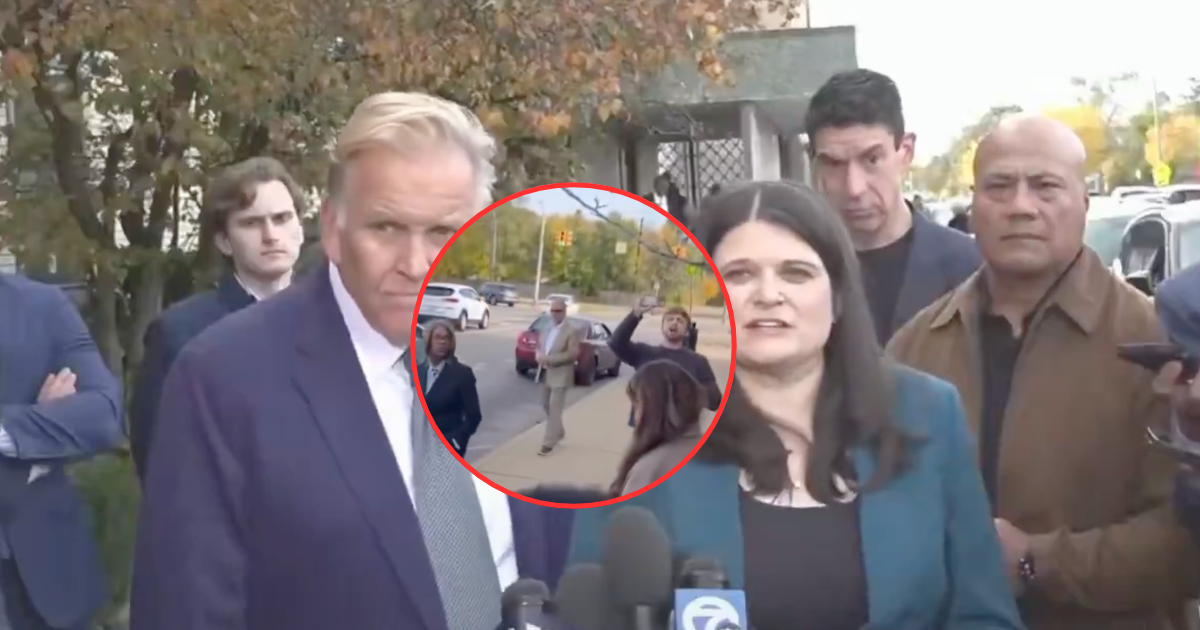
DETROIT, Michigan — November 2, 2026 — A public appearance by Democratic Congresswoman Haley Stevens and Republican Senate candidate Mike Rogers ended abruptly Sunday after a protester repeatedly shouted that Stevens was a traitor, reflecting growing anger over her decision to endorse a Republican instead of her party’s Senate nominee, Abdul El-Sayed.
The confrontation took place outside Perfecting Church in Detroit, where Stevens and Rogers had attended a Sunday service together just two days before the November 3 election.
Video circulating on social media shows a man shouting criticism of Stevens as she answered reporters’ questions about her unexpected endorsement of Rogers.
The incident has drawn attention to the distinction between constitutionally protected political protest and conduct that could constitute intimidation or violence.
Protester Interrupts Stevens During Questions From Reporters
Stevens was speaking to journalists about her decision to support Rogers when a man nearby began shouting that she was a traitor.
As the shouting continued, Rogers turned toward the protester, while Stevens ended her remarks and departed with the Republican candidate.
Reports from CNN, TheWrap, and Mediaite confirm that the interruption brought the news conference to an abrupt conclusion.
The available reporting does not establish that the protester physically attacked Stevens or Rogers, or that his remarks included a threat of violence.
The man’s identity has not been publicly established in the reports reviewed.
A Political Reversal Sparks Public Anger
The protest followed Stevens’ announcement that she was endorsing Rogers, the Republican candidate competing against Abdul El-Sayed for Michigan’s open U.S. Senate seat.
Stevens had lost the Democratic primary to El-Sayed in August and had previously expressed support for the Democratic nominee.
Her decision to endorse Rogers on November 1 shocked Democratic officials and prompted strong criticism from within her own party.
Michigan Democratic leaders reaffirmed their support for El-Sayed and accused Stevens of undermining party unity during the final days of the election campaign.
The dispute has centered partly on disagreements over Israel, political messaging, and accusations concerning antisemitism.
Stevens maintains that her concerns about El-Sayed’s campaign and its political associations influenced her decision.
Does the First Amendment Protect the Protest?
The incident has also prompted discussion about freedom of speech in public spaces.
Under the First Amendment to the U.S. Constitution, individuals generally have broad protections when expressing political opinions on public sidewalks and other traditional public forums.
Those protections can extend to harsh criticism, shouting, and statements that elected officials may consider offensive.
Calling a politician a traitor is ordinarily a form of political expression rather than a criminal threat, although the full circumstances of a confrontation matter.
Authorities may enforce lawful restrictions concerning public safety, obstruction, harassment, and genuine threats.
The available evidence does not establish that the protester committed a violent act.
However, the precise location, conduct, and circumstances would need to be established before reaching a legal conclusion about this particular incident.
Political Speech and Public Accountability
Public demonstrations have long been part of American political life, particularly during election campaigns.
Supporters and opponents of candidates frequently gather outside rallies, campaign appearances, government buildings, and other public events to express their views.
The Constitution protects the right to criticize elected representatives, including members of one’s own political party.
At the same time, peaceful protest should be distinguished from physical intimidation or violence.
Political disagreement, even when expressed in confrontational language, does not automatically constitute an act of violence.
In the Detroit incident, the protester’s shouted criticism became part of a broader public reaction to Stevens’ endorsement of Rogers.
A Campaign Already Divided
The confrontation came amid growing tensions within Michigan’s Democratic Party.
Stevens’ decision to support Rogers followed the collapse of plans for a unity appearance with El-Sayed.
Democratic officials publicly criticized her endorsement, while El-Sayed’s campaign reported a significant increase in fundraising following the announcement.
According to POLITICO, the campaign said it raised approximately $1.2 million within four hours of Stevens’ endorsement.
The sudden fundraising increase and public criticism illustrate the intensity of the political response, although neither establishes how voters will respond on Election Day.
Questions Remain About the Incident
Despite the video’s circulation online, several details remain unconfirmed.
There has been no verified report in the sources reviewed that the protester physically assaulted either candidate.
It is also unclear whether security officials issued any instructions to the demonstrator or whether a formal complaint was made.
Those questions are important because the presence of a loud political protester does not, by itself, establish that a public appearance was unsafe.
Freedom of Speech in a Divisive Election
The incident outside Perfecting Church offers another example of how deeply political disagreements can affect public events during an election campaign.
Stevens’ endorsement of a Republican opponent has already generated criticism from Democratic leaders, campaign activists, and members of the public.
The protester’s interruption brought that reaction directly into a public appearance attended by both candidates.
As Michigan prepares to vote on November 3, the incident highlights an enduring principle of American democracy: political leaders may face vigorous public criticism, while the distinction between peaceful dissent, intimidation, and violence must remain grounded in evidence rather than political disagreement.
Sources: TheWrap, November 1, 2026; Mediaite, November 1, 2026; CNN, November 1, 2026; Associated Press via Michigan Public.
By NJ RADAR Team