


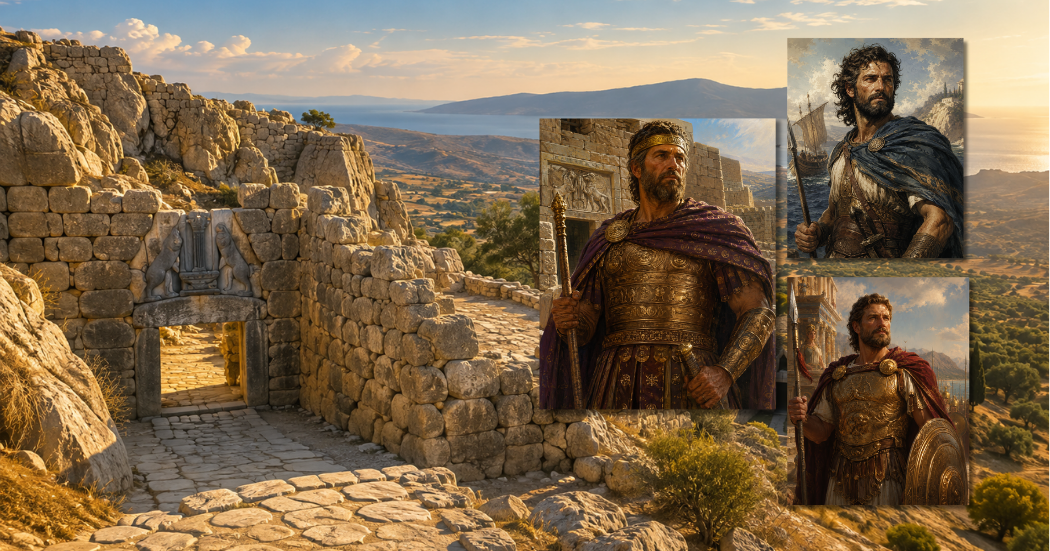
I read the Iliad and the Odyssey a long time ago, and a few decades ago I also visited Mycenae, the place from which, according to legend, the campaign against Troy began. Yet what keeps drawing me back to this story is not only the memory of those epics or of that journey, but their remarkable timelessness. Nearly three thousand years later, Homer’s works have outlived entire eras, languages, and civilizations, continuing to live through literature, art, and modern film.
Perhaps that is where Homer’s greatest power lies. What for centuries was considered pure legend did not remain trapped on the pages of a book. Those verses put archaeologists’ shovels into the ground, fired the imagination of artists, and inspired filmmakers to weave the old material into new forms for new generations. That is why Troy and Odysseus still do not feel like dead relics of antiquity, but like stories that continue to return to our world.
It is especially fascinating how deeply this ancient world influenced real archaeology. Convinced that Homer’s verses contained a historical core, Heinrich Schliemann began searching for Troy and Mycenae. His persistence was rewarded in 1876 with the discovery of royal graves and gold masks at Mycenae, including the most famous one, which he named the “Mask of Agamemnon,” even though later research showed that it came from a period earlier than the Trojan War itself.
Even in Mycenae today, everything seems to carry Agamemnon’s name. The city feels as if it still lives in that time, as though it never quite moved forward on the timeline but remained caught in the storm of the past. In the valley stands the so called Tomb of Agamemnon, a massive stone structure about forty three feet high, skillfully built into the hillside. It is nothing like the pyramids of Egypt, yet it is monumental in its own way. Although no one knows with certainty who it actually belonged to, the Greeks long ago associated it with Agamemnon. Our guide told us that it had remained buried and almost hidden in the landscape for a long time, until a shepherd noticed an opening and discovered it by chance, after which, unfortunately, its treasures were looted.
When I first saw Mycenae, turned almost entirely to stone on the hillside, I was surprised. I had expected something much larger. In my imagination, the place from which, at least according to legend, an army capable of destroying Troy had set out was almost the size of an entire world. Then I saw the stone walls. The Lion Gate seemed so small that I found myself wondering how tall those Greek heroes could really have been. A small circular space paved with stone blocks. Stone. Mountains. Silence.
And when I remember standing below the walls of Mycenae, the place from which Agamemnon supposedly left for the Trojan War, our guide simply pointed toward the walls and said, “That is where the terrible quarrel happened.” She said it so naturally, almost as if it had happened yesterday in the neighborhood rather than several thousand years ago. That was what fascinated me most about the Peloponnese. People there seem to still live with these stories. History, myth, and everyday life somehow blend into one.
Even one peninsula, when seen from above, could be recognized in the shape of a sleeping man. Our guide looked toward it and said, “That is Agamemnon sleeping.” And somehow it made sense. Perhaps that is why the story still feels so alive in the Peloponnese, as if Agamemnon has never completely left.
Agamemnon survived ten years of war at Troy, but when he returned home, he did not survive his own house. His wife Clytemnestra and her lover Aegisthus killed him soon after his return. Perhaps that is one reason the story has remained so powerful. The greatest commander did not fall beneath the walls of Troy. He died in his own home.
Standing in Mycenae, what surprised me most was how small the space was from which such an enormous story had emerged. What stood before me was not a legend. The Lion Gate looked so small that I wondered again how tall those Greek heroes must have been. A small circular space paved with stone blocks. Stone. Mountains. Silence. And yet from that small place, humanity has been drawing stories of war, love, loyalty, betrayal, honor, and the longing to return home for nearly three thousand years.
Perhaps that is exactly why the story survived. Not because it was only a story about war, but because from Helen to Penelope and Clytemnestra, it was also a story about people who went to war because of love and who tried to return from war because of love.
The Trojan War, at least in myth, began because of a woman, and women in many ways marked both its beginning and its end. Men fought the battles, conquered cities, and died beneath the walls of Troy, but the forces shaping their destinies were often love, jealousy, honor, wounded pride, and revenge.
Helen had many suitors before she married Menelaus. Odysseus was among them. According to the old story, it was Odysseus who proposed the solution that would later have enormous consequences. All of Helen’s suitors were to swear that they would defend the man chosen to marry her if anyone ever threatened their marriage. Menelaus, Agamemnon’s brother, was chosen. When Paris took Helen to Troy, the old oath came alive again. The Greek kings went to war, and that war would last ten years.
Troy was destroyed. Helen was brought back. But for many of the men who had won, the real tragedy was only beginning. Penelope waited faithfully for years for Odysseus to return home. Agamemnon, who had survived Troy, returned only to find betrayal and death waiting for him in his own house. Perhaps that is why the Trojan War was never only a story about men going to battle, but also about the women around whom they made decisions that changed their lives.
Almost every great character and symbol from the story of Troy has come to mean far more than the hero or object itself. The Trojan horse is no longer just a horse. It has become a symbol of deception, of entering something from within when it cannot be conquered from the outside. A Trojan is even the name we use for a type of malicious computer program. Achilles’ heel has become a synonym for a person’s weak point. An odyssey means a long, difficult journey filled with wandering, ingenuity, and hope. Penelope remains a symbol of loyalty and long waiting. Hector is remembered as a symbol of courage. Helen became a symbol of extraordinary beauty, but also of beauty powerful enough to provoke conflict, the face that, as the saying goes, launched a thousand ships. Agamemnon represents the powerful ruler and commander whom neither strength nor glory could save from fate.
Perhaps that is why the Trojan War never remained merely an ancient story. Its characters became words, comparisons, and symbols that we still use three thousand years later.
And perhaps that is the strange power of Homer. Something that for thousands of years was treated as epic and legend did not remain only on the page. Those verses inspired archaeologists to dig, artists to create, and filmmakers to retell the same story for new generations. Troy and Odysseus still do not feel like dead ancient history, but like something that continues to return to the modern world.
By Jenny