

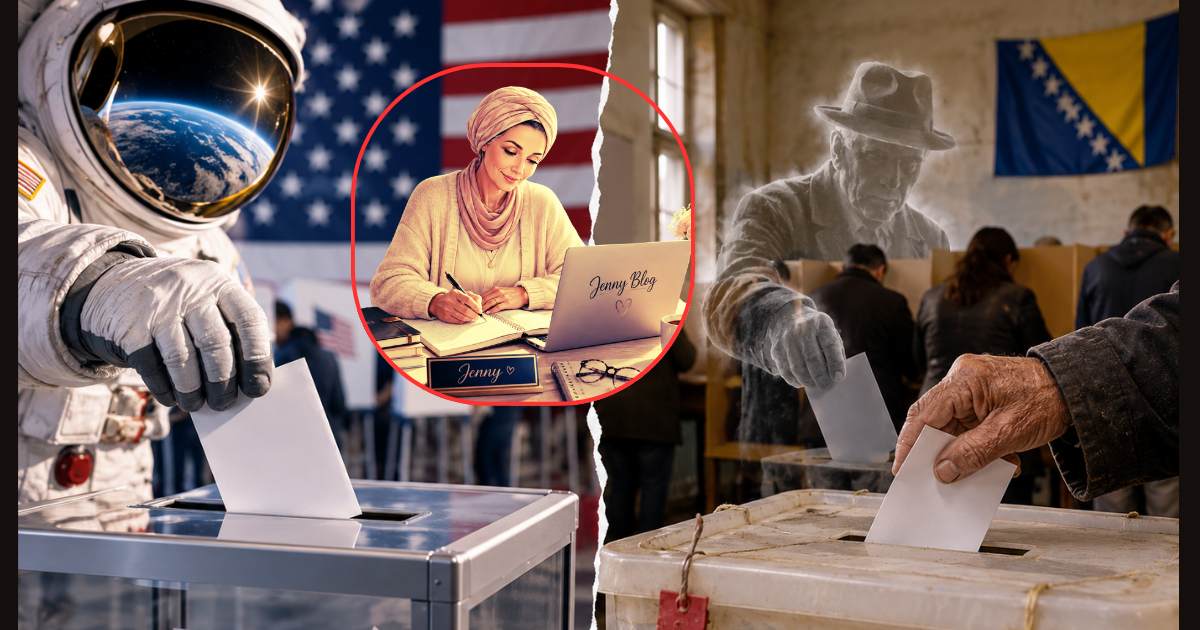
I have always been inspired by internet culture and memes, especially those that manage to say more in a single sentence than a serious political commentary. This time, a meme about voting caught my attention, and with elections approaching, I simply couldn’t resist.
It’s no secret that here in America, we take pride in the fact that even astronauts can vote from space. Technology truly is a marvel. A person leaves the planet, orbits hundreds of miles above Earth, and their right to vote faithfully travels along with them.
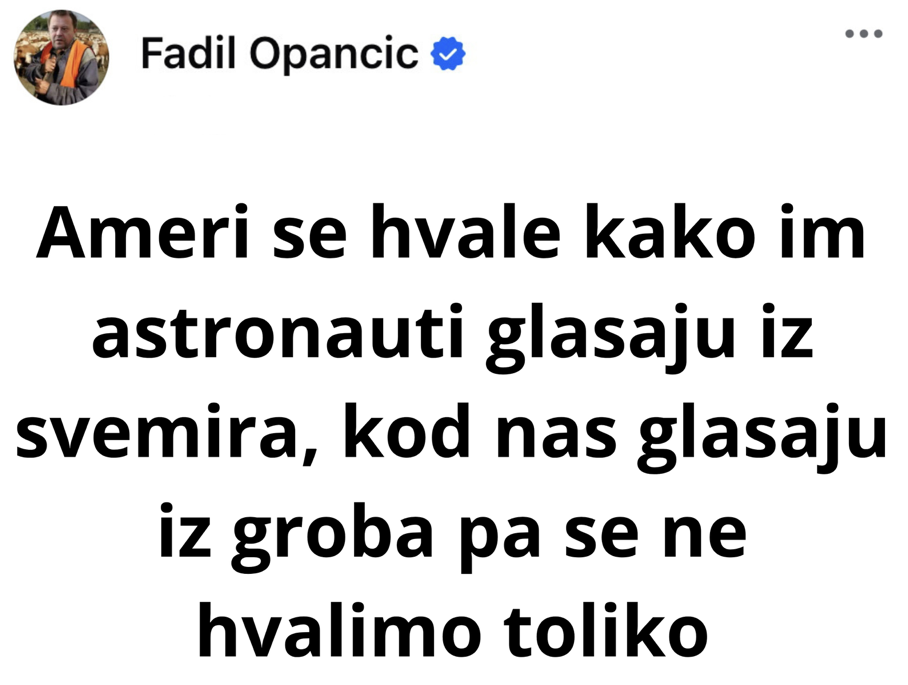
A certain Fadil Opančić wrote on Instagram:
“Americans brag that their astronauts can vote from space. Back home, people vote from the grave, and we don’t make such a big deal about it.”
And that’s where a particular kind of humor begins, the kind that only someone who has survived at least one election in the Balkans can truly appreciate. It’s a story of “phantom” voters, dead souls who mysteriously come back to life every election cycle, and a democracy that seems to defy even the laws of nature.
How is that even possible? Well, most often because people remain trapped on voter rolls for years. And to fully understand that, we need to take a look at the unique dynamics of elections in the Balkans.
In the Balkans, voting is particularly interesting because elections still rely heavily on paper voter lists, physical ballots, election commissions, and manual vote counting. Electronic technologies are only gradually being introduced. In Bosnia and Herzegovina, for example, biometric voter identification and ballot scanners have only recently become part of a broader modernization of the electoral process.
Such a system does not automatically mean that elections are irregular, but it leaves enormous room for some familiar Balkan phenomena: outdated voter rolls, people who moved away or died long ago but somehow continue to “faithfully” cast their ballots, and mysterious signatures that appear on voter lists before the actual voter has even stepped inside the polling station.
And then comes the counting. Because voting is only the first part of the process. In the Balkans, people have long understood that sometimes what matters most is not simply who voted, but what happened to that vote after the ballot was dropped into the box.
This brings to mind the famous saying attributed to Stalin:
“It doesn’t matter who votes. What matters is who counts the votes.”
Admittedly, there is no solid evidence that Stalin ever actually said those words. But the quote has outlived every debate about its authorship, probably because it captures, in a single sentence, the deep distrust that arises when citizens lose control over what happens to their votes.
Paper ballots, official records, election commissions, marathon vote counts, recounts, mysteriously invalidated ballots… At every stage, there is room for ordinary human error — and where strict oversight and transparency are lacking, for something far worse.
That is why election night is often not the moment when elections end. Sometimes, that is when they truly begin.
Let’s return to the meme about “voting from the grave.” This is where the real story behind the joke begins.
Because Fadil captured it perfectly in a single sentence:
“ people vote from the grave, and we don’t make such a big deal about it.”
And the story could comfortably end right there. It would be difficult to beat such a precise diagnosis of Balkan politics, neatly packed into one sentence.
But there is another old story from Montenegro. According to a long-standing joke about the absurdities of voter rolls, Čepurci, the municipal cemetery in Podgorica, supposedly had two representatives in parliament.
A good joke usually survives because the audience immediately understands exactly what it is getting at.
Such jokes, of course, did not emerge simply because someone forgot to remove a deceased person from the voter rolls. They also reflected suspicions that someone else had deliberately decided to take advantage of that vacant spot.
That is why a troubling question has followed elections in the Balkans for years: What exactly happens when a perfectly valid signature appears next to the name of someone who never even showed up at the polling station?
One story from Bosnia illustrates this particularly well.
A man arrived at his polling station and noticed his own brother’s name immediately above his on the voter list. Next to the name was already a signature — proof that his “brother” had dutifully fulfilled his civic responsibility.
There was just one tiny problem: His brother had spent that very morning having breakfast with his family in Germany, where he had been living and working for years.
So the problem is not always simply that slow-moving bureaucracy “forgets” to update its records when someone dies or moves away.
Sometimes, the far more intriguing question is: Who took matters into their own hands, voted in his place, and, more importantly, for whom?
And all of this, ultimately, because the system stubbornly clings to paper while reliable digital solutions continue to face a thousand obstacles.
But when we return to America — the country where astronauts vote from space — we realize that this achievement, this celebrated “American dream,” is something Balkan election manipulators probably wouldn’t even want to dream about.
After all, those who perform the “civic duty” of voting on behalf of the absent and the dead would hardly appreciate some astronaut up there in space ruining their carefully organized operation with a perfectly legitimate vote.
Still, it turns out that even all that electronics and technology are not all-powerful.
Take New Jersey, for example.
This year, the state acknowledged a serious software error in its Motor Vehicle Commission (MVC) system. As a result, approximately 6,600 people who had explicitly indicated that they were not U.S. citizens were mistakenly entered into the voter registration system.
The state later determined that approximately 340 individuals from that group had voted.
And New Jersey was not alone. Similar incidents and technical problems have also affected other states.
In America, a great deal revolves around driver’s licenses. They are not merely permits to drive; transactions involving driver’s licenses can also be connected to voter registration through agencies such as the Motor Vehicle Commission.
And then comes the absurdity: A person clearly indicates that they are not an American citizen, yet the software sends their information into the voter registration system anyway.
Not because the law allows it, but because the machine experienced a little “glitch.”
Well, those kinds of mistakes don’t exactly happen in the Balkans.
Other kinds? Absolutely.
But software glitches of this particular variety? Rarely.
In the end, both America and the Balkans have faced cases in which people who were not legally eligible ended up casting ballots.
And so we have learned that both technology and human beings can make mistakes, each in their own special way.
But somehow, in the end, democracy is always the one that pays the price.
By Jenny