

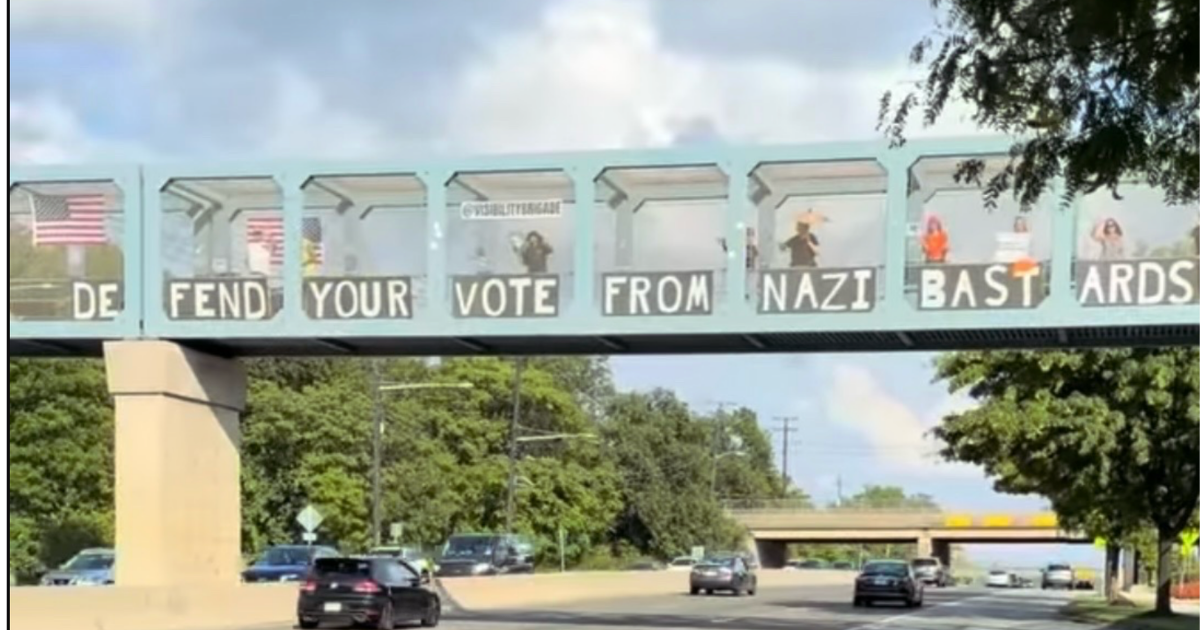
A provocative political banner displayed over a highway in Paramus is drawing attention not only for its message about voting, but also for the language used to deliver it. The banner, posted by New Jersey Project, reads: “Defend Your Vote From Nazi Bastards.”
The banner was displayed by New Jersey Project, a political activist organization that has been involved for years in New Jersey debates over elections, school boards, taxes, parental rights and government policy.
New Jersey Project describes itself as a coalition of citizen groups seeking to change the state through volunteerism, litigation and funding. On its website, the organization lists election integrity among its core concerns and has repeatedly criticized New Jersey’s voting system, including vote-by-mail practices.
The group has also been heavily involved in local education politics. It has promoted and supported candidates for school boards across the state and says parents should play a stronger role in decisions involving public schools.
The Paramus banner, however, goes beyond the language normally found in campaign literature.
Its use of the word “Nazi” immediately drew attention online, with reactions ranging from support for the message to criticism of both its language and the broader political climate in New Jersey.
The banner itself does not identify exactly who the phrase “Nazi bastards” is intended to describe. In the absence of a more specific statement from New Jersey Project accompanying the display, the wording is best understood as the organization’s own political message rather than a factual description of any particular person or group.
Comments beneath the post also show some confusion about the banner’s target. Several users asked who exactly the word “Nazis” was meant to refer to, suggesting that the message may attract attention without clearly identifying the political argument behind it.
That distinction matters.
Political speech in the United States is often intentionally provocative, and the First Amendment protects a very broad range of expression, including language that many people may find offensive. But the increasingly common use of words such as “Nazi,” “fascist” and “communist” to describe political opponents also illustrates how far American political language has moved from disagreement over policies toward attacks on the identity and character of the other side.
New Jersey Project’s own materials show that election issues have long been central to its activism. The organization argues that New Jersey suffers from corruption and diminishing freedoms and says citizens should become more directly involved in changing state and local government.
The banner in Paramus appears to be another expression of that broader campaign — only this time delivered not through a website, school board list or political meeting, but in eight large panels positioned above passing traffic.
Jenny’s Note
It is entirely legitimate to campaign before an election, to criticize policies and to draw attention to problems. But political arguments should be built on facts and arguments, not insults.
A public message should not rely on vulgarity simply because vulgarity attracts attention. If we believe there is a serious problem with elections, government or public policy, then we should be able to explain that problem clearly and support our position with evidence.
That standard matters even more when we communicate publicly. A banner above a highway is not seen only by political supporters or opponents. It is seen by everyone passing underneath it, including children.
Political disagreement can be sharp without becoming crude. In fact, the stronger the argument, the less it needs an insult to make people notice it.
I još jedna stvar: Tags i Sources trebaju ići poslije Jenny’s Note, ne između dvije bilješke. Tako članak izgleda urednije.
By Jenny