


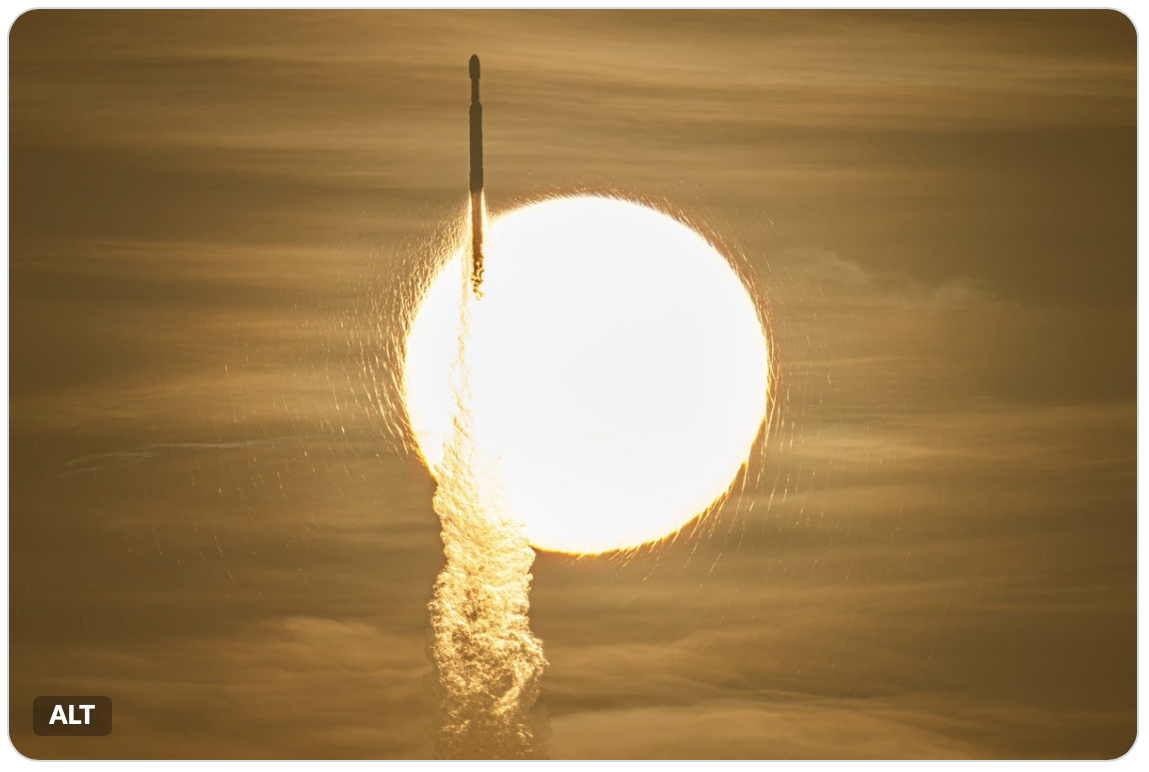
NASA’s Nancy Grace Roman Space Telescope successfully launched Sunday morning, beginning a million-mile journey that will eventually place one of the agency’s most powerful new observatories far beyond Earth.
The telescope lifted off at 7:26 a.m. EDT on August 30 aboard a SpaceX Falcon Heavy rocket from Launch Complex 39A at NASA’s Kennedy Space Center in Florida.
Roman is now traveling toward the Sun-Earth Lagrange Point 2, or L2, located about one million miles from Earth. The telescope is expected to reach its operating region in roughly a month, while its full commissioning process, including deployments, calibration and testing, will take about three months.
The observatory was designed to investigate some of the biggest unanswered questions in modern astronomy, including the nature of dark energy and dark matter, two mysterious components believed to make up most of the universe.
Roman will also search for planets beyond our solar system and conduct a broad statistical survey of planetary systems. NASA estimates that its surveys could uncover approximately 100,000 new exoplanets.
One of Roman’s greatest advantages is its extraordinarily wide view of space.
Its primary mirror is similar in size to Hubble’s, but Roman can observe an area of the sky roughly 100 times larger than Hubble can in a single image. That combination of a wide field of view and sharp infrared vision will allow astronomers to survey enormous regions of the universe much faster than previous space telescopes.
During its mission, Roman is expected to study more than two billion galaxies, helping scientists create an unprecedented three-dimensional picture of the universe and examine how cosmic expansion has changed over billions of years.
Roman will operate in the same general region of space as the James Webb Space Telescope, but the two observatories have very different strengths. Webb is designed to examine relatively small areas of the universe in extraordinary detail, while Roman is built to survey huge portions of the sky rapidly.
That means Roman can identify enormous numbers of galaxies, stars and planetary systems that scientists can later study in greater detail with other observatories.
The telescope is named after Nancy Grace Roman, NASA’s first chief astronomer and one of the scientists who helped lay the groundwork for space-based astronomy and the eventual development of the Hubble Space Telescope.
NASA says Roman launched nine months ahead of its original schedule, an unusual achievement for a space mission of this size and complexity. Its primary science mission is expected to last at least five years.
If everything proceeds as planned, Roman’s first observations could begin later this year, opening a new window onto planets, galaxies and the largely invisible forces shaping the universe.
Sources: NASA; Reuters
By NJ RADAR Team