


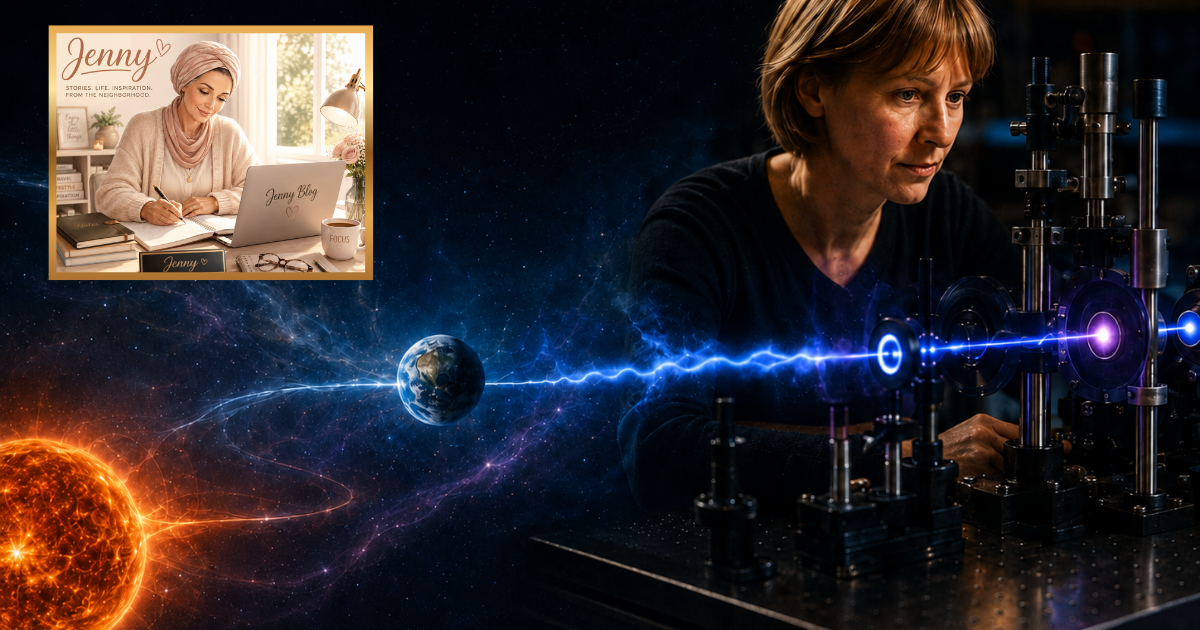
There are scientific stories we remember because they changed the world. And then there are those that remain tied to a particular moment in our own lives, to the room where we first heard them, to the year, to the feeling of who we were at the time.
For me, the story of the speed of light was exactly that kind of story. We are talking about something that, as far as we know, nothing in the universe can outrun, and yet someone managed to slow it down almost to the speed of a bicycle. I remember the sense of wonder I felt. I tried to explain to myself, and then to others, what that really meant: that light, that eternally elusive traveler, could be brought almost to a standstill.
Today, completely by chance, I came across a post about that experiment on X. And in an instant, it felt as though I had opened a small time capsule and traveled almost 25 years into the past.
It was 1999. At the time, the discovery felt like one of those moments when physics was stepping into a new century. It was not just science. There was hope in it too. A feeling that there were no boundaries and that perhaps we would soon understand everything.
As I read those few lines on the screen, I could almost smell that time again. The curiosity. The excitement at the beginning of a new era. Before the internet became what we know today. Before everything that came afterward.
Light slowed down. And for a moment, time stopped for me.
In the late 1990s, Danish physicist Lene Vestergaard Hau and her team at Harvard University accomplished something that had seemed almost impossible. They dramatically slowed a pulse of light inside a cloud of ultracold atoms.
The result was published in Nature in 1999. Light, which travels through a vacuum at nearly 300,000 kilometers per second, was slowed to just 17 meters per second, roughly the speed of a bicycle or a car moving slowly through a neighborhood.
Two years later, in 2001, her team went even further. Researchers showed that a pulse of light could effectively be stopped, its information stored in an atomic medium, and then released again.
At almost the same time, I was starting a small popular science magazine for children. Back then, news and information from the internet were just beginning to become a resource, and not everyone yet knew how to recognize its value or how to use it. I was simply fascinated by this new window into the world, this seemingly endless mine of knowledge.
This was one of the major science stories of the time, but I kept wondering whether people, especially children, could really understand what it actually meant. Did we truly understand that light travels just as an airplane or a ship travels from one place to another, only so incredibly fast that we have no real sense of its journey? Especially when we know that light needs only about 1.5 seconds to travel from the Moon to our eyes.
Even now, I remember how unbelievable that story seemed to me.
Eight minutes becomes almost 279 years
One of the first things students learn is that sunlight does not reach Earth instantly.
The average distance between the Sun and Earth is about 149.6 million kilometers. Traveling at its usual speed, light crosses that enormous distance in about 8 minutes and 20 seconds.
That fact alone is fascinating. When we look at the Sun, we are actually seeing it as it was about eight minutes ago.
But Lene Hau’s experiment opens the door to an interesting thought experiment.
What if sunlight traveled all the way from the Sun to Earth at the speed achieved in her laboratory, just 17 meters per second?
The calculation is simple:
149,597,870,700 meters ÷ 17 meters per second = about 8.8 billion seconds.
That is approximately 279 years.
Instead of eight minutes, light leaving the Sun today would not reach Earth until sometime around the year 2305. A ray of sunlight beginning its journey today would travel through space for more than a quarter of a millennium before reaching Earth.
A child born today would never live to see that particular ray of light arrive. Most likely, neither would their children or grandchildren. It would take several generations.
Of course, this is only a thought experiment. Hau did not change the universal speed of light in empty space. Her team slowed the group velocity of a light pulse as it passed through an extremely cold atomic medium, a Bose Einstein condensate. Light traveling through the vacuum between the Sun and Earth would still move at its familiar cosmic speed.
But if we want to understand just how slow 17 meters per second really is compared with the normal speed of light, it is difficult to imagine a better comparison.
How do you slow something that seems impossible to catch?
The experiment depended on one of the strangest states of matter in physics: the Bose Einstein condensate.
Atoms are cooled to temperatures extremely close to absolute zero. Under those conditions, their behavior changes dramatically, allowing researchers to influence the way a pulse of light moves through matter.
Lene Hau’s laboratory describes the work quite simply. Researchers managed to slow and even stop pulses of light in a sodium Bose Einstein condensate, reducing their speed by tens of millions of times compared with the speed of light in a vacuum.
That does not mean that photons simply froze in the air like something from a science fiction movie.
When researchers talk about “stopping light” in these experiments, the information carried by the optical pulse is transferred into the quantum state of the atoms. That information can later be converted back into a pulse of light.
And that distinction makes the achievement even more fascinating.
The experiment was not simply an attempt to force something to move more slowly.
It was a step toward understanding how light and matter can exchange information.
When I think about that time 25 years ago…
When the results of this research appeared, I was just beginning that first science magazine, and this story felt like an exclusive.
Something students learn to think of as almost unimaginably fast, light itself, had suddenly been slowed to a speed we could understand in ordinary, everyday terms.
Seventeen meters per second.
A distance a person can walk in just a few seconds.
It takes something completely familiar, sunlight entering through a window, and shows us that beneath the ordinary world around us lies something that is anything but ordinary.
More than a quarter of a century later, I still remember that story. And for almost 25 years, I had hardly thought about it again, until a single post today brought it all back.
Some scientific discoveries become part of textbooks.
Others become part of our personal timeline.
For me, this one became both.
By Jenny