


Sometimes the most interesting things are not found at major events or in official announcements. Sometimes we notice them completely by chance, while passing through our own neighborhood.
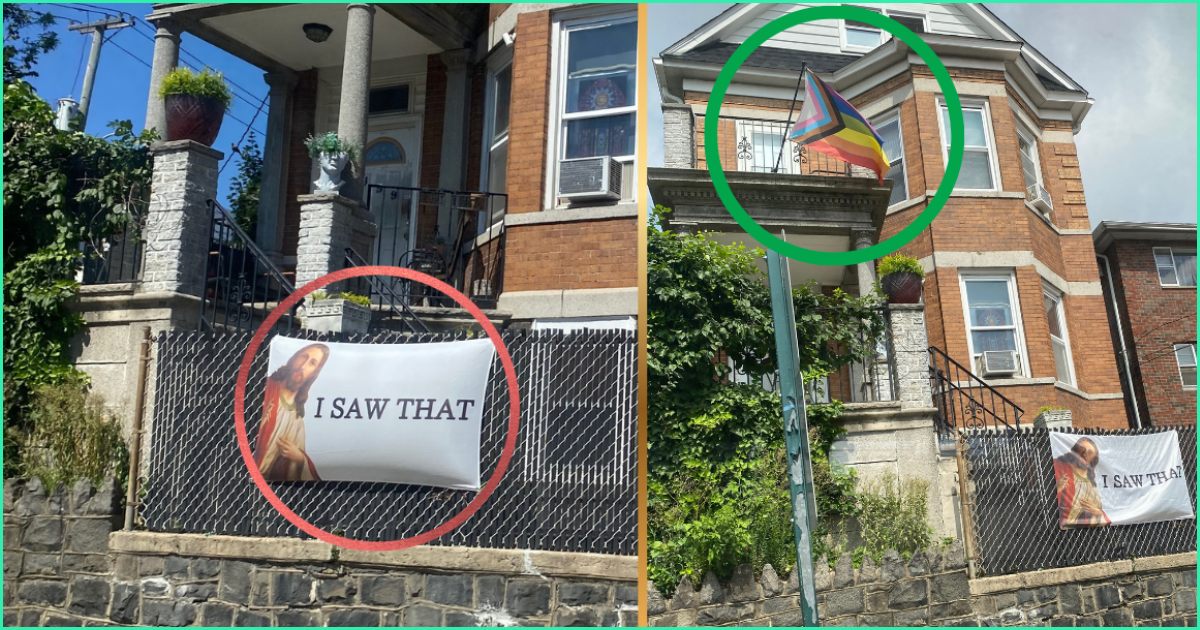
While driving down the road, I noticed something very unusual — actually, a kind of double performance. Near the very top of one house, I saw a rainbow-colored flag that resembles a Pride/LGBTQ flag. Much lower down, at ground level, a large white banner had been placed on the fence, showing an image of Jesus and just three words:
“I SAW THAT.”
The first thing that came to mind was to take a picture, and while we were stopped at the traffic light, that is exactly what I did. Today, I did another little photo shoot. I found the scene interesting and wanted to take a closer look, to try to decode the message — or perhaps the lesson. I am not even sure myself.
The banner has been in the same place for quite some time. I captured the scene on both occasions, and during my latest visit, strong wind kept lifting the fabric, making the image of Jesus disappear and reappear. At one point, it almost seemed as though the message itself had come alive and was speaking directly to the passerby:
I saw that.
But who is the message actually meant for?
The placement of these two symbols is exactly what makes the scene so interesting. The flag is high up, on the top floor of the house, while the banner with Jesus is down below, at ground level.
Perhaps people with different beliefs live in the same house. Maybe someone upstairs wanted to make their identity visible, while someone downstairs chose, in the same way, to make their faith visible.
Maybe the two have absolutely nothing to do with each other.
Or maybe they do.
Perhaps this is a quiet conversation between people who share the same house but not the same worldview. Maybe each person is simply leaving their own symbol, wanting their own message to be seen.
And there is another possibility: perhaps both symbols were displayed without any conflict at all, and it is actually we, the passersby, who are turning them into a story.
We cannot know.
And that is exactly why the scene catches your attention.
A neighborhood can sometimes become a stage for communication without words. Instead of a conversation across the fence, we get two powerful visual signs: on one side, a symbol of identity, and on the other, a clearly displayed religious identity.
And then there are the words:
“I SAW THAT.”
In a religious context, some may interpret them as a reminder that nothing goes unnoticed, that there is someone who sees human actions and that one day those actions will face final judgment. Others may see the same sign as simple humor, a popular internet joke, or an unusual way of expressing faith.
Combined with the flag above, however, those three simple words take on an entirely different weight.
Is it a good-natured joke, a local provocation, a message between people living in the same house, or simply a coincidence that we, as passersby, turn into a story?
Or perhaps both symbols are there precisely so that people will see them, stop for a moment, and draw their own conclusions.
The image is almost perfectly composed.
One house.
Two messages. Two ways of seeing the world.
Someone may stop and laugh. Someone may see the scene as contradictory. Someone may see faith in it, someone else identity and freedom, while another person may see nothing more than unusual decoration on a house they pass every day.
But it is hard to walk past without wondering what this unusual message in such an ordinary place actually means.
Because somewhere between the brick, the windows, and the fence, a small street scene has emerged — almost a spontaneous performance — in which everyone can see something different.
Perhaps that is why it feels a little like a mirror: it reflects those who display the flag, those who display their faith, and all of us who pass by and try to figure out whether there is a message connecting the two symbols.
The banner is still there.
The flag is still flying.
And between them, those three words still seem to echo:
I SAW THAT.
By Jenny