


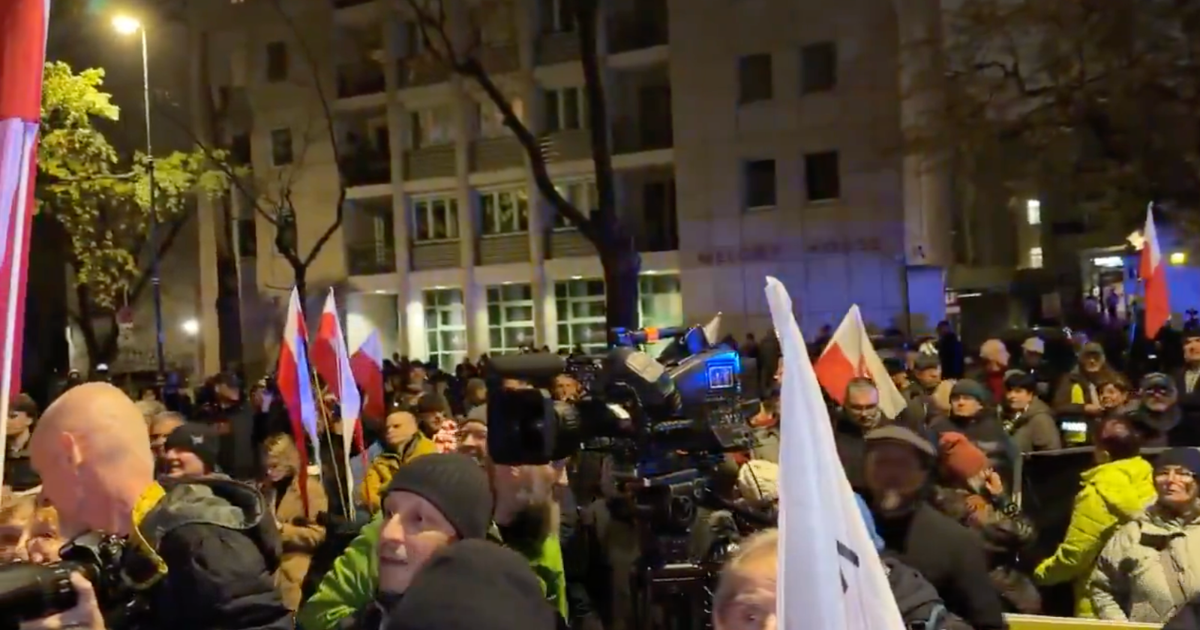
WARSAW, Poland — October 30, 2026 — Poland was plunged into a major constitutional confrontation Friday as police surrounded the Constitutional Tribunal, protesters attempted to force their way through a locked gate, and President Karol Nawrocki abruptly turned his plane around while traveling to Senegal.
The extraordinary scenes unfolded after the reported suspension of Constitutional Tribunal President Bogdan Święczkowski and his deputy, Bartłomiej Sochański, amid a deepening struggle over control of one of Poland’s highest judicial institutions.
Locked Gates, Police and Protesters
Tensions escalated outside the Constitutional Tribunal in Warsaw as opposition lawmakers and demonstrators gathered in support of Święczkowski.
According to Polish media, a participant who identified himself as a locksmith cut through a chain securing a gate at the court complex.
Police were deployed around the building and prevented unauthorized access. Authorities reported that demonstrators threw objects at officers, and three people were detained.
The confrontation reflected a broader political struggle between Prime Minister Donald Tusk’s government and the conservative Law and Justice (PiS) opposition.
President Turns Plane Around
As the situation escalated, Polish President Karol Nawrocki made the unusual decision to interrupt his official journey to Senegal and return to Warsaw.
“At a moment like this, the President must be in Poland. I am cutting short my flight to Senegal. I am returning,” Nawrocki announced on social media.
The president, politically aligned with the opposition, has been involved in a prolonged disagreement with the government over judicial appointments.
His decision to return underscored the seriousness of the confrontation.
Opposition Accuses Government of a Coup
Opposition leaders accused Tusk’s government of attempting to seize control of the Constitutional Tribunal.
Former Prime Minister Jarosław Kaczyński and other Law and Justice politicians condemned the suspension of the court’s leadership, portraying the events as an attack on Poland’s constitutional order.
The government rejected those accusations.
Prime Minister Donald Tusk defended efforts to reorganize the judiciary, arguing that restoring the rule of law requires decisive action after years of political interference in the courts.
A Constitutional Dispute Years in the Making
Poland’s judicial crisis has its roots in reforms introduced during the previous Law and Justice government, which governed from 2015 to 2023.
Those reforms triggered disputes with European Union institutions over judicial independence and the separation of powers.
Since taking office, Tusk’s government has sought to reverse some of those changes, but its efforts have encountered resistance from the opposition and the presidency.
The Constitutional Tribunal has become a central battleground in that conflict.
Earlier this year, President Nawrocki refused to swear in several judges selected by parliament, while the tribunal’s leadership prevented other newly elected judges from assuming their duties.
Poland Faces a New Test of Its Institutions
Friday’s confrontation represents one of the most dramatic episodes in Poland’s continuing judicial dispute.
The competing claims of constitutional legitimacy have raised serious questions about judicial independence, political authority, and the ability of the country’s institutions to function.
As the president returns to Warsaw and both political camps defend their positions, Poland faces a renewed test of its constitutional system.
The legal and political consequences of Friday’s events remain uncertain.
By NJ RADAR Team