


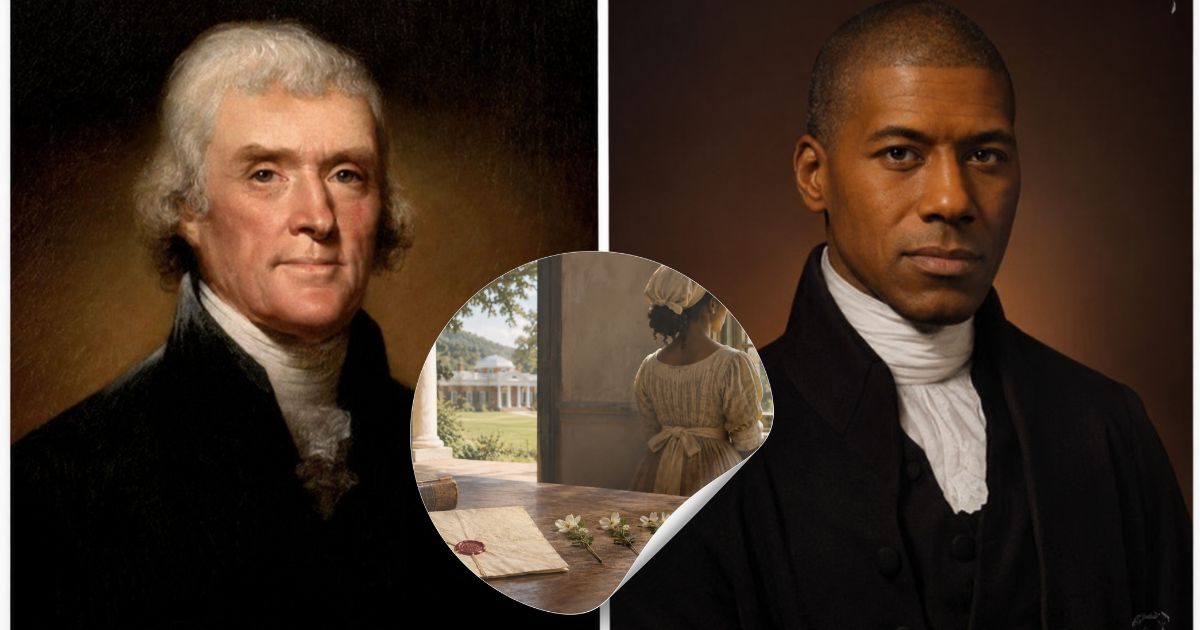
This is a story about Thomas Jefferson, Sally Hemings, the enslaved Black woman with whom he had children, a promise that brought freedom to their children but not to their mother, and a descendant who hesitated to stand before a camera in Jefferson’s image, not because he wanted to honor the former president, but because he wanted the world to remember her.
It is a story about slavery, motherhood, survival and a family history that America struggled for generations to acknowledge.
More than two centuries after Jefferson helped shape the ideals of American independence, the life of Sally Hemings continues to challenge how the nation remembers one of its most celebrated founding fathers.
Jefferson, the third president of the United States and principal author of the Declaration of Independence, wrote that all men are created equal. Yet he enslaved more than 600 people during his lifetime, including Hemings, with whom historical evidence indicates he fathered at least six children.
Four of those children survived to adulthood. All four eventually gained their freedom. Their mother was never formally emancipated.
Today, that history has found a powerful visual expression through Shannon LaNier, a television journalist and descendant of Jefferson and Hemings, whose portrait recreating the image of his famous ancestor asks viewers to confront the people and stories left outside traditional accounts of America’s founding.
A Sixteen-Year-Old Girl Facing an Impossible Choice
Sally Hemings was born into slavery in Virginia in 1773. As a teenager, she traveled to Paris, where Jefferson was serving as an American diplomat.
In France, enslaved people could seek legal recognition of their freedom. For Hemings, who was approximately 16 when Jefferson prepared to return to Virginia in 1789, remaining in Paris offered a possibility that her life in America did not.
According to an account later given by her son Madison Hemings, she initially refused to return to Virginia and negotiated an agreement with Jefferson.
He promised her special privileges and freedom for their future children when they reached adulthood.
It was an extraordinary negotiation under profoundly unequal circumstances.
Jefferson controlled her legal status, her work and much of her future. Returning to Virginia meant returning to a society where she and any children she bore would be legally considered property.
Historians cannot know every consideration behind her decision. Sally Hemings left no known written account of her own, and much of her story survives through records created by others and testimony from her children.
What is known is that she returned to Monticello, where she would remain enslaved for decades.
A Mother Whose Children Were Promised Freedom
At Monticello, Sally Hemings lived and worked within a system that denied enslaved people legal control over their own lives.
She had at least six documented children. Four survived to adulthood: Beverly, Harriet, Madison and Eston.
Although their father was one of the most powerful men in the country, the children were born into slavery because the law determined their status through their enslaved mother.
Their family circumstances revealed one of the deepest contradictions in American history: the children of a president who helped declare human equality could themselves be legally owned.
In the early 1820s, Jefferson allowed Beverly and Harriet to leave Monticello without pursuing them. Both subsequently lived as white Americans.
Madison and Eston received freedom through Jefferson’s will and were emancipated following his death in 1826.
In this way, the four surviving children eventually obtained the freedom their mother had negotiated for them decades earlier.
But Sally Hemings herself was not included in Jefferson’s will as someone to be formally freed.
After Jefferson died, his daughter Martha Jefferson Randolph permitted Hemings to leave Monticello and live with her sons in Charlottesville.
She spent her remaining years in what historians describe as informal freedom, without the legal documentation that would have formally established her emancipation.
Sally Hemings died in 1835. Her burial place remains unknown.
The children gained the freedom she had sought for them. Their mother never received the same formal legal recognition.
A Descendant Who Hesitated to Recreate Jefferson’s Portrait
Nearly two centuries later, another chapter of this family history emerged through a photograph.
In 2020, British photographer Drew Gardner invited Shannon LaNier, a descendant of Jefferson and Hemings, to participate in The Descendants, a photographic project featuring descendants of historical figures recreating well-known portraits of their ancestors.
LaNier, a television journalist based in Houston, had already explored his family’s complicated inheritance as co-author of Jefferson’s Children: The Story of One American Family.
The invitation presented him with a difficult question.
How could a Black descendant recreate the image of a founding father who had enslaved members of his own family without appearing to celebrate or excuse that history?
LaNier initially hesitated.
He understood the significance of his connection to Jefferson, but he also understood the painful circumstances under which that family had begun.
The photograph could easily be misunderstood as an expression of pride in Jefferson alone.
Yet participating offered another possibility: drawing attention to Sally Hemings, a woman whose name had remained far less familiar than that of the man who enslaved her.
LaNier ultimately agreed to participate.
In the resulting portrait, he appears in clothing resembling Jefferson’s, positioned to echo the former president’s famous image.
But he chose not to wear a wig, preserving a visible distinction between himself and his ancestor.
The photograph was published by Smithsonian Magazine in July 2020.
Its significance extends beyond the physical resemblance between generations. It places a Black descendant within the visual history of the American presidency and makes visible a family connection that slavery and racial prejudice had long obscured.
What might initially appear to be a portrait of Jefferson becomes an invitation to learn about Sally Hemings and the generations who followed her.
The History America Was Reluctant to Confront
For generations, Jefferson’s relationship with Sally Hemings was disputed, minimized or excluded from many traditional accounts of his life.
Historical documents, family oral histories and DNA evidence eventually transformed public understanding of the relationship.
The Thomas Jefferson Foundation at Monticello now recognizes Jefferson as the father of Hemings’s six documented children.
But establishing paternity is only one part of understanding their history.
The relationship existed within slavery, a system in which enslaved women lacked the legal freedom to refuse the demands of those who controlled their lives.
There was no equality of power between Jefferson and Hemings.
That reality matters when interpreting a relationship that has sometimes been presented in romantic terms.
Modern historians have increasingly focused on Sally Hemings as a historical figure in her own right rather than treating her merely as a detail in Jefferson’s biography.
She was a mother, a skilled domestic worker and a woman who negotiated within a deeply oppressive system to seek a different future for her children.
Her experience also represents the countless enslaved women whose lives were shaped by laws that denied them autonomy and whose stories were rarely preserved in their own words.
The history of the United States cannot be fully understood through the achievements of its founders alone. It must also include the experiences of the people whose labor sustained their households, plantations and wealth.
Remembering Sally Hemings
The story of Sally Hemings is not a romance, nor is it simply another chapter in the life of a famous president.
It is the story of a woman who lived in a system that denied her freedom, yet negotiated for a future in which her children would no longer be enslaved.
Thomas Jefferson’s name appears in textbooks, on monuments and throughout American history. Sally Hemings spent much of her life without the legal right to determine her own future.
And yet, more than two centuries later, it is her story that gives a deeper meaning to a photograph of Jefferson’s descendant.
When Shannon LaNier stood before Drew Gardner’s camera, he was not simply recreating the image of an American president. He was helping bring attention to a woman whose life had been overshadowed by the man who enslaved her.
That is what makes the photograph more than a historical portrait.
It reminds us that the legacy of slavery did not disappear when slavery ended. It continued through families, memories, identities and the stories that generations struggled to tell.
Sally Hemings secured a path to freedom for her children, but never received formal emancipation herself. Her descendants inherited not only a connection to one of America’s founding fathers, but also the responsibility of preserving a history too often left untold.
And perhaps that is the most important message behind the photograph.
We are not simply looking at the past. We are being asked whose names history taught us to remember, and whose names it allowed us to forget.
History remembered Thomas Jefferson as a founding father. It is time to remember Sally Hemings as more than a footnote in his story, as a woman who fought for her children’s freedom while never receiving the same freedom herself.
Sources: Thomas Jefferson Foundation at Monticello — Thomas Jefferson and Sally Hemings: A Brief Account and The Life of Sally Hemings; Smithsonian Magazine — The American Descendants, July 2020; Madison Hemings’ 1873 recollections.
By NJ RADAR Team