


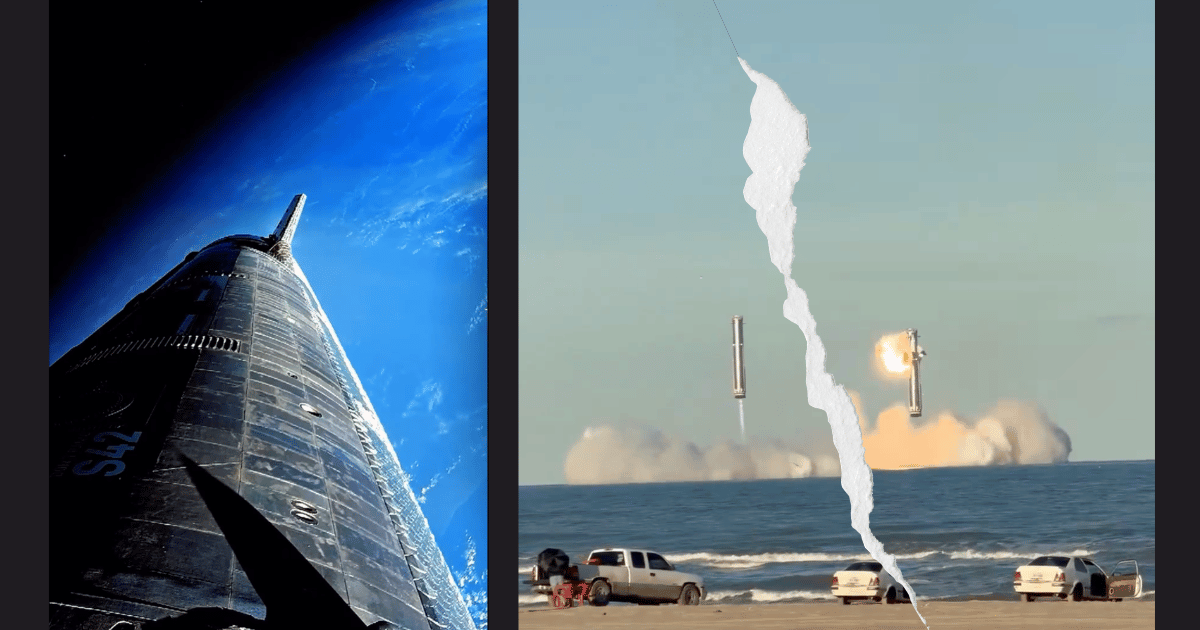
STARBASE, TX — SpaceX successfully launched its massive Starship rocket into orbit Friday, November 13, but an unexpected problem forced the company to abandon plans to recover its Super Heavy booster at the launch tower.
The mission, known as Starship Flight 15, lifted off from SpaceX’s Starbase facility in South Texas at 5:47 p.m. Eastern. It marked another major test of the company’s effort to develop the world’s first fully reusable orbital rocket system.
While the booster recovery failed, the upper stage, known as Ship 42, continued into orbit and successfully deployed 26 next generation Starlink satellites.
The spacecraft remained in orbit Saturday as SpaceX prepared for an even more ambitious operation: attempting to bring Starship back from space and catch it using the giant mechanical arms of its launch tower.
Booster Recovery Ends in the Gulf of Mexico
The rocket’s two stages separated successfully approximately two and a half minutes after liftoff.
The Super Heavy booster, equipped with 33 Raptor engines, was supposed to return to the launch site and be caught by the tower’s mechanical arms, nicknamed the chopsticks.
SpaceX Super Heavy booster exploded over the Gulf after an automatic abort canceled its return-to-launch-site catch attempt. Starship 42 continued toward orbit.
SpaceX had previously demonstrated successful booster catches using earlier versions of its launch system, but Friday’s mission involved an upgraded Super Heavy booster.
The failure prevented the company from attempting the planned recovery of both stages during the same mission.
Starship Successfully Deploys 26 Satellites
Despite the loss of the booster, Ship 42 successfully reached orbit approximately 275 kilometers above Earth.
The spacecraft then released 26 Starlink V3 satellites, a new generation designed to provide substantially greater communications capacity than earlier versions.
The successful deployment marked an important achievement for SpaceX’s satellite internet program.
According to mission updates, all 26 satellites were released during the early portion of the flight.
Controllers subsequently approved extending the mission rather than using an earlier opportunity to bring the spacecraft back to Earth.
The extended mission is expected to last approximately 22 and a half hours, making it the longest Starship test flight conducted so far.
Historic Landing Attempt Scheduled for Saturday
The most challenging part of the mission is still ahead.
SpaceX plans to guide Ship 42 back through Earth’s atmosphere and attempt to catch it at the Starbase launch tower.
The maneuver would represent the first recovery of a Starship upper stage returning from orbit.
Previous Starship tests have included controlled ocean splashdowns, but bringing the spacecraft back to the launch tower would be a major advance toward making the entire system reusable.
The landing attempt is currently expected at approximately 4:16 p.m. Eastern on Saturday, November 14.
Before authorizing the return, SpaceX engineers must evaluate the spacecraft’s systems and the condition of its heat shield, which protects it from extreme temperatures during atmospheric reentry.
If the vehicle does not meet the required safety conditions, flight controllers may abandon the tower catch and direct it toward an ocean splashdown instead.
Why Reusable Starship Matters
Starship is central to SpaceX’s long term plans for commercial space transportation, satellite deployment and human missions beyond Earth.
The company aims to create a launch system capable of carrying large payloads into orbit while recovering and reusing both stages.
That capability could significantly reduce the cost of future space missions.
NASA has also selected a modified version of Starship for its Artemis lunar exploration program, which aims to return astronauts to the Moon.
The technology being tested during Flight 15 is therefore important not only to SpaceX’s commercial plans but also to future government and scientific missions.
Friday’s flight delivered mixed results: a successful launch, orbital insertion and satellite deployment, alongside an unsuccessful booster recovery.
The outcome of Saturday’s planned upper stage landing attempt will determine whether the mission achieves one of the most important milestones in Starship’s development.
Sources: SpaceX; Associated Press; CBS News; Space.com; Spaceflight Now.
By NJ RADAR Team