


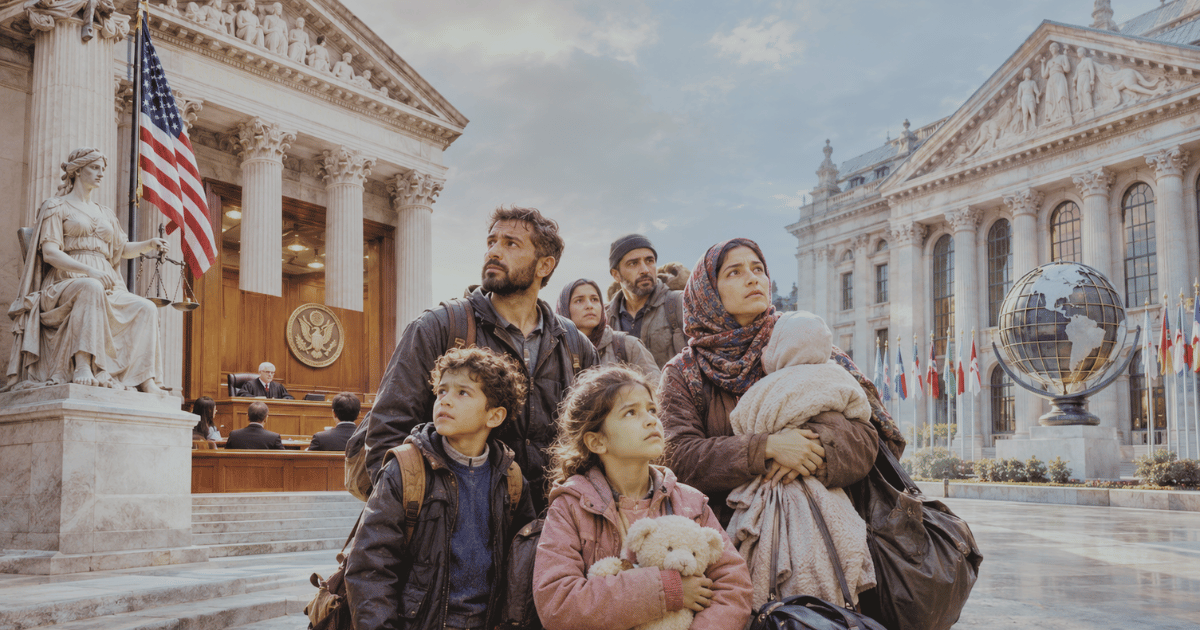
President Donald Trump wants to deny asylum to migrants crossing the southern U.S. border, and the Supreme Court has agreed to decide whether he has the legal authority to do so.
But the case raises a fundamental question: How can an American president seek to block access to asylum when the United States is a party to international agreements that protect refugees and prohibit returning people to countries where they face persecution?
The United States joined the 1967 Protocol Relating to the Status of Refugees in 1968 and incorporated key refugee protections into federal law through the Refugee Act of 1980. American immigration law also explicitly allows people who arrive in the country to apply for asylum, subject to certain legal requirements and exceptions.
Yet Trump argues that the situation at the southern border constitutes an invasion and that his presidential powers allow him to suspend access to asylum for affected migrants.
On November 13, 2026, the Supreme Court agreed to hear the administration’s appeal after lower federal courts ruled against the restrictions.
The justices will now confront a question that reaches beyond immigration policy: Can a president use emergency powers to restrict protections established by Congress, and how does that authority fit with the international refugee obligations the United States has accepted?
What Did Trump Actually Order?
On January 20, 2025, the first day of his second presidential term, Trump issued Presidential Proclamation 10888, titled “Guaranteeing the States Protection Against Invasion.”
The proclamation declared that conditions at the southern border constituted an invasion and suspended the entry of certain migrants crossing from Mexico.
More significantly, it directed federal officials to restrict those migrants from invoking provisions of immigration law that could allow them to remain in the United States, specifically including the federal asylum statute.
The administration relied on provisions of the Immigration and Nationality Act granting presidents broad authority to suspend the entry of certain foreign nationals when their admission would harm U.S. interests.
Trump also invoked constitutional responsibilities involving national security and protection of states against invasion.
The administration argued that large numbers of unauthorized border crossings, pressure on immigration processing systems, criminal organizations and difficulties verifying migrants’ backgrounds justified extraordinary restrictions.
The proclamation went beyond making asylum harder to obtain. For migrants covered by the policy, it sought to prevent access to the ordinary legal process for requesting that protection.
That is what triggered the court battle.
What Does American Law Say?
Federal immigration law contains an explicit provision addressing asylum applications.
Under Section 208 of the Immigration and Nationality Act, codified at 8 U.S.C. § 1158, a person physically present in the United States or arriving in the country generally may apply for asylum, regardless of immigration status and whether the person arrived at an officially designated entry point.
The law contains exceptions and eligibility requirements, including certain restrictions involving safe third countries, filing deadlines, prior applications and serious criminal or security concerns.
But its general rule is unmistakable: entering the country without authorization does not, by itself, automatically eliminate the ability to apply for asylum.
Applying does not guarantee approval.
A person must demonstrate that they qualify for protection under the law. Many applicants are denied after their claims are examined.
The distinction matters because a government can enforce immigration laws, investigate applicants and reject unsupported claims without necessarily eliminating access to the asylum process itself.
Congress established that framework. The central legal question is whether the president can effectively set it aside by invoking a different statutory authority.
America Accepted International Refugee Obligations in 1968
The controversy also raises an important question about the United States’ responsibilities under international law.
Following World War II and the displacement of millions of people, the international community adopted the 1951 Convention Relating to the Status of Refugees.
The convention established fundamental protections for people fleeing persecution because of their race, religion, nationality, political opinion or membership in a particular social group.
In 1967, an additional protocol expanded the international refugee protection framework beyond the original convention’s historical limitations.
The United States did not become a party to the 1951 Convention itself. Instead, it joined the 1967 Protocol on November 1, 1968, accepting key obligations contained in the convention.
One of the most important is the principle known as non-refoulement.
Under this principle, a refugee generally must not be returned to a territory where their life or freedom would be threatened because of a protected characteristic.
It is a central safeguard of international refugee law.
But there is an important legal distinction: the principle does not mean that every asylum applicant must be admitted permanently or granted asylum.
Countries retain authority to examine claims, establish procedures and deny protection when legal requirements are not met.
What they cannot simply disregard are the protections against prohibited returns.
The scope of those duties, particularly in situations involving people outside a country’s territory or at its borders, has itself been the subject of legal disagreement.
Congress Put Refugee Protections Into American Law
In 1980, Congress enacted the Refugee Act, bringing key elements of American immigration law into closer alignment with the international refugee protection framework.
The legislation helped establish the modern U.S. asylum system and strengthened protections against returning people to countries where they face persecution.
That history is crucial to the current dispute.
International agreements and domestic legislation do not always operate in precisely the same way in American courts.
The United States’ obligations under the 1967 Protocol are implemented largely through federal statutes, including provisions governing asylum and withholding of removal.
Therefore, the Supreme Court is not simply being asked whether international refugee law is important.
It must determine how federal immigration statutes interact with presidential authority.
The Court also has a history of interpreting the reach of refugee protections narrowly in some circumstances. In the 1993 case Sale v. Haitian Centers Council, it upheld a policy of returning intercepted Haitian migrants from international waters without first processing their refugee claims.
That decision involved actions outside U.S. territorial waters, however, and does not automatically resolve the legal questions surrounding migrants who reach the southern border.
Why Does Trump Call Border Crossings an Invasion?
The administration’s use of the word invasion is central to its legal argument.
Article IV of the Constitution requires the federal government to protect states against invasion.
Trump’s proclamation claims that unauthorized migration has reached a scale threatening national sovereignty and public safety, allowing the president to exercise extraordinary powers.
The administration also relies on Section 212(f) of the Immigration and Nationality Act, which grants the president broad discretion to restrict entry by certain categories of foreign nationals.
Administration lawyers argue that those authorities allow the government to act decisively when ordinary immigration procedures cannot adequately respond to conditions at the border.
They also contend that restricting asylum access has helped reduce unauthorized crossings.
Trump’s lawyers have described the policy as a major reason for declining border encounters.
Opponents dispute the claimed relationship between the policy and the decline, noting that crossings were already falling before the proclamation took effect.
More fundamentally, they argue that migration cannot simply be classified as a military invasion to bypass protections established by Congress.
Whether the administration’s constitutional and statutory arguments justify the restrictions is now a question for the Supreme Court.
What Have the Lower Courts Decided?
The legal challenge was brought by immigrant advocacy organizations, including the Refugee and Immigrant Center for Education and Legal Services, known as RAICES, and organizations providing legal assistance at the border.
The plaintiffs argued that the administration could not use presidential entry restrictions to eliminate access to humanitarian protections established by federal law.
In July 2025, a federal district court in Washington, DC, ruled against the proclamation and blocked its implementation.
The government appealed.
During the appeals process, the legal situation became more complicated.
An interim appellate ruling allowed restrictions on asylum access to remain in place while preserving access to certain other forms of humanitarian protection, including withholding of removal and protections under the Convention Against Torture.
On April 24, 2026, the U.S. Court of Appeals for the District of Columbia Circuit upheld the district court’s ruling that the proclamation and related guidance unlawfully displaced procedures established by Congress.
The administration then asked the Supreme Court to review the case.
On November 13, the justices agreed to consider two questions: whether the proclamation and its implementing guidance are lawful, and whether federal law permits the broad court ordered relief granted to the group of affected migrants.
The Court has not yet decided the merits of the dispute.
Asylum, Deportation Protection and Torture: Three Different Legal Questions
The case also exposes an important feature of American immigration law that is frequently overlooked.
Asylum, withholding of removal and protection under the Convention Against Torture are not identical.
Asylum can provide a path toward more stable legal status for a person who establishes a qualifying fear of persecution.
Withholding of removal generally prevents the government from deporting someone to a particular country where the required risk of persecution has been established. It does not provide the same immigration benefits as asylum.
Protection under the Convention Against Torture addresses the risk that a person will be tortured if returned to a particular country.
These protections have different legal requirements and consequences.
That means a government policy restricting asylum does not necessarily eliminate every legal barrier to deporting a person who faces severe danger.
But losing access to asylum can still have major consequences, including fewer options for long term legal security and family reunification.
For someone who has fled political imprisonment, religious persecution or threats of violence, those distinctions are far from theoretical.
They can determine whether the person has an opportunity to rebuild a life in safety.
Can the Supreme Court Override an International Agreement?
The Supreme Court cannot simply cancel an international agreement because its justices disagree with it.
But it does have authority to interpret the Constitution, federal statutes and the domestic legal effect of international obligations.
That distinction makes the current case especially significant.
Under the American constitutional system, treaties and federal laws can create binding legal obligations, but not every international treaty provision is directly enforceable in domestic courts.
The 1967 Refugee Protocol has generally been understood as requiring implementation through domestic legislation.
The Supreme Court must therefore evaluate the powers Congress gave the president alongside the protections Congress established for people seeking asylum.
If the Court accepts the administration’s interpretation, it could allow presidents greater authority to restrict access to asylum during declared border emergencies.
If it rejects that interpretation, the ruling could reinforce the principle that presidential entry powers do not authorize the executive branch to disregard the asylum procedures Congress enacted.
Either result would affect the balance of authority between the president and Congress.
What About National Security and Border Control?
The government has a legitimate responsibility to control its borders, enforce immigration law and protect public safety.
That authority is not inherently inconsistent with protecting refugees.
The United States can investigate asylum applicants, deny fraudulent claims, apply legally authorized exclusions and remove individuals who do not qualify for protection.
Supporters of tighter restrictions argue that large numbers of asylum claims overwhelm immigration courts, prolong proceedings and encourage unauthorized crossings.
They believe the executive branch needs flexibility to respond quickly when existing systems cannot handle the volume of arrivals.
Immigration rights organizations counter that the answer to administrative pressure is to improve processing capacity and decision making, not eliminate legal avenues for protection.
They argue that collective restrictions can prevent legitimate refugees from presenting their circumstances and may expose vulnerable people to persecution or torture.
The unresolved question is where lawful border enforcement ends and unlawful denial of protection begins.
That boundary is now before the nation’s highest court.
Why the Decision Matters Beyond the Southern Border
The practical impact could extend well beyond Texas, Arizona, New Mexico and California.
Immigration policy affects families, legal service organizations, employers and communities throughout the country, including New Jersey and New York.
A person seeking protection at the southern border may have relatives elsewhere in the United States or may ultimately seek to live in another state if legally permitted.
Changes to asylum eligibility can also affect immigration court caseloads, detention practices and the work of organizations assisting people fleeing persecution.
The broader legal consequences could be even more significant.
A Supreme Court ruling recognizing expansive emergency authority to restrict asylum could influence how future presidents approach other immigration protections.
A ruling limiting that authority could establish a stronger boundary between the president’s power to control entry and Congress’s responsibility for determining who may seek humanitarian protection.
The justices are expected to hear arguments in the spring, with a decision anticipated by the end of June 2027.
A Question Bigger Than One President
The United States helped shape the modern international refugee protection system and has spent decades maintaining a legal framework for people fleeing persecution.
That framework has never guaranteed that every applicant will receive asylum. Nor has it eliminated the government’s authority to control immigration.
Its central purpose is to ensure that requests for protection are considered under established legal standards, while preventing prohibited returns to serious danger.
The Supreme Court’s forthcoming decision will test whether those standards can be restricted by a presidential emergency declaration or whether changing them requires action by Congress.
It will also reveal how the Court understands the relationship between national sovereignty, presidential power and the legal obligations the United States has accepted.
The question is not whether America must admit everyone who reaches its borders.
It is whether a country that helped establish international refugee protections can deny people access to the very process created to determine who needs them.
Sources: U.S. Supreme Court, Mullin v. RAICES, No. 26-239; U.S. Department of Justice; White House, Presidential Proclamation 10888; U.S. Code, 8 U.S.C. § 1158; United Nations Treaty Collection; UNHCR; Refugee Act of 1980; American Civil Liberties Union; Center for Gender and Refugee Studies; Associated Press; Roll Call.
By NJ RADAR Team