


More than a century ago, women stood outside the White House holding signs and asking a simple question: how much longer would they have to wait for liberty? A few years later, the U.S. Constitution was changed.
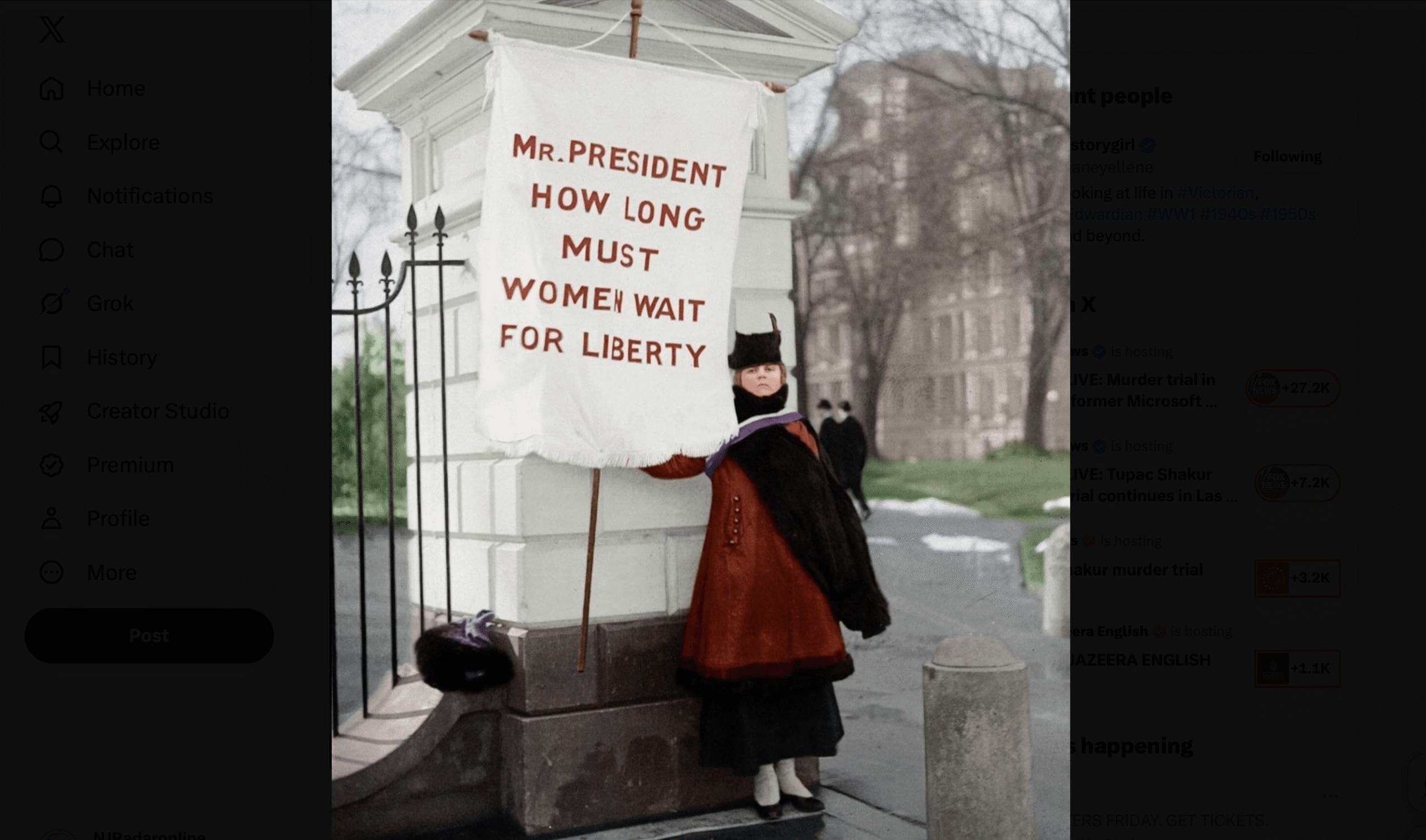
In a photograph now preserved by the Library of Congress, Alison Turnbull Hopkins, a member of the National Woman’s Party, is seen standing outside the White House gates on January 30, 1917.
She is holding a banner that reads:
“Mr. President, how long must women wait for liberty?”
At the time, women in much of the United States still did not have equal voting rights.
Hopkins was one of the women known as the Silent Sentinels, activists who began regularly protesting outside the White House in 1917, calling on President Woodrow Wilson and Congress to support a constitutional amendment guaranteeing women the right to vote.
Their protest was unusual for its time. Rather than relying only on large speeches and rallies, the women often stood silently with banners, using the language of democracy and liberty to highlight the contradiction that millions of women at home still had no political voice.
The fight, however, did not begin in 1917.
A proposed constitutional amendment granting women voting rights was first formally introduced in Congress in 1878, and the issue would be debated for more than four decades.
The White House protests became one of the most visible stages of that much longer struggle.
The pressure continued.
Congress finally passed the proposed 19th Amendment on June 4, 1919. It then had to be ratified by three-fourths of the states.
The decisive moment came on August 18, 1920.
Tennessee became the 36th state to ratify the amendment, providing the final state needed for it to become part of the Constitution.
The 19th Amendment prohibited the federal government and the states from denying or restricting a U.S. citizen’s right to vote on the basis of sex.
That is why the photograph of Alison Turnbull Hopkins represents much more than a woman holding a sign.
Three years before ratification, she stood outside the White House and asked how long women would have to wait for liberty.
The answer came in 1920.
Sources: Library of Congress, U.S. Senate, National Archives
By NJ RADAR Team