


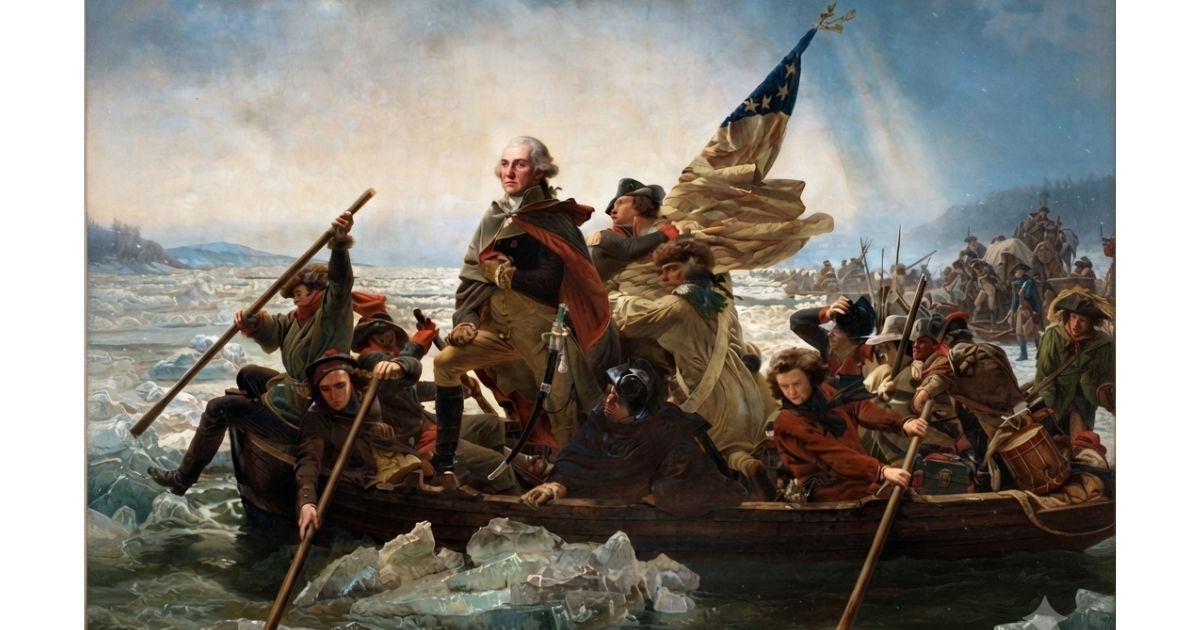
Picture a freezing December night, a river choked with ice, and an army on the brink of collapse deciding to bet everything on one shot. That’s exactly what happened on Christmas night, 1776 — and it played out on New Jersey soil.
America on the Edge of Defeat
By late 1776, George Washington’s Continental Army was in serious trouble. British forces and their Hessian allies had pushed the Americans into retreat after retreat. Morale was at rock bottom, and many soldiers’ enlistments were about to expire — meaning the army could simply dissolve if something drastic didn’t happen soon.
Washington needed a victory. And he needed it fast.
The Dice Were Cast
Rather than wait, Washington decided to risk everything. On the night of December 25, 1776, he led his troops across the frozen Delaware River, from Pennsylvania into New Jersey. It wasn’t easy — soldiers battled icy winds, drifting ice floes, and brutal conditions as they pushed across the water in small boats under cover of darkness.
The goal was clear: a surprise attack on the Hessian troops stationed in Trenton.
Trenton: A Small Battle, an Enormous Impact
Early on the morning of December 26, Washington’s forces reached Trenton and struck. The Continental Army defeated the Hessians in what became known as the Battle of Trenton — modest in scale, but massive in consequence.
Why did it matter so much? Because it came at a moment when many believed the Revolution was already lost. After Trenton, everything shifted — the army regained its confidence, new volunteers signed up, and the independence movement got the momentum it desperately needed, right when it needed it most.
New Jersey as the “Crossroads of the Revolution”
Thanks to its location between New York and Philadelphia, New Jersey became the stage for some of the most important military events of the war. It’s no accident the state earned the nickname “Crossroads of the Revolution.”
The Painting That Became a Symbol
Decades later, German-born painter Emanuel Leutze created the famous canvas “Washington Crossing the Delaware,”which became one of the most recognizable images in American history. It’s worth noting the painting isn’t a faithful historical reconstruction — it was created long after the event and takes real artistic liberties — but it managed to capture something more important than accuracy: the spirit of courage and resolve behind that night.
Why It Still Matters Today
Washington’s crossing of the Delaware still stands as a symbol of leadership, sacrifice, and perseverance — a reminder that one icy night on a river helped change the fate of an entire new nation.
New Jersey wasn’t just a place where history happened. It was one of the places where America was born.
Sources: National Park Service; Library of Congress; Washington Crossing Historic Park.
By Jenny