


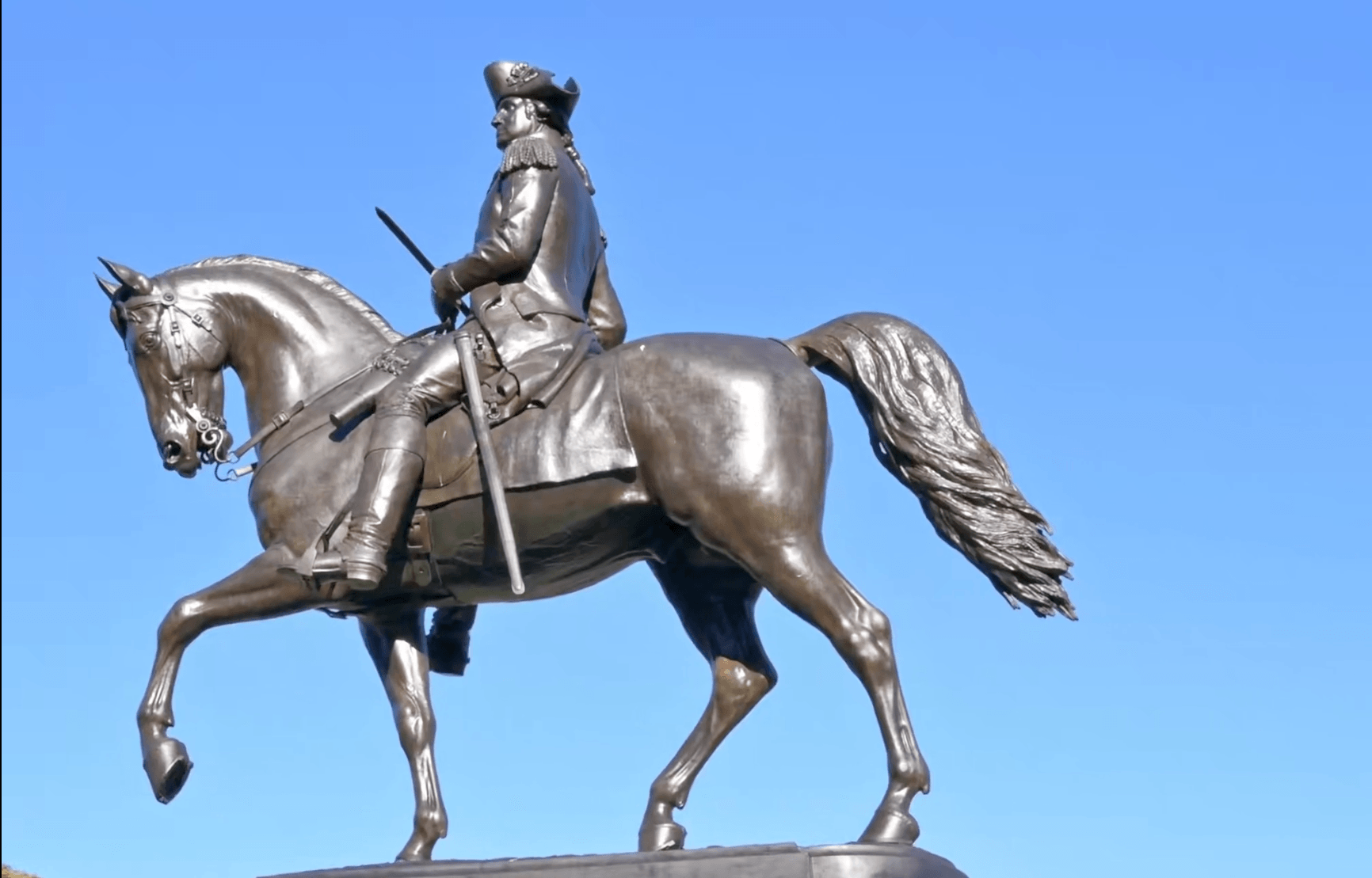
On August 14, 1795, President George Washington moved ahead with one of the most controversial diplomatic agreements of America’s early years — the Jay Treaty with Great Britain.
The agreement was designed to ease tensions that had continued between the United States and Britain more than a decade after the Revolutionary War ended.
Officially known as the Treaty of Amity, Commerce and Navigation, the agreement had originally been negotiated by American statesman and Supreme Court Chief Justice John Jay and British Foreign Secretary Lord Grenville. They signed it in London on November 19, 1794.
Why Was Another Agreement With Britain Needed?
Although the Treaty of Paris of 1783 had formally ended the Revolutionary War and recognized American independence, relations between the two countries remained tense. British troops still occupied frontier posts in territory claimed by the United States, while disputes involving trade, shipping and American sailors continued. (National Archives)
Washington sent John Jay to Britain in hopes of avoiding another conflict.
The resulting treaty addressed several outstanding disputes and helped preserve peace between the young United States and one of the world’s most powerful nations.
Americans Were Deeply Divided
The agreement was anything but universally popular.
The U.S. Senate approved it by a narrow 20–10 vote on June 24, 1795, meeting the required two-thirds majority. Opponents believed the agreement gave Britain too much while failing to protect American interests strongly enough.
The political fight became one of the fiercest of Washington’s presidency and contributed to the growing divide between the emerging political factions associated with figures such as Alexander Hamilton, Thomas Jefferson and James Madison. National Archives materials describe the treaty dispute as a major political crisis during Washington’s administration.
Washington nevertheless concluded that maintaining peace with Britain was essential for the still-young nation. The State Department’s Office of the Historian notes that he proceeded despite widespread public opposition because the agreement gave the United States valuable time to strengthen itself. (Office of the Historian)
A Treaty With Lasting Consequences
The Jay Treaty did not solve every disagreement between Britain and the United States, and tensions between the countries would eventually contribute to the War of 1812.
But in the 1790s, the agreement helped prevent an immediate new war and became an important early test of how the United States would conduct foreign policy under the Constitution.
More than two centuries later, the controversy surrounding the Jay Treaty remains a reminder that some of America’s earliest foreign-policy decisions were every bit as politically divisive as those of today.
Sources: U.S. Department of State, Office of the Historian; U.S. National Archives.
Social media source: Today in History via X (Twitter)
By NJ RADAR Team