


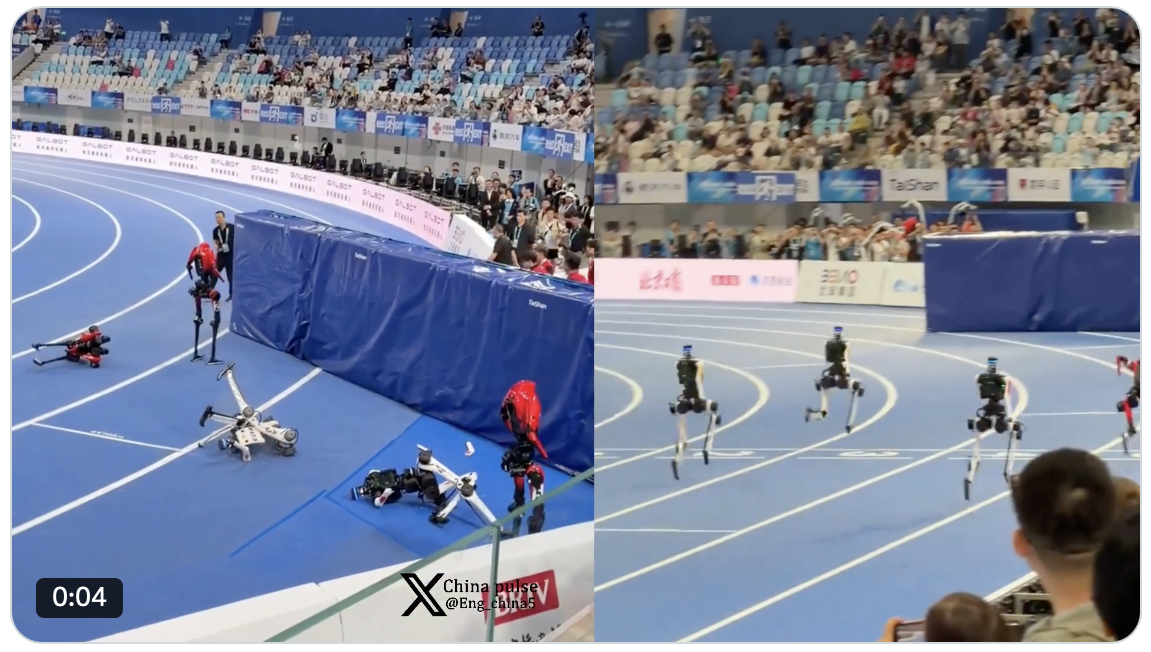
The World Humanoid Robot Games are underway in Beijing, China, bringing together thousands of humanoid robots for what looks increasingly like an Olympics for machines.
This year’s competition, held from August 22 to 26 at Beijing’s National Speed Skating Oval, includes 2,056 robots from 666 teams representing 16 countries. The program features 51 events, ranging from running, soccer and martial arts to industrial and household tasks designed to test how robots could eventually operate in real-world environments.
One of the most impressive events has been the 100-meter sprint.
China’s Tiangong Ultra completed the 100 meters in 8.86 seconds during the large-size humanoid semifinal, improving on its previous time of 9.39 seconds. The result is even faster than Usain Bolt’s 9.58-second human world record, although the comparison is mostly symbolic because the robot competition and human athletics are governed by very different conditions and rules.
But the videos from Beijing also reveal something equally interesting: running fast and stopping safely are two very different problems for humanoid robots.
In footage circulating from the competition, several robots continue moving at high speed after crossing the finish area. Some crash directly into padded barriers and fall to the ground. Event staff then approach the fallen machines, and in some cases robots are carried away on stretchers, creating an almost surreal scene that resembles medical teams responding to injured athletes.
The crashes may look funny, but they demonstrate a serious engineering challenge. At high speeds, humanoid robots must continuously coordinate balance, leg movement, braking, impact forces and body position. The faster they become, the more difficult it is to keep them stable and prevent damage. Tiangong Ultra itself sustained minor damage after its record-setting sprint.
And the Games are about much more than speed.
Robots are also being tested in soccer, dancing, martial arts, weightlifting and table tennis, while other competitions recreate factories, hotels, homes and logistics centers. In these events, robots may be asked to assemble objects, perform housekeeping tasks, respond to emergencies or sort books. Organizers say these challenges are intended to move humanoid robotics from demonstrations toward practical applications.
The scenes from the running track perhaps summarize the current state of humanoid robotics better than anything else: the machines are becoming remarkably fast and capable, but sometimes the hardest part is still knowing how to stop.
Source: Reuters / World Humanoid Robot Games organizers; X / Engineering China
By NJ RADAR Team