


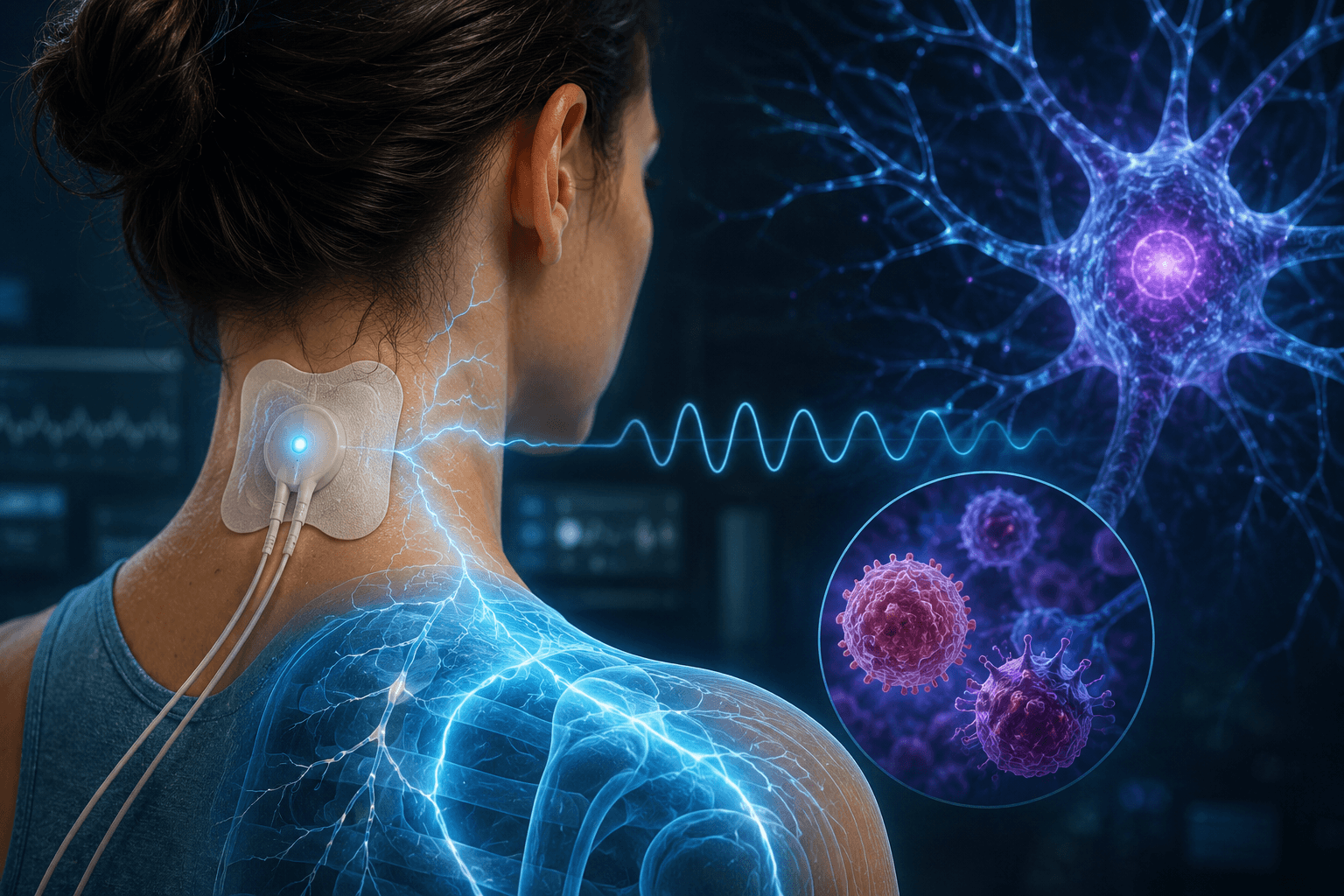
For decades, treating chronic illness has largely meant one thing: medication. But a new generation of medical devices is exploring a very different approach — using tiny electrical signals to communicate directly with the body’s nervous system.
The field is known as bioelectronic medicine, and one of its newest breakthroughs is already being used in patients with rheumatoid arthritis.
National Geographic recently highlighted the story of Jennie Moore, a retired 60-year-old teacher from New York who had lived with severe rheumatoid arthritis for decades. Medications including Humira and Orencia had failed to provide lasting relief. Earlier this year, she received a small nerve-stimulation device implanted in her neck.
The implant, roughly the size of a multivitamin capsule, stimulates a branch of the vagus nerve, one of the body’s major communication pathways between the brain and internal organs. Once a day, while Moore sleeps, the device delivers a short electrical pulse intended to activate a neural pathway involved in controlling inflammation.
A few months later, Moore reported that she was moving more easily and no longer needed her walker for trips around her neighborhood. Her experience does not mean the technology works for everyone, but it illustrates why researchers are increasingly interested in using the nervous system itself as a therapeutic tool.
The Body Has Its Own Electrical Communication Network
The idea behind bioelectronic medicine sounds futuristic, but electricity has been used in medicine for years.
Electrical stimulation is already used in treatments involving Parkinson’s disease, epilepsy, depression and rehabilitation after stroke. The difference is that newer devices are becoming smaller, more targeted and less invasive.
Scientists are now asking whether those same principles could be applied to diseases driven partly by chronic inflammation.
One of the central targets is the vagus nerve.
Research led by neuroscientist Kevin J. Tracey helped identify what became known as the inflammatory reflex — a neural circuit through which the nervous system can influence the immune response. Signals traveling through this pathway can ultimately reduce the release of inflammatory molecules by immune cells.
That discovery raised a remarkable possibility:
Instead of circulating another drug throughout the entire body, could doctors send a precise electrical signal to a nerve and instruct the body to reduce inflammation?
A One-Minute Electrical Signal
SetPoint Medical developed a small implant designed to do exactly that.
The device delivers approximately 60 seconds of electrical stimulation each day to the vagus nerve while the patient is asleep.
In a randomized trial involving 242 people with moderate-to-severe rheumatoid arthritis, 35.2 percent of participants whose devices were activated met the study’s measure of clinical improvement after 12 weeks, compared with 24.2 percent in the control group. Some participants continued to improve during longer-term follow-up. The results helped support FDA approval of the device in 2025.
That approval represents an important milestone because it moves bioelectronic medicine from an experimental concept closer to everyday clinical practice.
Arthritis May Be Only the Beginning
Researchers are already investigating whether similar technology could help treat other conditions.
Clinical studies are examining vagus nerve stimulation in conditions including Crohn’s disease, multiple sclerosis, chronic pain, Parkinson’s disease and Long COVID. Some researchers are also experimenting with devices that stimulate branches of the vagus nerve through the ear, avoiding an implanted device altogether.
Other teams are looking beyond the vagus nerve.
Scientists are studying electrical stimulation of nerves involved in bladder control, metabolic regulation and even the complex interaction between nerves, inflammation and cancer. One experimental device, for example, is being tested for overactive bladder and delivers mild electrical stimulation to pelvic nerves.
But many of these ideas are still at an early stage.
This Is Not a Cure for Everything
Despite the excitement, researchers caution that bioelectronic medicine is not a universal cure.
Even the approved rheumatoid arthritis device does not work for every patient, and scientists still do not fully understand why some people respond while others do not. Cost, insurance coverage, implantation procedures and long-term safety will also influence how widely these devices can eventually be used.
For many of the other diseases currently being studied, larger clinical trials will still be needed before researchers can determine whether electrical stimulation is both safe and effective.
Yet the broader idea is striking.
Medicine has traditionally relied heavily on chemistry — drugs designed to alter what happens inside cells and tissues.
Bioelectronic medicine adds another possibility: information.
The nervous system already carries electrical messages between the brain and virtually every organ in the body. Researchers are now learning how to intercept, modify and sometimes redirect those signals.
The future of medicine may therefore include not only pills and injections, but tiny devices capable of speaking the electrical language of the human body.
Source: National Geographic, “Could Electricity Zap Away Chronic Disease?”, published August 17, 2026.
By NJ RADAR Team