


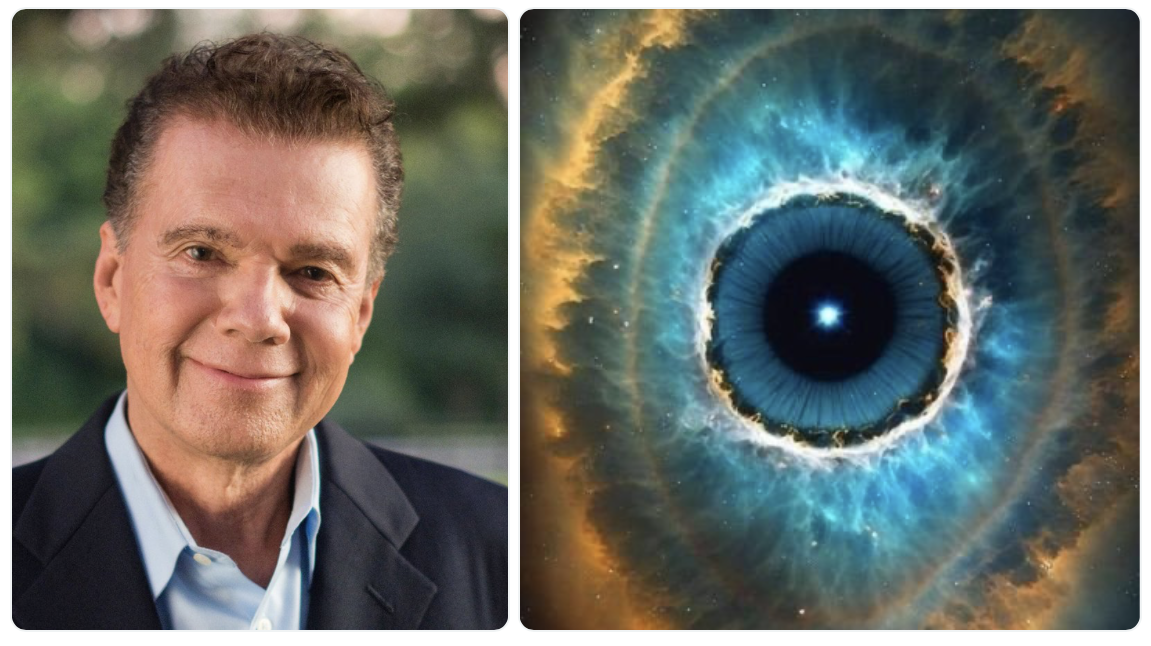
Could a place described by religions for thousands of years have some kind of address in the physical universe? One physicist believes modern cosmology may at least offer an intriguing place to think about that question.
Physicist and science communicator Michael Guillén, a former Harvard physics lecturer, has proposed an unusual idea: if heaven exists as a physical place, it might lie beyond what cosmologists call the cosmic horizon — the boundary beyond which we can no longer observe the universe from Earth.
His estimate places that hypothetical location at roughly 439 billion trillion kilometers from Earth, or about 273 billion trillion miles.
But Guillén is not claiming that a telescope has discovered heaven.
His idea is a theoretical interpretation that connects cosmology with religious belief, not an accepted scientific discovery or a measurement proving that heaven exists at a particular location in the universe.
Where Does That Number Come From?
Guillén begins with one of the most fascinating facts about our universe: space is expanding.
Generally speaking, the farther away a galaxy is, the faster it appears to be moving away from us. Guillén extends that relationship toward the enormous distances associated with the cosmic horizon.
He argues that at a distance of around 273 billion trillion miles, the recession speed would correspond to the speed of light.
In his interpretation, that boundary becomes especially interesting because regions beyond the cosmological horizon are inaccessible to us through observation. Light from sufficiently distant parts of the universe may never reach us, meaning that there are regions of the wider universe that human beings cannot see or directly investigate.
And this is where Guillén moves from physics into theology.
If heaven is real but inaccessible to humans through ordinary physical travel, he asks, could it exist somewhere beyond the boundary of the observable universe?
Science Ends Where the Question Begins
This is where an important distinction needs to be made.
Physics can describe the expansion of the universe, the behavior of light and the limits of what human beings can observe.
But at present, it cannot test whether heaven exists beyond those limits.
There is no astronomical observation showing a place identified as heaven, and Guillén’s idea is not part of generally accepted cosmological theory.
In other words, physics provides the boundary.
The idea of what might exist beyond that boundary is Guillén’s philosophical and religious interpretation.
An Almost Unimaginable Distance
Even the number itself is difficult to comprehend.
439 billion trillion kilometers looks like this:
439,000,000,000,000,000,000,000 kilometers.
At ordinary spacecraft speeds, such a journey would make little sense on a human timescale.
According to the theory of relativity, an object with mass cannot simply accelerate through the speed of light and cross such a boundary. Guillén uses precisely that physical limitation as part of his idea about why such a hypothetical place might remain forever beyond ordinary human reach.
But Is Heaven Really Somewhere in Space?
The answer may depend less on physics and more on what someone means by the word heaven.
Religious traditions have not always described heaven as another planet, galaxy or physical destination somewhere above Earth.
For many believers, heaven belongs to a spiritual reality that may not be measurable in kilometers at all.
Guillén, however, deliberately asks a different question: what if a religious description somehow corresponds to something physically real?
It is an idea that naturally attracts attention because it brings two fields that are often treated separately into the same conversation — science and faith.
A Theory, Not a Discovery
Posts on social media sometimes present Guillén’s idea as though a physicist has actually “located heaven.”
That goes far beyond what scientific evidence supports.
No scientific experiment has found heaven. No telescope has photographed it. And there is no consensus among physicists that the cosmic horizon has anything to do with a religious afterlife.
What Guillén has offered resembles a question more than a discovery.
If the universe contains regions that are forever beyond our ability to see or reach, can science say with certainty what does, or does not, exist there?
For physics, the answer stops at the limits of observation.
For faith, perhaps that is precisely where another kind of question begins.
This idea has not been confirmed mathematically or experimentally and, for now, remains his hypothesis and personal theoretical interpretation.
But perhaps, for some questions, we simply do not yet have the right laboratory. It is enough to imagine how small Earth is compared with the Sun, how small our Solar System is compared with our galaxy, and how small even our galaxy is compared with the universe. Perhaps the limits of our knowledge tell us more about how much we are still unable to see and measure than about what certainly does not exist.
Sources: Night Sky Today via X; Michael Guillén; Popular Mechanics; IFLScience.
By NJ RADAR Team