

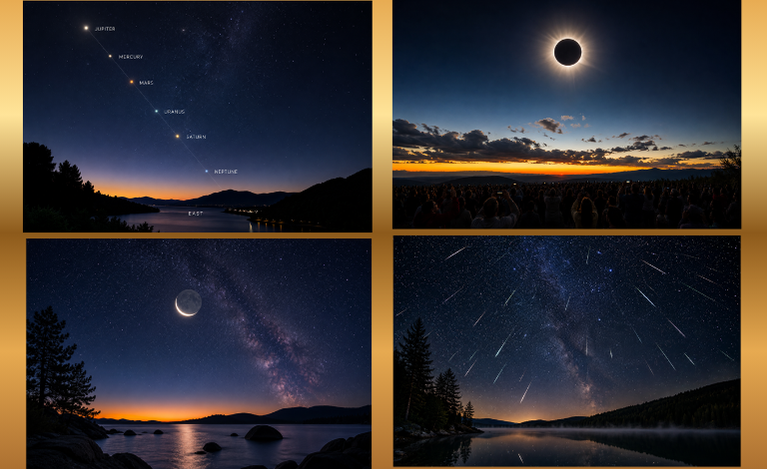
August 12, 2026, is shaping up to be an unusually eventful day in the sky. A six-planet gathering before sunrise will be followed by a New Moon and a total solar eclipse later in the day, while one of the year’s most anticipated meteor showers will reach its peak overnight.
The events will not all happen at exactly the same moment, and what people can see will depend heavily on their location. But within roughly 24 hours, skywatchers will have several reasons to look up.
1. Before Sunrise: Six Planets Gather in the Morning Sky
The celestial show begins before sunrise on Wednesday, August 12.
Six planets — Jupiter, Mercury, Mars, Uranus, Saturn and Neptune — will be spread across the morning sky along the ecliptic, the apparent path followed by the planets as seen from Earth.
This is often described as a “planetary parade,” although the planets will not form a perfectly straight line.
Several can be spotted without special equipment under favorable conditions, while Uranus and Neptune require binoculars or a telescope. Mercury will also be challenging because it sits low in the brightening dawn sky.
For observers in the New York and New Jersey area, the best opportunity comes shortly before sunrise on August 12, with a clear view toward the horizon.
2. Afternoon: A Total Solar Eclipse Crosses Parts of the World
The biggest astronomical event of the day arrives later on August 12: a total solar eclipse.
The path of totality crosses parts of Greenland, Iceland, northern Spain and other areas of the North Atlantic and Europe. People inside that narrow path will see the Moon completely cover the Sun for a short period, turning daylight into twilight.
New Jersey will not experience totality — but it is inside the partial-eclipse zone.
Across New Jersey, the partial eclipse begins shortly after 1 p.m. EDT and ends around 2:40 p.m. In Jersey City, for example, it begins around 1:07 p.m., reaches maximum eclipse around 1:54 p.m. and ends around 2:38 p.m. Only about 9% of the Sun will be obscured there.
Anyone watching the eclipse must use proper certified solar-viewing glasses. Regular sunglasses are not safe for looking directly at the Sun.
3. The New Moon Makes It All Possible
August 12 also brings a New Moon.
This isn’t simply a coincidence with the solar eclipse. A solar eclipse occurs during the New Moon phase, when the Moon passes between Earth and the Sun. During this particular New Moon, the alignment is precise enough for the Moon’s shadow to cross Earth, producing the eclipse.
But the New Moon has another important consequence this year.
Because the Moon’s illuminated side is facing away from Earth, there will be virtually no moonlight washing out the night sky.
And that creates excellent conditions for what comes next.
4. Night of August 12–13: The Perseids Reach Their Peak
After the eclipse is over and darkness returns, the sky has one more major event in store.
The Perseid meteor shower reaches its peak during the night of August 12 into the early morning of August 13.
The Perseids occur every year as Earth passes through debris left behind by Comet 109P/Swift-Tuttle. Tiny particles enter Earth’s atmosphere at tremendous speed and burn up, creating the bright streaks commonly called “shooting stars.”
Under dark, clear skies, observers could see dozens of meteors per hour, with considerably higher rates possible under ideal conditions.
And 2026 offers something especially valuable: the peak coincides with the New Moon.
With essentially no moonlight interfering, this could be one of the better Perseid viewing opportunities in years.
The best viewing generally comes after midnight and before dawn on August 13, away from streetlights and city glow. No telescope is necessary — in fact, the naked eye is better because meteors can appear across a large portion of the sky.
One Day, Four Reasons to Look Up
So the astronomical sequence is remarkably simple:
Before sunrise August 12: six planets gather across the morning sky.
Afternoon August 12: a total solar eclipse crosses parts of the Northern Hemisphere, while New Jersey sees a partial eclipse.
August 12: the Moon reaches its New Moon phase, creating both the eclipse and exceptionally dark nighttime skies.
Night of August 12 into August 13: the Perseid meteor shower reaches its peak.
It isn’t quite accurate to say that four completely independent rare astronomical events suddenly occur at the same instant. But having a solar eclipse, a New Moon, the Perseid peak and a notable gathering of six planets packed into the same roughly 24-hour period certainly makes August 12 a day worth watching the sky.
[…] The total solar eclipse of August 12, 2026 swept across Greenland, Iceland, northern Russia, the North Atlantic, northern Spain and a small part of Portugal. Many other locations across Europe, Canada and parts of the northern United States experienced a partial eclipse instead. […]