


📱 The Tweet That Lit the Fuse: @wakeupnj
Wake Up NJ (@wakeupnj): “Our Jersey Roads Suck”
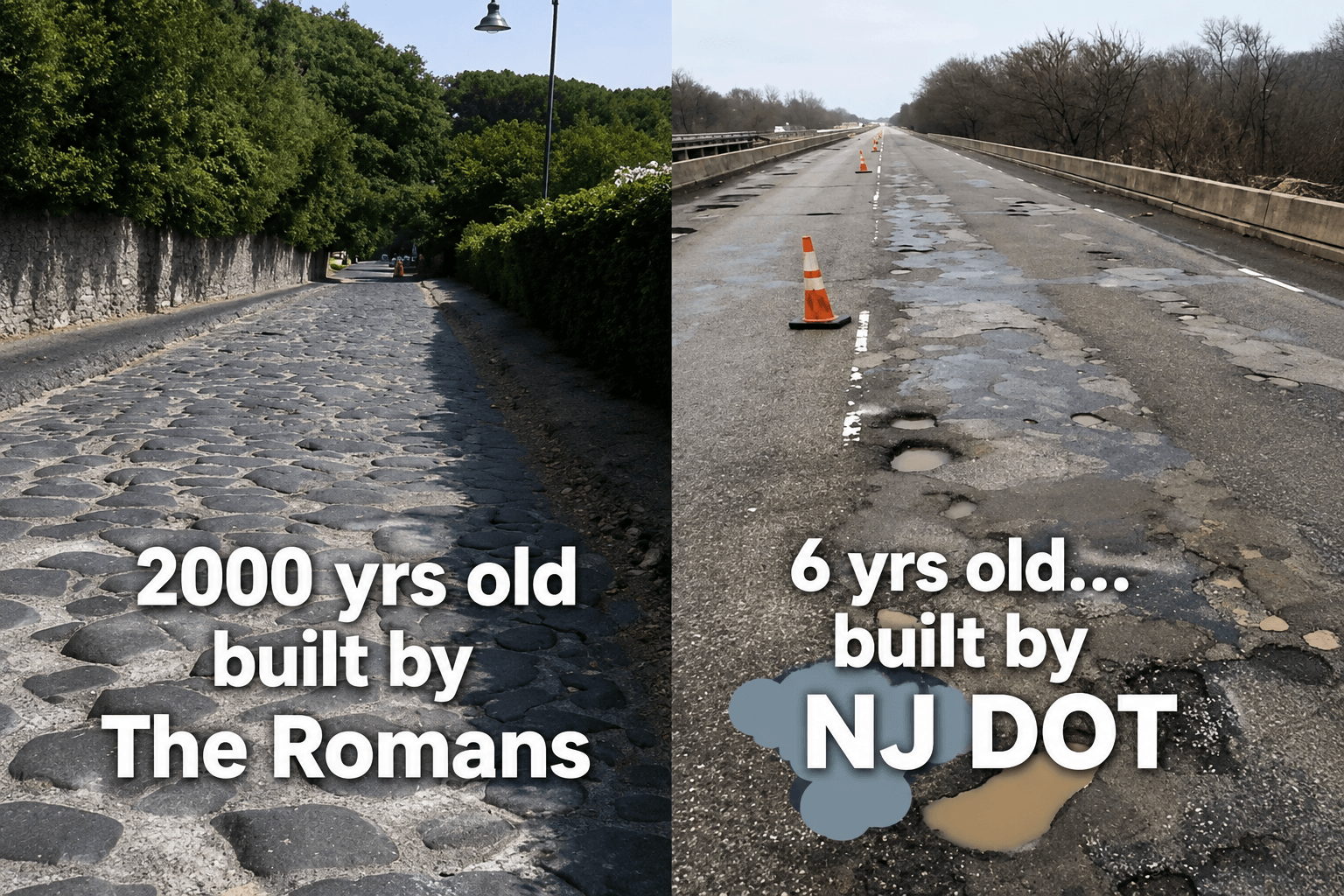
It all started innocently enough—with a single image comparing two roads.
On the left: the smooth, perfectly preserved Appian Way, built by the Romans 2,000 years ago.
On the right: a roadway filled with potholes, patches and cracks, labeled:
“6 yrs old… built by NJDOT.”
Within hours, the post spread like wildfire, and the comments exploded into a heated debate filled with strong opinions, unverified claims and conspiracy theories about the construction industry, along with an unmistakable nostalgia for the Roman legions.
Once a debate on X catches fire after a post from Wake Up NJ (@wakeupnj), there’s no turning back. Angry drivers, frustrated taxpayers and self-appointed construction experts flooded the comment section, rallying behind the slogan that “our Jersey roads suck,” turning an ordinary internet meme into an epic discussion about the decline of modern civilization.
Let’s be honest—there isn’t a therapist alive who can cure the frustration of a driver who has just destroyed their suspension on an unmarked pothole while everyone keeps promising better roads.
A Brief Reflection
Picture this.
Julius Caesar is returning from his campaign in Gaul, comfortably seated in his chariot as its wheels glide effortlessly across the perfectly cut basalt stones of the Appian Way.
Two thousand years have passed.
The Roman Empire has fallen. Latin has become a dead language.
Yet Roman concrete and mortar, mixed with their mysterious formula rich in lime, continue to withstand the test of time, harsh weather and even barbarian invasions.
Meanwhile, in the modern miracle of democracy and engineering known as New Jersey, proud motorists drive on six-year-old asphalt that sometimes looks more like the surface of the Moon.
The Secret of Self-Healing Mortar and the State Budget
While scientists around the world continue trying to unlock the secret behind ancient Roman self-healing concrete, modern builders in New Jersey appear to have developed their own revolutionary method:
Permanent reconstruction.
Why build a road that lasts 2,000 years when you can rebuild it, tear it up, repave it and dig it up again every six months—thus ensuring, at least jokingly, job security for three generations of relatives of local politicians?
Comments on social media spared neither government officials nor contractors.
Some blamed private contractors who, they claim, “won the job by offering to do it cheaply,” while others nostalgically observed that the moment they cross the border of their hometown—such as Woodbridge, where the roads are supposedly decent—and merge onto a state highway, they instantly feel as if they’ve entered a war zone.
Naturally, politics also found its way into the conversation.
One user wrote:
“While the governor is busy redirecting millions of dollars to provide legal aid for illegal immigrants, our shocks and suspension bushings are quietly paying the price.”
Another added that New Jersey drivers pay some of the nation’s highest fuel prices and tolls while road maintenance, according to his claims, costs several times more than the national average.
Fraud… or Art?
The “economic experts” of Twitter (X) seriously began debating whether today’s road construction model is actually a brilliant piece of financial engineering.
Do a below-average job.
People complain.
The government approves another budget.
Contractors receive another contract.
Repeat.
A perfect economic perpetual motion machine.
Meanwhile, drivers in Pennsylvania can breathe a little easier because, at least, they know their roads are even worse, while New Jersey motorists continue staring at toll booths wondering whether all those millions were swallowed by moles, labor unions or mysterious ancient spirits who took the Roman concrete formula with them to the grave.
At the center of this digital storm stood one simple question:
How is it possible that an empire which built roads without asphalt pavers, computers or government procurement rules left behind infrastructure that has survived for millennia, while a modern state with multi-billion-dollar budgets can destroy a roadway in less time than it takes to binge-watch a Netflix series?
From Ancient Roman Mortar to Modern Conspiracy Theories
As the discussion intensified, the theories became even more fascinating.
Some commenters accused what they called a “construction mafia” and corrupt politicians who allegedly steal money intended for road repairs.
Others dove into detailed discussions about the chemistry of ancient Roman mortar.
“The Romans had lime that healed itself in water, while our contractors use asphalt that melts after the first summer rain,” one user joked.
Another sarcastically suggested that the real secret is simply “job security”—do a poor job today so you can get paid to fix it tomorrow.
Selected Comments from the Heated Debate
@alabamaspimp (2h)
“NJDOT didn’t build that. A contractor did… Sanzari or Della Pello, or someone who bid the job cheap. The Roman Empire had a massive government that actually built roads. Maybe that’s the difference?”
@KenX357 (5h)
“To be fair, the Roman Empire had self-healing mortar. I think it had something to do with lime, but we’re not sure. That’s why there are still bridges thousands of years old. We still don’t know the formula.”
@BigJimHit (6h)
“It hurts even more when you realize we drive on some of the most expensive roads in the country and spend eleven times the national average maintaining them. We pay premium prices and get garbage in return.”
@JeffreyVentrone (2h)
“Do a below-average job today so you can do it again tomorrow. It’s called job security. Disgraceful.”
The Politics of Satire and Digital Trenches
Every discussion on social media—provided it remains civil—is a fascinating reflection of society.
However, once the familiar political finger-pointing begins, with people insisting that “things would be different if our side were in charge,” satire has to step back for a moment.
Because, let’s be honest…
One party was in power.
Then another.
Then the first one again.
Yet, according to many of the drivers taking part in the debate, the roads still feel similar enough to shake your kidneys loose every time you get behind the wheel.
Jenny Blog is a satirical commentary inspired by a viral post on X. Opinions quoted in this article belong to the users who posted them and do not necessarily represent verified facts or the views of NJ Radar.