


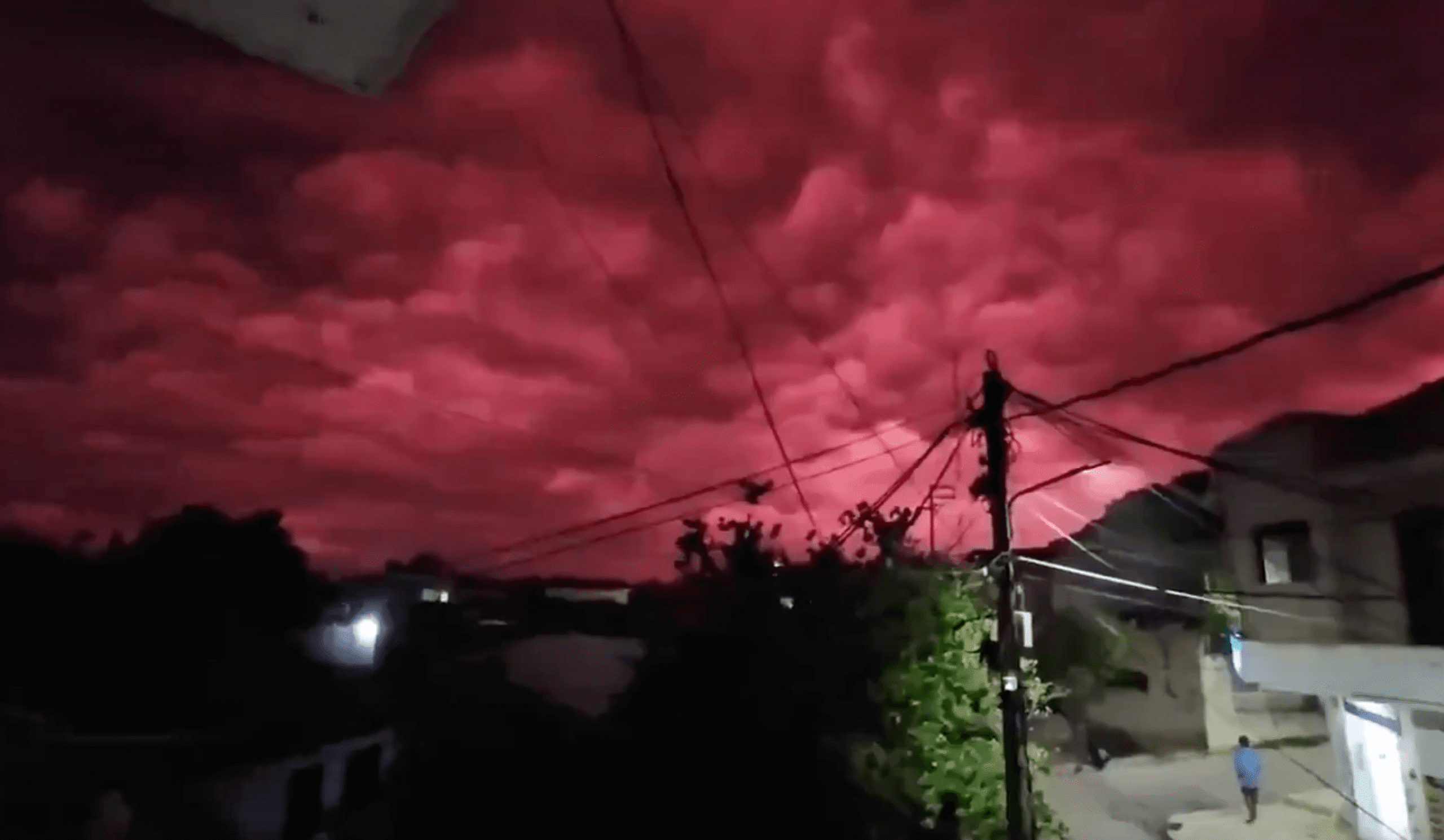
A striking red sky over Colombia has attracted attention just days after the country was hit by a devastating magnitude 7.4 earthquake. Similar images have circulated after other major earthquakes, including the 2023 disaster in Turkey and Syria. But scientists caution against assuming that unusual clouds or colorful skies are caused by seismic activity.
COLOMBIA — Days after a powerful 7.4-magnitude earthquake struck western Colombia on August 10, residents near Galeras were confronted with another dramatic sight: clouds glowing an intense red across the evening sky.
The earthquake caused widespread destruction across western Colombia, with severe damage reported in cities including Cali.
Videos and photographs of the crimson sky quickly spread online, with some people wondering whether the unusual colors could somehow be connected to the earthquake.
But the explanation offered for the Galeras sky is much less mysterious.
The phenomenon has been described as “candilazo” or “arrebol,” an atmospheric effect that can occur around sunset when sunlight passes through humid air, clouds, dust and other particles. The result can be spectacular shades of deep orange, pink and red.
We have seen this fear before
The reaction is familiar.
After the devastating earthquakes that struck Turkey and Syria in February 2023, images of an extraordinary reddish, disk-shaped cloud over the Turkish city of Bursa began circulating online.
Some social media posts later claimed that the cloud had been connected to, or even warned of, the earthquake.
There was one major problem with that theory.
The cloud had appeared on January 19, 2023, nearly three weeks before the February 6 earthquake, and meteorologists identified it as a lenticular cloud, a well-known atmospheric formation commonly associated with strong airflow over mountains. Reuters and AFP both found no evidence connecting that cloud to the earthquake.
Its dramatic red and pink coloring came from sunlight illuminating the cloud at a low angle, creating a sight unusual enough to become an international viral image.
But what about “earthquake lights”?
This is where the story becomes more complicated.
Scientists have documented reports of unusual lights appearing before, during or around some earthquakes. The phenomenon is generally referred to as earthquake lights, or EQL.
According to the U.S. Geological Survey, reports have included glowing skies, balls of light, flashes, streamers and other luminous effects. But geophysicists still disagree about how many of these observations represent a genuine earthquake-related phenomenon.
Various physical mechanisms have been proposed, but there is still no universally accepted explanation that would allow unusual lights or clouds to be used reliably as earthquake warnings.
And that distinction matters.
A red sunset, an unusual cloud formation and a genuine unexplained luminous event are not necessarily the same phenomenon.
Beautiful skies are not earthquake predictions
There is currently no scientific method that can predict a major earthquake based on the appearance of clouds or the color of the sky.
The USGS states clearly that neither it nor other scientists can currently predict a major earthquake by specifying its exact time, location and magnitude. Scientists instead calculate probabilities of future earthquakes over longer periods.
That does not make the images from Colombia any less remarkable.
Against the backdrop of a country recovering from a devastating earthquake, a glowing red sky can understandably feel unsettling and even ominous.
But sometimes an extraordinary sky is simply the result of ordinary atmospheric physics producing an extraordinary view.
And as history has shown, when dramatic natural events happen close together, social media can connect them long before science does.
Sources: U.S. Geological Survey; Associated Press; Reuters; AFP Fact Check; NEXTA / X. reporting the red sky observed near Galeras, Colombia.
By NJ RADAR Team