


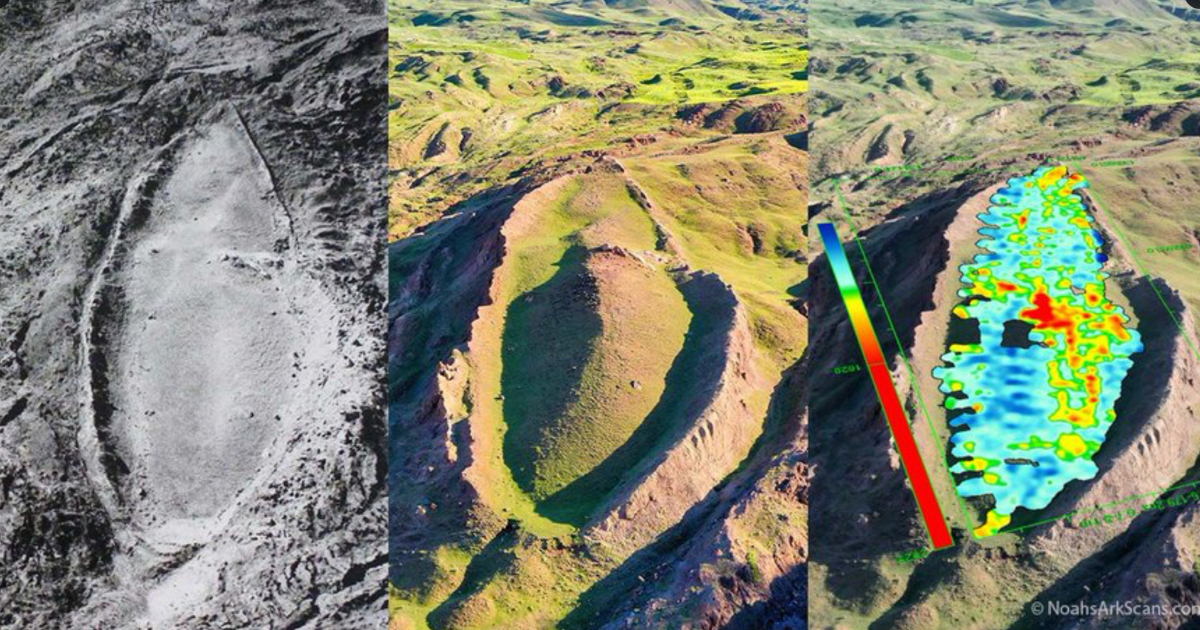
TURKEY — November 8, 2026 — For thousands of years, the story of Noah’s Ark has captured the imagination of people around the world. Now, an international team of researchers is examining a mysterious, boat-shaped formation in eastern Turkey, hoping to determine whether it holds evidence connected to one of history’s most famous flood stories.
The site, known as the Durupınar Formation, lies near Mount Ararat, close to Turkey’s border with Iran. From above, its outline resembles a large vessel, measuring approximately 515 feet (157 meters) in length. That unusual shape has attracted researchers, religious scholars and explorers for decades.
This year, scientists moved beyond photographs and surface observations. Working with Turkish universities and the U.S.-based organization Noah’s Ark Scans, an international team carried out ground-penetrating radar surveys, three-dimensional mapping and drilling beneath the formation.
The researchers collected soil and rock samples for laboratory testing, looking for organic material, possible traces of ancient wood and evidence that could help explain how the formation developed.
The investigation has produced intriguing observations, but there is an important distinction: no scientific evidence has yet established that the formation is the remains of Noah’s Ark.
What Did Researchers Find?
The latest fieldwork began in June and continued through September 2026 under the direction of Professor Cenker Atila of Sivas Cumhuriyet University, with researchers from several countries participating.
Using specialized radar equipment, the team identified underground features that some members believe could represent corridors, chambers or structural boundaries.
Researchers also drilled into the formation to collect samples from below the surface. During one operation, a drill bit reportedly broke after striking an unidentified hard object. Team members have suggested several possibilities, including mineralized material, but its identity remains unknown.
Andrew Jones, who leads Noah’s Ark Scans, has argued that the underground patterns deserve further examination.
Still, radar signals do not reveal a buried wooden ship. Changes in rock, sediment, moisture and underground fractures can create similar patterns, making physical evidence and laboratory analysis essential.
The samples collected this year have been sent for examination, with more detailed findings expected in 2027.
A Discovery That Began With an Aerial Photograph
The Durupınar Formation gained international attention in 1959 after Turkish military officer İlhan Durupınar identified its unusual outline in aerial photographs.
Its proximity to Mount Ararat was especially significant. The Book of Genesis describes Noah’s Ark coming to rest on the mountains of Ararat after a catastrophic flood.
In the biblical account, Noah was instructed to build an enormous vessel to protect his family and pairs of living creatures from the approaching waters.
The story also appears in Islamic tradition, where Noah is known as Prophet Nuh. The Quran describes the prophet, the flood and the vessel that carried believers to safety, although it identifies the vessel’s resting place as Mount Judi rather than Mount Ararat.
The accounts share themes of faith, warning, survival and a new beginning, while differing in certain details.
The story’s place in Jewish, Christian and Islamic traditions has helped sustain worldwide interest in the search for physical evidence.
Why Many Geologists Remain Skeptical
The idea that Durupınar could be Noah’s Ark is not new, and neither are the objections.
Geologists have studied the formation and argued that it can be explained by natural processes, including landslides, erosion and the movement of rock layers.
In a 1996 scientific paper, geologist Lorence Collins and researcher David Fasold concluded that features previously presented as evidence of an ancient vessel were consistent with natural geological structures.
Later geological research also supported explanations involving displaced limestone and surrounding earthflow deposits.
These findings do not mean that researchers should stop studying the site. They do, however, establish a high standard for any claim that a human-built vessel lies beneath it.
To demonstrate that the formation contains an ancient ship, investigators would need identifiable construction materials, evidence of deliberate human workmanship, reliable dating and results that independent specialists could examine.
So far, that evidence has not been produced.
What Happens Next?
The 2026 investigation marks a new stage in the decades-long search because researchers have collected physical samples from beneath the formation rather than relying exclusively on its appearance or remote scans.
Laboratory analysis could help identify the materials involved, clarify the site’s geological history and determine whether any findings justify more extensive archaeological work.
The research team expects to return in 2027 for additional investigations.
Whether those efforts will resolve the mystery is unknown. The formation may ultimately prove to be a remarkable geological coincidence, or researchers may uncover evidence that changes the current understanding of the site.
For now, Noah’s Ark remains a powerful story shared across religious traditions, while its physical existence and final resting place remain unverified by archaeology.
Sources: The Jerusalem Post (October 22, 2026); Rudaw (October 8, 2026); Anatolian Archaeology (September 30, 2026); Baptist Press (November 3, 2026); Noah’s Ark Scans (September 23, 2026); Collins and Fasold, Journal of Geoscience Education (1996).
By NJ RADAR Team