


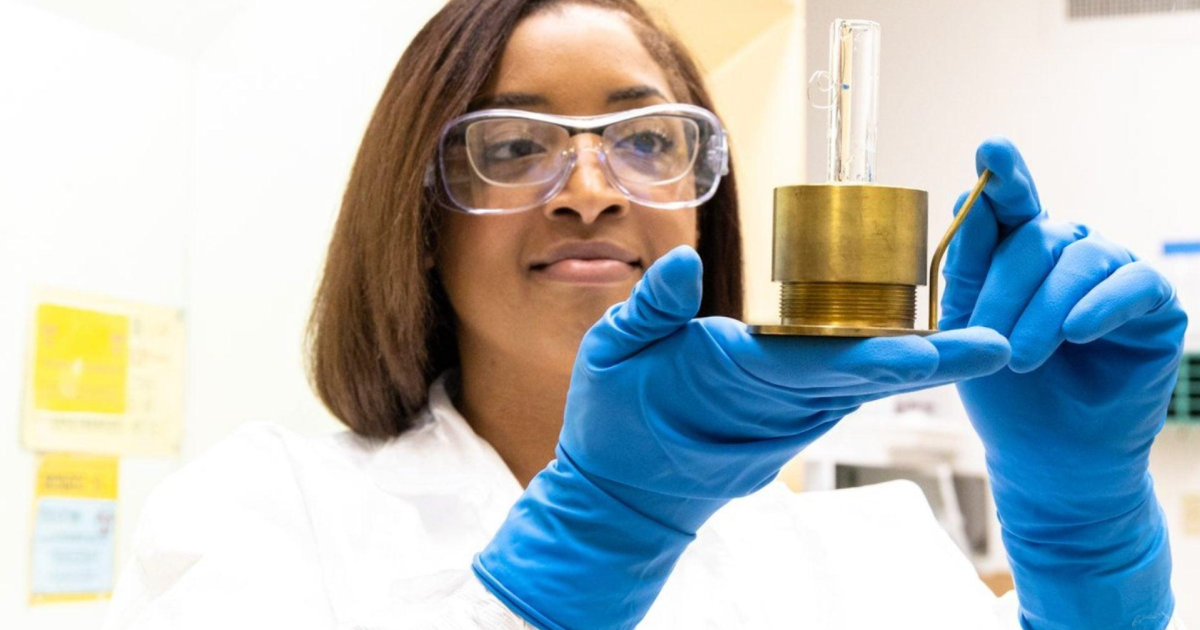
Some of the most important discoveries in science depend on people whose names rarely make the headlines. Clarice Phelps is one of those scientists, and her contribution to the periodic table has earned her a remarkable place in history.
Phelps, a nuclear engineer at Oak Ridge National Laboratory in Tennessee, became the first African American woman recognized for contributing to the discovery of a chemical element. Her work helped scientists confirm the existence of tennessine, element 117 on the periodic table.
The discovery was the result of international scientific collaboration, but one of its essential steps took place in a laboratory where Phelps and her colleagues worked with an extremely rare radioactive material.
The Science Behind Element 117
Tennessine, represented by the symbol Ts, is a synthetic element that does not occur naturally in measurable quantities. Scientists must create it through highly controlled nuclear experiments.
At Oak Ridge National Laboratory, Phelps was part of a team responsible for purifying berkelium-249, a rare radioactive isotope needed for those experiments.
The purified material was used in nuclear reactions involving calcium ions, allowing researchers to produce atoms of the new element and gather evidence confirming its existence.
The process demanded exceptional precision. Even tiny quantities of radioactive material required careful preparation, specialized equipment and extensive scientific expertise.
Without the work of researchers preparing those materials, the experiments could not have proceeded as planned. Oak Ridge National Lab+1
From the U.S. Navy to Nuclear Research
Phelps did not follow a simple or traditional path into scientific history.
After earning a bachelor’s degree in chemistry from Tennessee State University, she served in the U.S. Navy’s Nuclear Power Program, gaining valuable experience in nuclear technology.
She joined Oak Ridge National Laboratory in 2009, initially working as a nuclear operations technician. Her responsibilities involved processing and purifying radioactive isotopes, work that would later place her at the center of research connected to one of chemistry’s most significant modern achievements.
Phelps continued her education while advancing her scientific career. She earned a master’s degree in mechanical engineering from the University of Texas at Austin, specializing in nuclear and radiation engineering, and later completed a doctorate in nuclear engineering at the University of Tennessee, Knoxville.
Her research has extended beyond the discovery of tennessine, including isotope production and separation for applications in medicine, industry and government research. Oak Ridge National Lab+1
Recognition Beyond the Laboratory
In 2019, Phelps received international recognition when the International Union of Pure and Applied Chemistry selected her for its Periodic Table of Younger Chemists, an initiative celebrating scientists and their contributions to chemistry.
She was chosen to represent einsteinium, element 99, while being recognized for her involvement in the discovery of tennessine.
Her achievements have also brought attention to the contributions of Black women in scientific fields where they have historically been underrepresented.
In February 2026, Phelps was again featured in a television report highlighting her journey from Nashville’s Edgehill neighborhood to a career in nuclear science. Speaking about her early struggles in school, she encouraged young people not to allow academic setbacks or difficult circumstances to determine their futures. Oak Ridge National Lab+1
A Name Worth Remembering
The periodic table is one of the most familiar symbols of scientific knowledge, displayed in classrooms and laboratories around the world. Yet few people know the names of the researchers whose work made its expansion possible.
Clarice Phelps helped change that story.
Her contribution demonstrates that scientific discovery is rarely the achievement of one person. It often depends on years of careful laboratory work, international cooperation and specialists whose contributions are essential even when they remain outside the public spotlight.
For students considering careers in chemistry, physics or engineering, her journey offers a compelling example of what determination, education and scientific curiosity can accomplish.
And the next time someone looks at element 117 on the periodic table, there is another name worth remembering: Clarice Phelps.
Sources: Oak Ridge National Laboratory; U.S. Department of Energy; ORNL – Periodic Table of Younger Chemists.Image source: Oak Ridge National Laboratory / U.S. Department of Energy
By NJ RADAR Team