


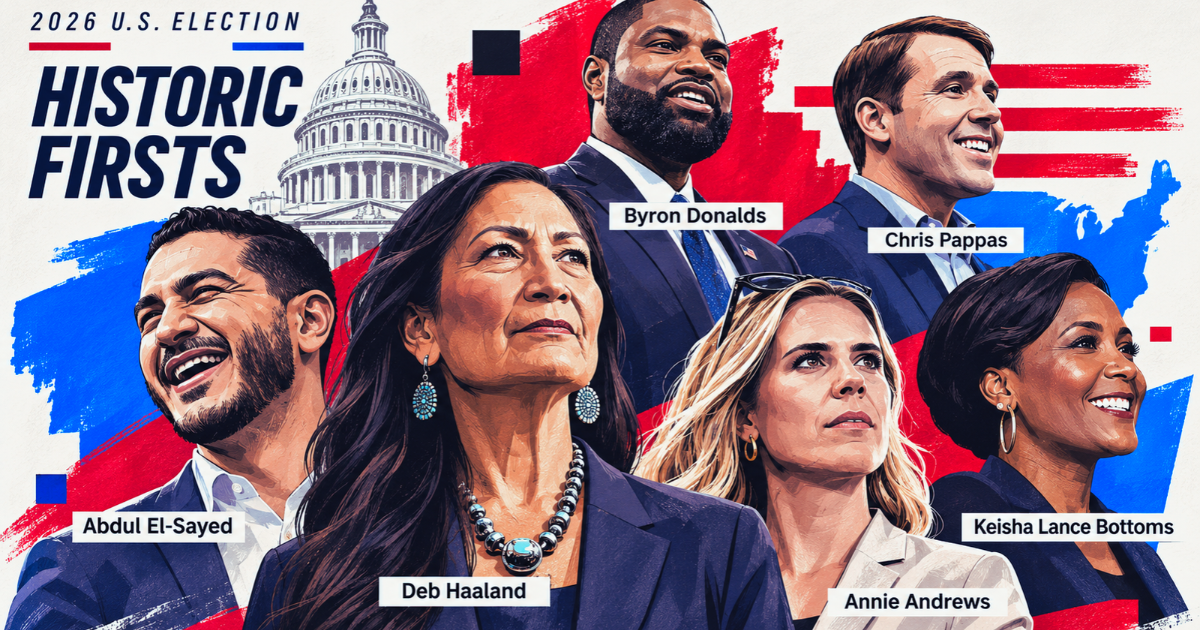
From the first Muslim U.S. senator to the first Black woman elected governor, the midterm elections mark an unprecedented series of political milestones across the United States.
WASHINGTON, D.C. — November 4, 2026 — The 2026 midterm elections will be remembered not only for Democrats winning control of Congress but also for an extraordinary number of historic firsts that have transformed political representation across the United States.
Across the country, voters elected candidates who broke barriers involving race, gender, religion, and political representation, opening offices that had never before been held by people from their backgrounds.
From Georgia and Michigan to New Mexico, Minnesota, Texas, Florida, and California, election night produced a remarkable series of milestones in American political history.
CNN journalist Omar Jimenez highlighted the historic results in a social media post Wednesday morning, drawing attention to the unprecedented number of first-time achievements in a single election.
America Elects Its First Black Woman Governor
In Georgia, Democrat Keisha Lance Bottoms became the first Black woman elected governor in the history of the United States.
The former Atlanta mayor defeated Republican Rick Jackson, ending decades of Republican control of Georgia’s governorship.
Her victory is historic on several levels.
She will become Georgia’s first Black governor, its first female governor, and the first Black woman to serve as governor of any American state.
Despite the country’s long political history, no Black woman had previously won a gubernatorial election.
Bottoms’ victory marks a major milestone in political representation and comes eight years after Stacey Abrams’ unsuccessful campaign for the same office.
Abdul El-Sayed Becomes the First Muslim U.S. Senator
Michigan delivered another historic result.
Democrat Abdul El-Sayed defeated Republican Mike Rogers, becoming the first Muslim elected to the United States Senate.
A physician and former Detroit public health director, El-Sayed built his campaign around healthcare affordability, economic inequality, and government accountability.
His victory followed a contentious election campaign that attracted national attention, including disputes over religion, immigration, and foreign policy.
Although Muslim Americans have served in the U.S. House of Representatives since Keith Ellison’s election in 2006, none had previously been elected to the Senate.
El-Sayed’s victory represents a new chapter in Muslim American political representation.
New Hampshire Elects First Openly Gay Male Senator
In New Hampshire, Democratic Congressman Chris Pappas defeated Republican John E. Sununu to become the first openly gay man elected to the U.S. Senate.
Pappas, who previously served in the House of Representatives, had already made history as New Hampshire’s first openly gay member of Congress.
His Senate victory extends LGBTQ representation in federal elected office.
Pappas emphasized during his campaign that he wanted voters to judge him on his policies and qualifications rather than his sexual orientation.
Deb Haaland Becomes First Native American Woman Governor
New Mexico elected Democrat Deb Haaland as the first Native American woman governor in American history.
Haaland, a citizen of the Laguna Pueblo, previously served in Congress and became the first Native American Cabinet secretary when President Joe Biden appointed her secretary of the interior.
Her victory over Republican Gregg Hull adds another historic achievement to a political career marked by several firsts.
Haaland’s election is particularly significant in a country where Native Americans were excluded from many aspects of political participation for generations.
Peggy Flanagan Becomes First Native American Woman Senator
Minnesota elected Democrat Peggy Flanagan to the U.S. Senate, making her the first Native American woman to serve in the chamber.
Flanagan, a member of the White Earth Band of Ojibwe, defeated Republican Michele Tafoya.
She previously served as Minnesota’s lieutenant governor and was among the highest-ranking Native American women in state government.
Her victory brings Native American female representation to the U.S. Senate for the first time.
Texas Elects Its First Latina Governor
Texas voters made history by electing Democrat Gina Hinojosa as the state’s first Latina governor.
Hinojosa defeated Republican incumbent Greg Abbott in one of the most closely watched gubernatorial elections of the year.
The result represents a major political change in a state that has been governed by Republicans for decades.
It also marks a historic milestone for Latina political representation in Texas, a state with a large Hispanic population.
Florida Elects Its First Black Governor
Florida elected Republican Byron Donalds as its first Black governor.
Donalds, who previously represented Florida in the U.S. House of Representatives, won the gubernatorial election and will become the first Black person to hold the state’s highest executive office.
His victory demonstrates that the historic breakthroughs of the 2026 election were not limited to one political party.
While Democrats achieved most of the major electoral firsts, Republicans also reached significant milestones.
Ohio Elects Its First Woman Governor
In Ohio, Democrat Amy Acton became the first woman elected governor in the state’s history.
Acton, a physician and former director of the Ohio Department of Health, gained national attention during the COVID-19 pandemic.
Her election marks a significant milestone for women in Ohio politics.
Her professional background in public health also brings a different perspective to the governor’s office.
South Carolina Elects Its First Woman U.S. Senator
South Carolina voters elected Democrat Annie Andrews to the U.S. Senate, making her the first woman elected to represent the state in the chamber.
The pediatrician defeated Republican Darline Graham in an election that also marked a major political shift.
Women had previously served in the U.S. Senate through appointments from South Carolina, but Andrews is the first to win election to the office.
California Elects Its First Latino Governor in More Than 150 Years
California elected Democrat Xavier Becerra as governor, marking a historic milestone for Latino political representation.
The former U.S. secretary of health and human services and California attorney general defeated Republican Steve Hilton.
Becerra will be California’s first Latino governor since Romualdo Pacheco briefly held the position in 1875.
His victory reflects the changing political representation of a state with one of the largest Latino populations in the country.
Kansas Elects First Democratic Senator in 94 Years
One of the most unexpected political developments occurred in Kansas.
Democrat Adam Hamilton defeated Republican incumbent Roger Marshall, becoming the first Democrat elected to the U.S. Senate from Kansas since 1932.
Hamilton, a Methodist pastor, campaigned on affordability, economic fairness, and bipartisan cooperation.
His victory ended a 94-year period during which Kansas voters had not elected a Democrat to the Senate.
Unlike the other milestones, this achievement concerns party representation rather than the personal identity of the elected candidate.
Nevertheless, the result represents one of the most significant political shifts of the election.
America Could Have Its First Black Speaker of the House
The Democratic takeover of the House of Representatives has also created the possibility of another historic first.
House Democratic Leader Hakeem Jeffries of New York is positioned to become the first Black speaker of the U.S. House of Representatives.
Jeffries has served as the leader of House Democrats since 2023.
However, becoming speaker requires a separate vote by members of the House when the new Congress convenes in January 2027.
If elected, Jeffries would become the first Black person to preside over the chamber in its history.
New Jersey Also Makes History
New Jersey contributed to this historic election night with the victory of Adam Hamawy in the state’s 12th Congressional District.
Hamawy, an Egyptian-born surgeon, U.S. Army veteran, and humanitarian physician, became the first Muslim elected to Congress from New Jersey.
His election adds another milestone to the changing religious and cultural representation of American political institutions.
His victory came on the same night that Abdul El-Sayed won his historic Senate race in Michigan.
Together, these results mark an important moment for Muslim American political participation at the national level.
A Turning Point in American Political Representation
The 2026 election results show that the composition of American political leadership continues to change.
Women, racial and ethnic minorities, Native Americans, Muslim Americans, and LGBTQ candidates have achieved milestones once considered difficult or even impossible.
These victories also demonstrate that historic breakthroughs can occur across party lines.
The election of Republican Byron Donalds in Florida, for example, stands alongside Democratic victories that expanded representation in other states.
The new officials will now face the practical challenges of governing, including economic uncertainty, healthcare, education, immigration, national security, and public accountability.
Their historic identities do not determine their political positions or guarantee agreement on policy.
But their election changes who has a voice in the country’s highest institutions.
The 2026 midterm elections were more than a contest over control of Congress. They marked a historic transformation in American political representation, with a series of firsts that will become part of the nation’s political history.
Sources: Associated Press – Historic Firsts of the 2026 Midterm Elections; CNN – The Historic Firsts of the 2026 Election; NPR – Historic Gubernatorial Elections; Reuters – Kansas Senate Election; Reuters – Hakeem Jeffries and House Leadership; Omar Jimenez – November 4, 2026.
By NJ RADAR Team