


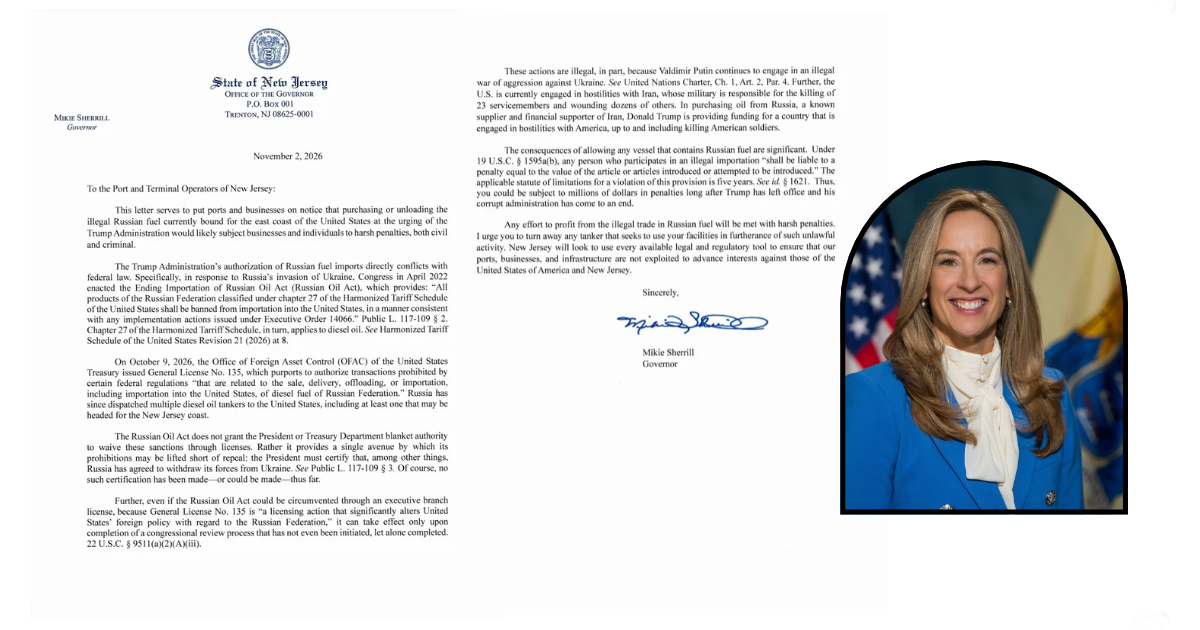
TRENTON, NJ — November 2, 2026 — New Jersey Governor Mikie Sherrill has issued a direct warning to the state’s port and terminal operators against accepting shipments of Russian diesel fuel, arguing that the imports violate federal law and could expose companies to serious civil and criminal penalties.
In a letter sent Monday, Sherrill cautioned businesses involved in importing, unloading, storing, and distributing petroleum products about the legal consequences of participating in a controversial fuel agreement between President Donald Trump and Russian President Vladimir Putin.
The governor’s action comes as Russian diesel tankers approach the United States following the Trump administration’s decision to authorize certain transactions involving Russian fuel.
Sherrill Issues Direct Warning to Port Operators
In a statement published on X on November 2, Sherrill said she had formally notified New Jersey’s port and terminal operators about the risks associated with importing Russian diesel.
She argued that allowing the shipments would undermine American interests and provide additional revenue to Russia while its war against Ukraine continues.
Sherrill, a former Navy helicopter pilot and federal prosecutor, also emphasized the national security implications of the arrangement.
The governor accused Trump of prioritizing his agreement with Putin over the interests of American consumers and U.S. military personnel.
Her warning represents a further escalation in New Jersey’s opposition to the planned shipments, following earlier statements that her administration was examining options to prevent Russian diesel from being unloaded at state ports.
Russian Diesel Tanker Headed Toward New York and New Jersey
The controversy intensified after Reuters reported on October 23 that a tanker carrying approximately 40,000 metric tons of Russian diesel had departed the Russian Baltic port of Primorsk.
The Malta-flagged vessel, Agioi Fanendes, initially listed the Port of New York and New Jersey as its destination, with an expected arrival date of November 7.
However, subsequent vessel-tracking information indicated that its destination had changed to unspecified orders, leaving its final unloading location uncertain.
Additional Russian diesel cargoes have also been reported heading toward the United States under the agreement.
The shipments are part of a broader arrangement announced by Trump in October, intended to increase fuel supplies and address rising diesel prices.
A Legal Dispute Over Russian Energy Imports
At the center of the controversy is the Ending Importation of Russian Oil Act, enacted by Congress in 2022 following Russia’s full-scale invasion of Ukraine.
The legislation prohibits imports of Russian-origin petroleum products, including diesel, subject to statutory conditions governing any restoration of such imports.
In October 2026, the U.S. Treasury Department issued General License No. 135, authorizing certain transactions involving Russian diesel.
The Trump administration maintains that its authorization is legally permissible.
However, Democratic lawmakers and some Republicans argue that an executive license cannot override restrictions established by Congress.
They contend that businesses involved in importing Russian diesel could face legal consequences despite the Treasury Department’s authorization.
The dispute has not been conclusively resolved by a court, making the legality of the proposed imports a contested issue.
Bipartisan Opposition Emerges in Congress
Sherrill is not the only elected official challenging the diesel agreement.
A bipartisan group of federal lawmakers, including Democratic Senators Jeanne Shaheen, Ron Wyden, Sheldon Whitehouse, Chris Coons, and Elizabeth Warren, along with Republican Senator Thom Tillis, has warned banks, port authorities, and fuel distributors against facilitating Russian diesel imports.
In an October 26 letter, the lawmakers raised concerns about potential civil and criminal liability and requested that companies preserve records relating to proposed transactions.
Senator Richard Blumenthal of Connecticut separately called on shipping companies to recall tankers carrying Russian diesel toward American ports.
Opposition has also emerged among New Jersey Republicans.
Congressman Tom Kean Jr., who represents the state’s 7th Congressional District, urged Trump to revoke the authorization, warning that the arrangement could help finance Russia’s war against Ukraine.
The criticism demonstrates that concerns about Russian energy imports extend beyond a single political party.
Could Russian Diesel Lower Fuel Prices?
The Trump administration has presented the agreement as a way to increase diesel supplies and reduce fuel costs for American consumers.
Diesel prices affect transportation companies, farmers, construction businesses, and the distribution of goods throughout the economy.
Higher diesel costs can contribute to rising prices for food and other products because many businesses depend on diesel-powered trucks and equipment.
However, critics question whether the proposed imports would produce meaningful or lasting savings.
They argue that the potential economic benefits must be weighed against national security concerns, existing sanctions legislation, and the possibility of providing additional revenue to Russia.
The actual impact on U.S. fuel prices will depend on shipment volumes, whether American companies accept the cargoes, and broader conditions in global energy markets.
Why New Jersey Ports Matter
The Port of New York and New Jersey is one of the nation’s most important transportation and commercial gateways.
Petroleum terminals on the New Jersey side of the harbor play a significant role in receiving and distributing fuel throughout the northeastern United States.
Any Russian diesel shipment directed toward the region could therefore involve terminal operators, shipping companies, storage facilities, and distributors operating in New Jersey.
Sherrill’s warning places those businesses at the center of a dispute between state officials, federal lawmakers, and the Trump administration.
However, it remains unclear what legal authority New Jersey could use to prevent a shipment authorized by the federal government from entering a port.
Federal law, maritime regulations, customs requirements, and state-level responsibilities could all become relevant if a tanker attempts to unload.
The War in Ukraine Remains Central to the Dispute
Beyond the legal questions, the controversy concerns the financial consequences of renewed American purchases of Russian energy.
Russia continues its war against Ukraine, and energy exports remain an important source of government revenue.
Sherrill and the lawmakers opposing the agreement argue that purchases of Russian diesel could provide Moscow with additional funds while the conflict continues.
The Trump administration, meanwhile, has defended its approach as part of a broader effort to manage energy supplies and reduce fuel prices.
These competing arguments have turned a commercial fuel arrangement into a national political and legal dispute.
What Happens Next?
The immediate question is whether the tankers carrying Russian diesel will be able to find American buyers and unload their cargoes.
Reports indicate that some energy companies have been reluctant to participate because of legal uncertainty, potential congressional investigations, and reputational risks.
The destination of the tanker initially headed toward New York and New Jersey remains uncertain.
Sherrill has not announced a formal port closure or confirmed that any Russian diesel shipment has been blocked.
Her November 2 letter instead puts companies on notice of the legal risks her administration believes they face.
As Russian diesel shipments approach American waters, New Jersey has emerged as a central battleground in a dispute over federal law, energy prices, national security, and the consequences of doing business with Russia during its ongoing war against Ukraine.
Sources: Governor Mikie Sherrill – Official Statement, November 2, 2026; ; ; ; ; .
By NJ RADAR Team