


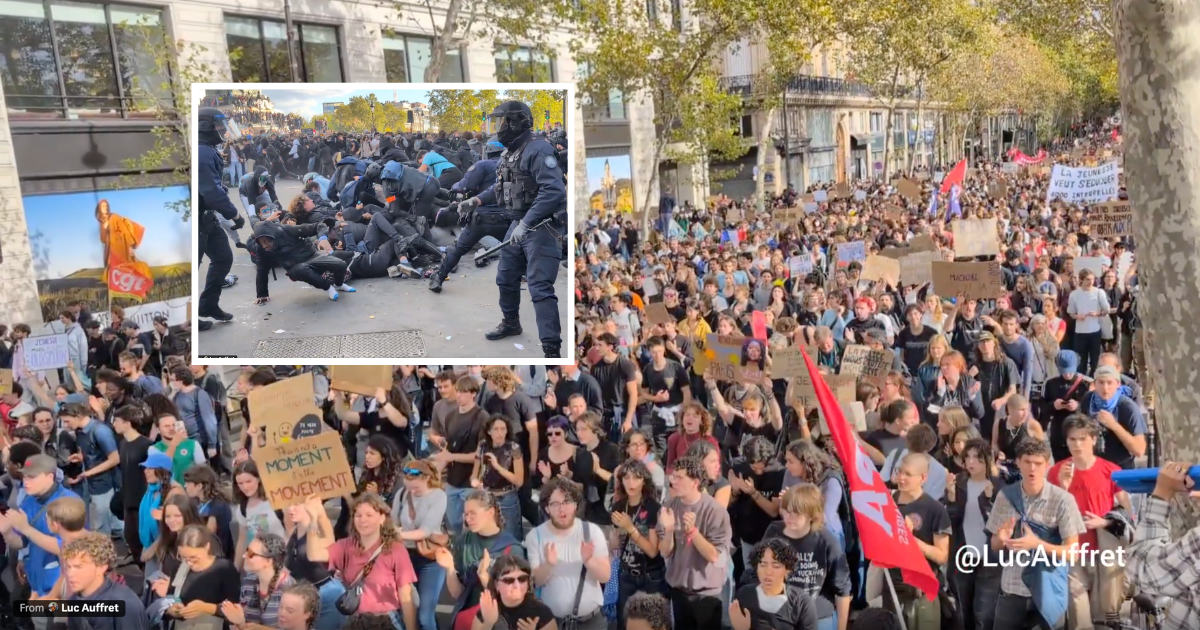
Demonstrations in Lyon, Paris, Nantes, Marseille and other French cities have brought thousands of students into the streets. Videos of confrontations with police are drawing attention to growing tensions over education, government spending and the use of force.
FRANCE — October 13, 2026 — A new wave of demonstrations swept across France on Tuesday as high school and university students continued protesting deteriorating educational conditions, teacher shortages and overcrowded classrooms.
Protests were reported in Lyon, Paris, Nantes, Marseille, Strasbourg, Bordeaux and several other cities, marking another day of nationwide mobilization.
Videos circulating on social media show confrontations between demonstrators and riot police, including scenes of tear gas, officers carrying batons, burning objects and crowds running through streets.
French police have also used water cannons during the wider protest movement, including documented interventions in Paris and Rennes. However, not every circulating video has been independently verified as footage from October 13.
The unrest comes after several weeks of student demonstrations that have developed into one of France’s most significant recent challenges involving education and public order.
Thousands Demonstrate Across French Cities
In Lyon, approximately 11,000 demonstrators participated in Tuesday’s march, according to local authorities.
In Marseille, police reported around 3,800 participants.
Demonstrations and school blockades also took place in Nantes, Strasbourg, Bordeaux, Lens and the Paris region.
The protests have drawn support from students, teachers and education unions.
According to Reuters, approximately 161,000 people participated nationwide on Tuesday, compared with about 266,000 during the previous major mobilization.
Although overall participation declined, demonstrations continued across the country.
Police Use Water Cannons, Tear Gas and Batons
The police response has become one of the most controversial aspects of the protests.
Video footage from recent demonstrations shows riot police advancing toward crowds, using tear gas and deploying water cannons to disperse protesters.
Officers carrying batons have also been photographed during clashes.
Reuters previously documented the use of water cannons in Paris and Rennes, while tear gas was deployed in several cities where demonstrations turned violent.
In Lyon, confrontations on Tuesday included damaged property, street fires and arrests.
French authorities say police interventions are necessary when demonstrations involve vandalism, attacks or threats to public safety.
Students and civil rights advocates, however, have questioned whether some police actions have been proportionate, particularly because many demonstrators are minors.
Not all demonstrations have involved violence. Large numbers of students and teachers have marched peacefully to demand improvements in public education.
Why Are French Students Protesting?
The demonstrations began over longstanding problems in France’s education system.
Students and teachers have complained about overcrowded classrooms, deteriorating buildings, insufficient teaching staff and inadequate school resources.
Some students report attending classes in buildings affected by poor ventilation, damaged facilities and unsanitary conditions.
Teachers have also described shortages of desks, chairs and replacement instructors.
Another major source of frustration is Parcoursup, France’s university admissions system, which some students criticize as stressful and overly restrictive.
The protesters are demanding greater investment in public education and more meaningful government action.
Injuries and Arrests Raise Concerns
The protest movement has also been marked by serious injuries and thousands of detentions.
One particularly disturbing incident involved a 15-year-old student who lost a hand after being struck by a police explosive device.
The injury intensified criticism of crowd-control methods used against young demonstrators.
French authorities have opened internal investigations into several incidents involving police conduct.
The General Inspectorate of the National Police, known as IGPN, has been examining complaints linked to the use of force.
French crowd-control rules require police interventions to be necessary and proportionate, although the application of these principles during violent demonstrations remains disputed.
The combination of injuries, arrests and destruction of property has intensified tensions between demonstrators and security forces.
Government Promises Additional Teachers
France’s government has attempted to reduce tensions by announcing measures intended to address problems in schools.
Education Minister Édouard Geffray has pledged to deploy 3,000 substitute teachers to institutions facing particularly serious staffing shortages.
Officials have also discussed improvements to school schedules, facilities and university admissions procedures.
Student organizations and education unions argue that the proposals remain insufficient.
The government faces difficult financial choices as it attempts to address demands for greater public spending while managing budgetary pressures.
Greta Thunberg Joins Student Demonstrations
The protests received additional international attention Tuesday when Swedish activist Greta Thunberg joined students protesting outside a school in Saint-Denis, near Paris.
Thunberg expressed solidarity with young people demanding better educational conditions and greater influence over decisions affecting their futures.
Her participation highlighted the broader political and social significance of the demonstrations, which have increasingly attracted attention beyond France.
October 17: Another Mobilization Being Planned
The current wave of student demonstrations may be followed by additional protests later this week.
Calls circulating online have encouraged a new mobilization on Saturday, October 17, including participation by supporters of the Yellow Vest movement.
Unlike the student protests, which focus primarily on education, the Yellow Vest movement has historically emphasized rising living costs, fuel prices and purchasing power.
French media have reported plans for renewed gatherings, although the scale of participation remains uncertain.
A Broader Debate Over Protest and Public Order
France has a long tradition of public demonstrations, strikes and political mobilization.
The current movement illustrates continuing tensions between citizens demanding improvements in public services and a government facing pressure to control public spending.
At the same time, the confrontations raise difficult questions about how authorities should respond when demonstrations involve both peaceful participants and violent incidents.
Police are responsible for protecting public safety, but the use of force must also respect legal protections and the rights of demonstrators.
The controversy is particularly sensitive when young people protesting educational conditions become involved in confrontations with heavily equipped riot police.
As demonstrations continue across France, the central question is no longer only whether the government will improve conditions in schools. It is also whether authorities and protesters can find a way forward without further violence, injuries and escalation.
Sources: Reuters | Associated Press | AFP / TV5MONDE | The Guardian | Le Monde | Lyon Capitale | Euronews
By NJ RADAR Team