


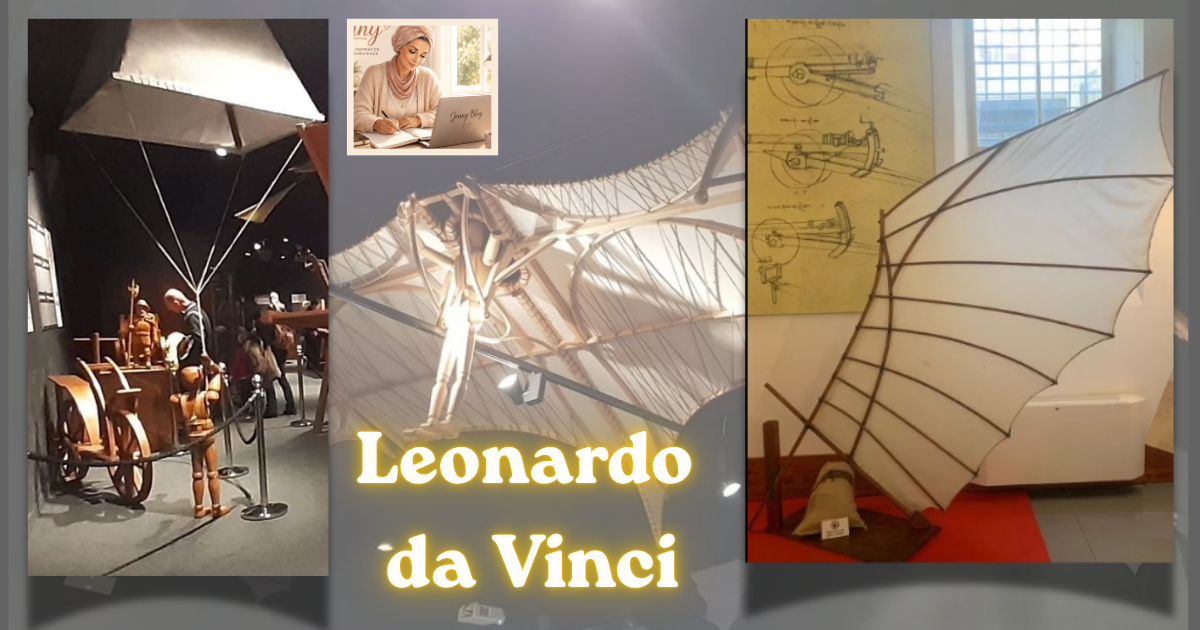
When we hear the name Leonardo da Vinci, most of us immediately think of the Mona Lisa. But Leonardo was much more than a painter. Centuries before the age of modern aviation, he was sketching flying machines, designing an aerial screw that resembles an early concept of the helicopter, and describing a parachute in remarkable detail. His mechanical inventions and automated devices are also associated today with some of the earliest ideas that would eventually lead toward robotics. More than 500 years later, many of his concepts have been reconstructed as working models that can be seen in museums in Florence and they still look surprisingly modern.
More than five centuries ago, long before airplanes crossed the skies, tanks moved across battlefields, or modern machines transformed everyday life, Leonardo da Vinci was already drawing ideas that seemed to belong to another era.
Today, many of those ideas can be seen in Florence, transformed into real three-dimensional models.
I have always been fascinated by Leonardo’s work, and I became even more interested when people who visited the museum in Florence sent me photographs from their visit. Those images inspired me to write this story today.
Museums dedicated to Leonardo da Vinci display functional reconstructions based on drawings from his famous notebooks and codices. They include flying machines, mechanical devices, hydraulic systems, military machines, and many other mechanisms that reveal just how far ahead of his time Leonardo was.
Leonardo was born in 1452 in Vinci, not far from Florence, and is best known around the world as the artist behind the Mona Lisa and The Last Supper. But painting was only one of his extraordinary talents. He was also a visionary, an inventor, and a man deeply interested in science.
He studied anatomy, mathematics, mechanics, water, light, architecture, and flight. He observed birds, analyzed the movement of their wings, and tried to understand whether human beings might one day be able to fly.
On X, I also came across a video of a book in which Leonardo’s inventions rise from the pages as three-dimensional models when the book is opened.
The Dream of Flight
Some of Leonardo’s most fascinating drawings are those of flying machines.
He designed several types of ornithopters — machines with wings intended to imitate the movement of birds — as well as his famous aerial screw, a spiral-shaped device often described as an early concept resembling the modern helicopter.
Leonardo never built a helicopter capable of flying, and the materials and sources of power available in his time probably would not have made such a flight possible. But what is fascinating is that he was already asking the question:
Can a machine lift a human being into the air?
Centuries later, humanity answered: yes.
Leonardo also designed other flying devices, including structures resembling gliders and even a kind of “flying chair,” in which a person would sit or be attached to the structure and control the wings, ropes, pedals, or rudder.
Why Leonardo’s Flying Machines Could Not Take Off
Leonardo was, above all, an artist, inventor, and extraordinary observer of nature — not a physicist in the modern sense of the word.
He could not have known Bernoulli’s equation because Daniel Bernoulli was not born until 1700 — nearly two centuries after Leonardo da Vinci.
Leonardo studied birds and tried to give humans wings that could be powered by their own muscles. That was one of the main problems with his flying machines: human muscles simply cannot produce enough power relative to body weight to allow a person to fly by flapping large wings like a bird.
Throughout history, many people tried to imitate birds. From the ancient myth of Icarus to real experiments with artificial wings, humans long believed that perhaps all they needed was a pair of wings and enough strength to move them.
But the key was never for humans to become as strong as birds.
A thought often attributed to Jules Verne says that humanity would not fly through the strength of its muscles, but through the strength of its mind.
The real key was understanding why a bird can fly in the first place.
Later studies of birds, especially the shape and angle of their wings, helped humans understand that wings do not have to flap in order to generate lift. A wing moving through the air, because of its shape and angle of attack, creates a different pressure distribution around it.
The difference in pressure between the lower and upper surfaces of the wing contributes to the upward force we call lift. At the same time, the wing redirects airflow downward.
Only when humans began to understand aerodynamics, wing shape, and the way air moves around a wing did the real path toward powered flight begin to open.
Leonardo did not have those equations. He did not have an engine capable of providing his machines with the necessary power.
What he did have was something else — an extraordinary ability to observe and a mind that was asking the right questions centuries before modern aerodynamics existed.
A Parachute Designed Centuries Before Modern Parachuting
Leonardo did not think only about how humans might rise into the air. He also considered how they might return safely to the ground.
He drew a pyramid-shaped parachute and left a remarkably precise description with it. He wrote that if a person had a piece of linen cloth measuring 12 braccia in width and 12 braccia in height, that person should be able to jump from a great height without being injured.
For someone living in the 15th century, this was an extraordinarily bold and specific idea.
Even more remarkable is that Leonardo did not simply sketch a shape. He tried to determine the dimensions needed for such a device to support the weight of a human being. This shows that he was not merely dreaming about flight — he was trying to turn his ideas into real mechanical problems that could be solved.
A Machine That Resembled a Tank
Leonardo also drew an armored vehicle with a circular protective covering and weapons positioned around it.
This design is often referred to today as Leonardo’s armored tank.
It was not a direct predecessor of the modern tank, but the idea of an enclosed, protected, mobile military vehicle was highly unusual for his time.
Machines, Gears, and Motion
Leonardo was particularly fascinated by something even more fundamental: how motion is created and transferred.
His notebooks are filled with drawings of gears, screws, bearings, pulleys, and different systems designed to transfer movement from one part of a machine to another.
That is exactly why museums dedicated to Leonardo are so fascinating. A drawing that may look complicated on paper suddenly becomes much easier to understand when it is transformed into a real machine that visitors can see, touch, or operate.
In Florence today, visitors can see numerous reconstructions of his ideas — from flying machines, parachutes, and the aerial screw to mechanical drums, hydraulic devices, and armored vehicles.
He Did Not Literally Invent Everything We Use Today
Stories about Leonardo sometimes go too far and describe him as the literal inventor of the helicopter, airplane, tank, and many other modern technologies.
The reality is actually even more interesting.
Many of his machines were never built during his lifetime, and some could not have worked without technologies that would not be developed until centuries later. But his drawings reveal an extraordinary ability to imagine mechanical solutions long before humanity had the means to turn them into reality.
Leonardo did not look only at the world as it was.
He was constantly asking what it could become.
Walking Through Leonardo’s Mind
Perhaps that is the most fascinating part of visiting a Leonardo museum in Florence.
Drawings that are more than five centuries old become three-dimensional objects standing right in front of you.
A wooden flying machine, a parachute, large gears, or mechanical systems suddenly reveal that Leonardo’s notebooks were not merely collections of artistic sketches. They were the laboratory of a man trying to understand nature, motion, and technology.
And perhaps that is exactly why Leonardo da Vinci still fascinates us today.
He painted some of the most famous works in human history, but at the same time he spent his life trying to answer questions that science and engineering would continue exploring for centuries after his death.
Leonardo did not leave humanity only the Mona Lisa, with her mysterious gaze that seems to follow us from almost every angle. He also left us an entire world of ideas, from simple mechanisms to complex machines, from flying devices to parachutes, as if he were already trying to invent what humanity would need centuries later.
By Jenny