


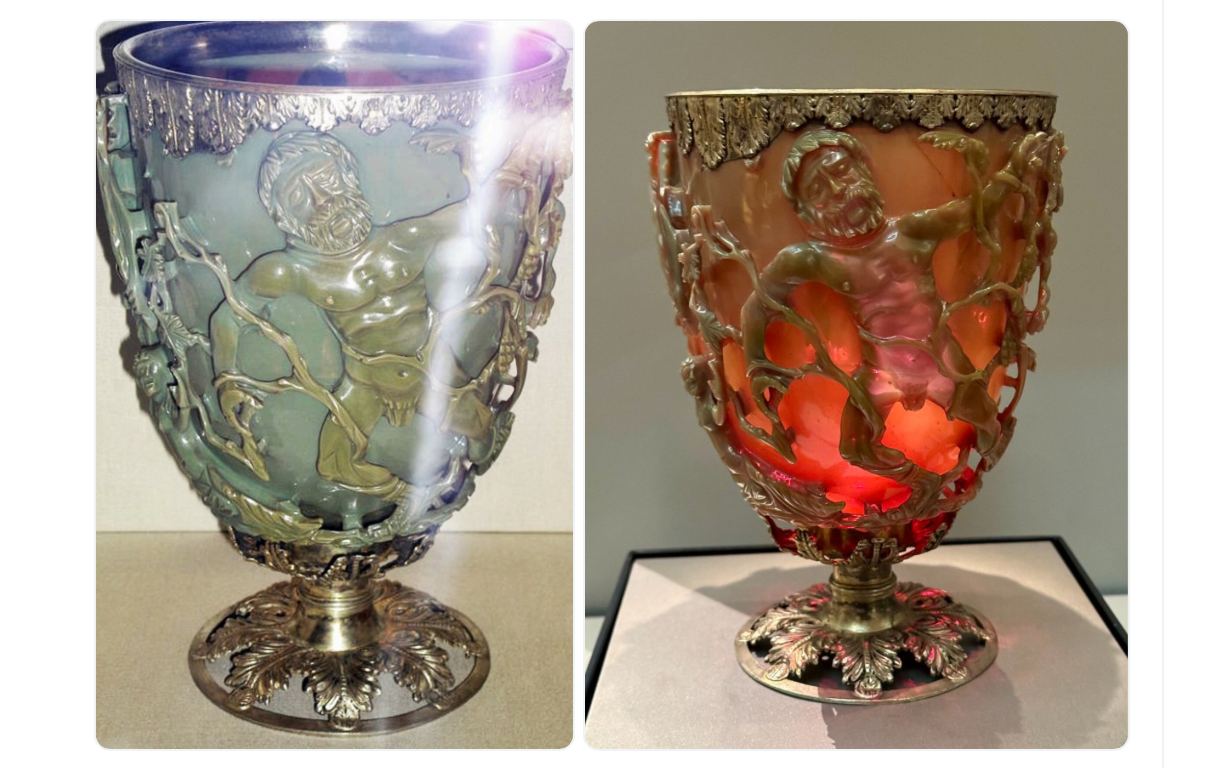
More than 1,600 years ago, Roman glassmakers created an object that still surprises scientists today. The Lycurgus Cup can appear jade green under one kind of lighting and glow ruby red under another — all because of particles so small they are measured in nanometers.
The Lycurgus Cup, made in the 4th century and now held by the British Museum, is one of the most remarkable surviving examples of ancient Roman glassmaking.
When light shines onto the front of the cup, the glass appears green. But when light passes through it from behind, the cup turns a deep ruby red.
For centuries, the reason for this dramatic color change remained unclear.
Modern analysis revealed that the glass contains extremely tiny particles of gold and silver, some measuring only tens of nanometers across. At that scale, metals interact with light very differently than they do in larger pieces.
The effect is linked to the way electrons in the metal nanoparticles respond to incoming light, a phenomenon related to surface plasmon resonance. Depending on how the cup is illuminated, different wavelengths of light are absorbed, scattered or transmitted, producing the striking shift between green and red.
In other words, Roman artisans were creating a material with properties that today would be studied under the field of nanotechnology.
Scientists published a detailed analysis of the cup in 1990, showing that its unusual optical behavior was caused by the tiny metallic particles embedded in the glass.
What remains less certain is whether Roman glassmakers fully understood why the effect worked.
They clearly possessed extraordinary glassmaking skills, but researchers still debate whether they deliberately controlled particles at such a tiny scale or whether the effect emerged through carefully developed craftsmanship and experimentation.
Either way, the result is remarkable.
The Lycurgus Cup shows that ancient artisans were capable of producing materials with highly sophisticated optical properties nearly two millennia before modern scientists developed the language and tools used to describe them.
Sometimes, history reminds us that technology can exist long before anyone fully understands the science behind it.
Sources: British Museum, scientific studies on the Lycurgus Cup, Earth Curated on X
By NJ RADAR Team