


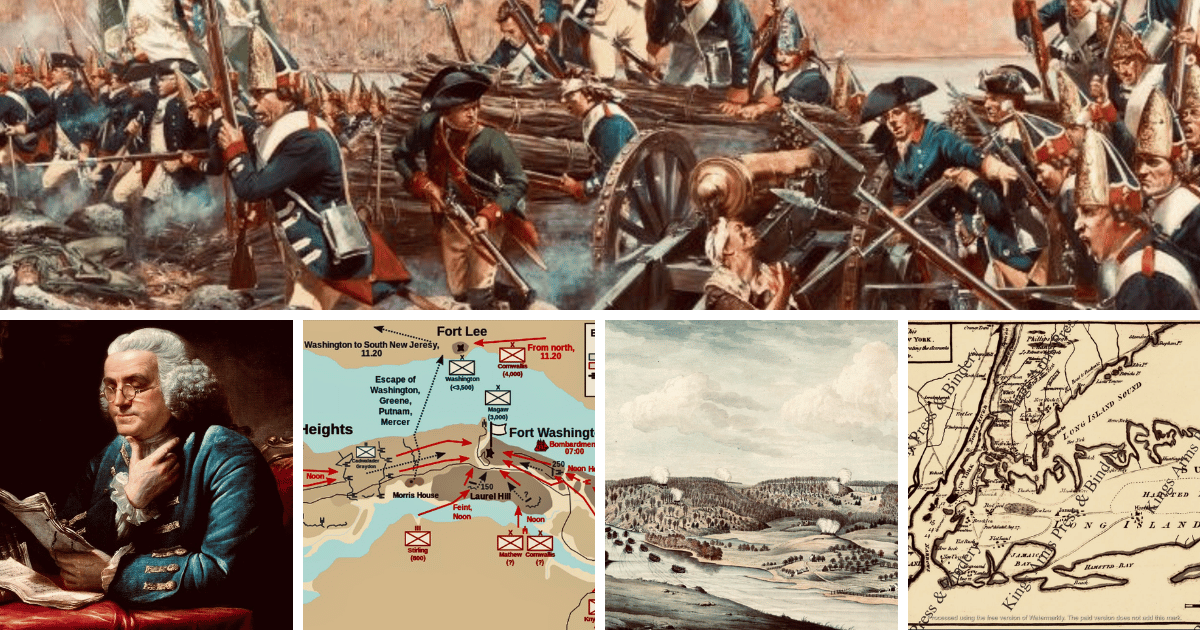
FORT LEE, NJ — On November 16, 1776, British and Hessian forces captured Fort Washington, the last major American stronghold on Manhattan. Across the Hudson River, at a military outpost known as Fort Lee, the defeat set in motion a desperate retreat that would take George Washington’s army across New Jersey and eventually lead to some of the most important victories of the American Revolution.
Exactly 250 years later, the two sides of the Hudson are commemorating events that remain closely connected in American history.
On Sunday, November 15, Fort Tryon Park in Manhattan hosted a reenactment of the Battle of Fort Washington, featuring soldiers in 18th century uniforms, blacksmith demonstrations, historical music and battlefield activities.
The anniversary itself falls on Monday, November 16, but the story does not end in Manhattan. Four days after Fort Washington fell, British forces crossed the Hudson and forced American troops to abandon Fort Lee, beginning one of the most difficult retreats of the Revolutionary War.
Before Fort Lee Had Its Name
In July 1776, only weeks after the Declaration of Independence, American forces began building defensive positions along the cliffs overlooking the Hudson River in what is now Fort Lee.
The fortification was originally called Fort Constitution.
By the end of September, it had been renamed Fort Lee in honor of Major General Charles Lee, one of the senior officers of the Continental Army.
Across the river, on the high ground of northern Manhattan, stood Fort Washington, named for the commander of the American forces.
The two forts were intended to work together, using artillery and defensive positions on opposite banks to challenge British naval movements along the Hudson.
Control of the river was crucial. British commanders hoped to secure New York and the Hudson corridor, potentially separating New England from the other American colonies.
But the defenses proved unable to prevent British warships from passing, and the American position became increasingly vulnerable as British forces gained control of New York City.
November 16, 1776: The Fall of Fort Washington
The British launched their assault on Fort Washington with a force that greatly outnumbered the American defenders.
Attacking from multiple directions, British and Hessian troops overwhelmed the fort’s outer defenses and forced the Americans to retreat toward the main position.
Colonel Robert Magaw, who commanded the garrison, eventually surrendered.
Approximately 2,800 American soldiers were captured, making the defeat one of Washington’s most devastating setbacks of 1776.
Washington had crossed from New Jersey toward Manhattan that morning to assess the situation, but he returned to the western bank as the attack unfolded.
The loss of Fort Washington left Fort Lee exposed.
Without the American stronghold across the river, the remaining defensive position in New Jersey became increasingly difficult to hold.
Four Days Later, Fort Lee Was Abandoned
On November 20, British forces under General Charles Cornwallis crossed the Hudson River and advanced toward Fort Lee.
The Americans were in danger of being trapped.
Major General Nathanael Greene ordered the evacuation of the fort, and Washington’s forces began withdrawing before the British could surround them.
The retreat was hurried. Soldiers abandoned artillery, tents, ammunition, food and other valuable supplies.
The British captured the position, but the Continental Army escaped.
That distinction proved crucial. Although Washington lost the forts and much of his equipment, he preserved enough of his army to continue fighting.
The retreat carried American troops through Bergen County toward the crossing at New Bridge over the Hackensack River, then farther across New Jersey and eventually into Pennsylvania.
The events demonstrated how close the American struggle for independence had come to failure only months after the Declaration of Independence was signed.
From Defeat to Victory
Washington’s retreat across New Jersey was marked by exhaustion, shortages of supplies, uncertainty and declining morale.
The British pursued the Americans, while the Continental Army struggled to remain intact.
Yet the campaign did not end in defeat.
On the night of December 25, 1776, Washington led his troops across the Delaware River and launched a surprise attack against Hessian forces at Trenton the following morning.
The victory at Trenton, followed by another American success at Princeton in early January 1777, helped restore confidence in the revolutionary cause.
The road to those victories had begun with the difficult withdrawal from Fort Lee.
For that reason, the retreat is remembered not merely as an American defeat but as part of the campaign that helped preserve the Continental Army during one of its most dangerous moments.
Fort Lee Prepares to Mark 250 Years of History
Today, Fort Lee Historic Park occupies the cliffs where American soldiers once defended the Hudson.
Visitors can explore reconstructed military positions, soldiers’ huts, artillery displays and a visitor center overlooking the George Washington Bridge and Manhattan.
The park preserves a landscape that connects the modern borough with the earliest years of American independence.
This weekend, November 21 and 22, Fort Lee and Historic New Bridge Landing will host special events commemorating the 250th anniversary of the retreat.
The programs, organized with historical associations and park agencies, will include Revolutionary War reenactors, military demonstrations, period activities and commemorative marches.
On Saturday, November 21, activities are planned at Fort Lee Historic Park, including reenactments and historical presentations.
On Sunday, November 22, the commemoration continues at Historic New Bridge Landing in River Edge, where reenactors will recreate the movement of Washington’s troops across the Hackensack River.
The two days will bring attention not only to the military events of 1776 but also to the communities and roads that became part of the Continental Army’s escape.
Two Forts, One Historic Turning Point
Fort Washington and Fort Lee are now separated by the busy waters of the Hudson and connected by the George Washington Bridge.
In 1776, they were part of the same American defense strategy.
The fall of one led directly to the abandonment of the other, setting off a retreat that carried Washington’s army across New Jersey at a moment when the future of American independence remained uncertain.
Two and a half centuries later, the anniversary offers an opportunity to remember that Fort Lee’s importance in American history is not limited to its name or its surviving historic landscape.
It was here, above the Hudson River, that a defeated army began a retreat that helped make its later victories possible.
Sources: American Battlefield Trust; Palisades Interstate Park Commission; Fort Tryon Park Conservancy; Bergen County Historical Society; Crossroads of the American Revolution; Bergen County Government; Brigade of the American Revolution.
By NJ RADAR Team