


WASHINGTON, DC — Thousands of canceled flights, stranded passengers, disrupted travel plans and crowded airport terminals were the consequences of a nationwide air traffic shutdown that brought much of America’s aviation system to a standstill on Friday, November 13.
Two days later, as airlines continued struggling to restore normal schedules, Transportation Secretary Sean Duffy faced a direct question about responsibility.
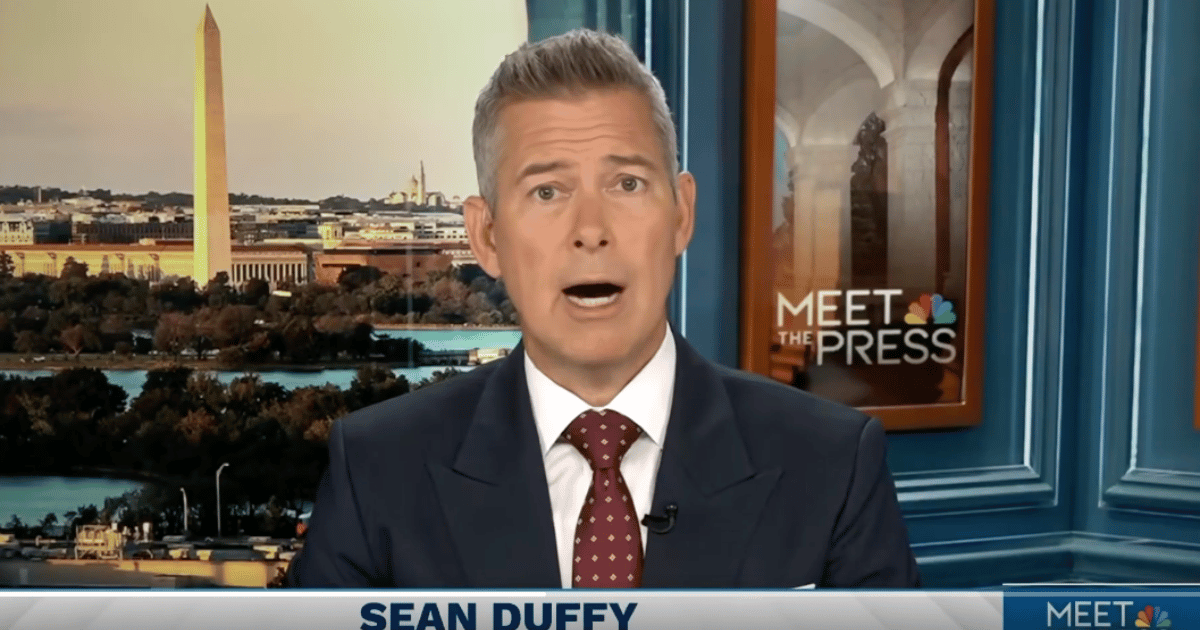
During an interview on NBC’s Meet the Press on Sunday, November 15, host Kristen Welker asked whether he owed the American people an apology for a crisis that occurred during his tenure.
“I can’t apologize for what was passed off to us,” Duffy replied.
His response shifted attention from the technical failure itself to a broader debate over who should be held accountable when a federal system fails on such an extraordinary scale.
Four Hours That Disrupted Air Travel Across America
The Federal Aviation Administration ordered a nationwide ground stop Friday afternoon after instability in its telecommunications network began affecting radar information and communications used by air traffic controllers.
The disruption spread across 17 of the FAA’s 22 regional air traffic control centers and affected additional facilities responsible for managing aircraft near airports.
For more than four hours, departures across the country were largely suspended while approximately 3,500 aircraft already in the air continued to land safely.
The FAA lifted the restriction at 8:15 p.m. Eastern, but reopening American airspace did not immediately restore airline operations.
Aircraft were left at the wrong airports, flight crews were displaced, and airlines faced the difficult task of rebuilding schedules that had been disrupted across the entire country.
According to the FAA’s November 15 update, approximately 12,462 flights were canceled on Friday. The agency cautioned that not all those cancellations could be attributed directly to the ground stop.
The disruption continued through the weekend, affecting major airports including Newark Liberty International, JFK, LaGuardia, Atlanta and Chicago O’Hare.
By Sunday, airlines were still dealing with cancellations and delays, although officials expected operations to return to full capacity by Sunday evening or Monday.
Duffy Points to Problems Inherited From Previous Administrations
Asked whether he owed passengers an apology, Duffy defended his department’s response and argued that the underlying technological problems long predated his leadership.
He said the nation’s air traffic control system had suffered from decades of insufficient investment and continued relying on obsolete communications equipment.
The secretary has repeatedly called on Congress to provide additional funding for a comprehensive modernization program.
His argument is that the Trump administration inherited an aging system whose weaknesses had accumulated under both Democratic and Republican administrations.
That explanation raises a distinction between responsibility for creating a problem and responsibility for managing it once it occurs.
While much of the infrastructure predates the current administration, the FAA and the Department of Transportation remain responsible for maintaining safe operations, overseeing contractors and responding to failures.
The question facing federal officials is therefore not only why the system became outdated, but also why a technical problem at a remote facility could spread across the national airspace network.
Investigators Focus on Equipment in Arkansas and Texas
The FAA’s preliminary findings point to excessive data traffic that overwhelmed portions of its older telecommunications network.
Investigators identified two locations of particular interest: a communications facility in El Dorado, Arkansas, and a radar site in Amarillo, Texas.
Contractor L3Harris had been replacing equipment at the Arkansas facility as part of the transition from older copper connections to newer technology.
According to the FAA, the network received approximately 1,000 connection attempts every four to five seconds, creating instability in communications and radar feeds.
Federal officials disabled certain router functions to stabilize the system and prevent the problem from spreading.
The precise technical cause remains under investigation.
The FAA has reported no evidence of a cyberattack, and officials emphasized that existing safety procedures allowed aircraft already in flight to land safely.
Who Takes Responsibility When a National System Fails?
Duffy’s refusal to apologize has added a political dimension to an incident that already raised serious questions about the reliability of American aviation infrastructure.
The secretary argues that the system requires substantial investment and that Congress must provide the resources needed to replace aging equipment.
The administration has requested roughly $30 billion in additional modernization funding, building on $12.5 billion already approved by Congress.
But funding is only part of the discussion.
The shutdown also raises questions about technical safeguards, contractor oversight, equipment testing and the ability to prevent a problem at one facility from affecting operations nationwide.
For millions of Americans who depend on air transportation, the immediate issue is not which administration originally purchased the equipment.
It is whether the government can identify the failure, correct the vulnerability and prevent another nationwide disruption.
The FAA says its system is now stable and that the safety of passengers was never compromised during Friday’s emergency.
Still, the incident demonstrated how quickly a technical failure could spread through an essential national transportation network.
The disruption may have lasted only a few hours, but the questions it raised about government accountability, aging infrastructure and the reliability of American air travel are likely to remain long after flight schedules return to normal.
Sources: Federal Aviation Administration, November 15, 2026; U.S. Department of Transportation; NBC News, Meet the Press, November 15, 2026; Associated Press; ABC News; CNN; FlightAware.
By NJ RADAR Team