


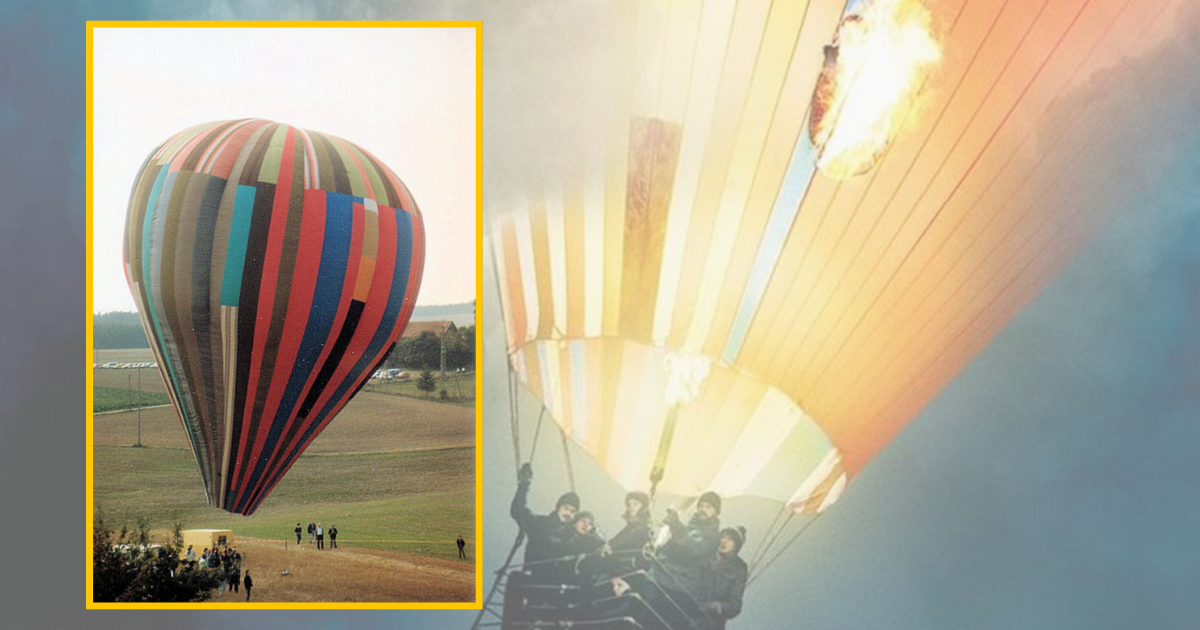
On September 16, 1979, two East German families carried out one of the most remarkable escapes of the Cold War — crossing the heavily guarded border into West Germany in a homemade hot-air balloon.
The Strelzyk and Wetzel families, eight people in total, had secretly spent months designing and building their balloon in the East German town of Pößneck in Thuringia. Peter Strelzyk and Günter Wetzel studied aerodynamics and experimented with homemade burners, while the balloon itself was sewn from more than 1,200 square meters of fabric purchased in small quantities from different locations to avoid attracting attention.
It was not their first attempt. An earlier flight in July 1979 failed just short of the border, forcing the Strelzyk family to abandon the balloon and return home without being detected. East German authorities later found the balloon and began searching for those responsible.
Despite the danger, the two families tried again.
During the night of September 15–16, favorable winds gave them their chance. The eight adults and children climbed onto a small metal platform beneath the balloon and took off from near Oberlemnitz.
Their nighttime flight lasted only 28 minutes, but it carried them approximately 18 kilometers across the border. The balloon climbed to roughly 2,000 meters — about 6,500 feet — before eventually losing altitude and landing near Naila, Bavaria, in West Germany.
At first, they did not know whether they had actually crossed the border. Peter Strelzyk and Günter Wetzel went looking for signs of where they had landed and encountered West German authorities.
Their question was simple: Were they in the West?
When they learned that they were indeed in West Germany, the escape was finally over.
The successful balloon flight became international news and embarrassed East Germany’s security services, which subsequently intensified efforts to prevent similar escapes.
More than four decades later, the story remains one of the most extraordinary examples of the lengths ordinary families were willing to go to cross the Iron Curtain in search of freedom.
Sources: German Federal Archives | Haus der Bayerischen Geschichte | Museum of Bavarian History
By NJ RADAR Team