


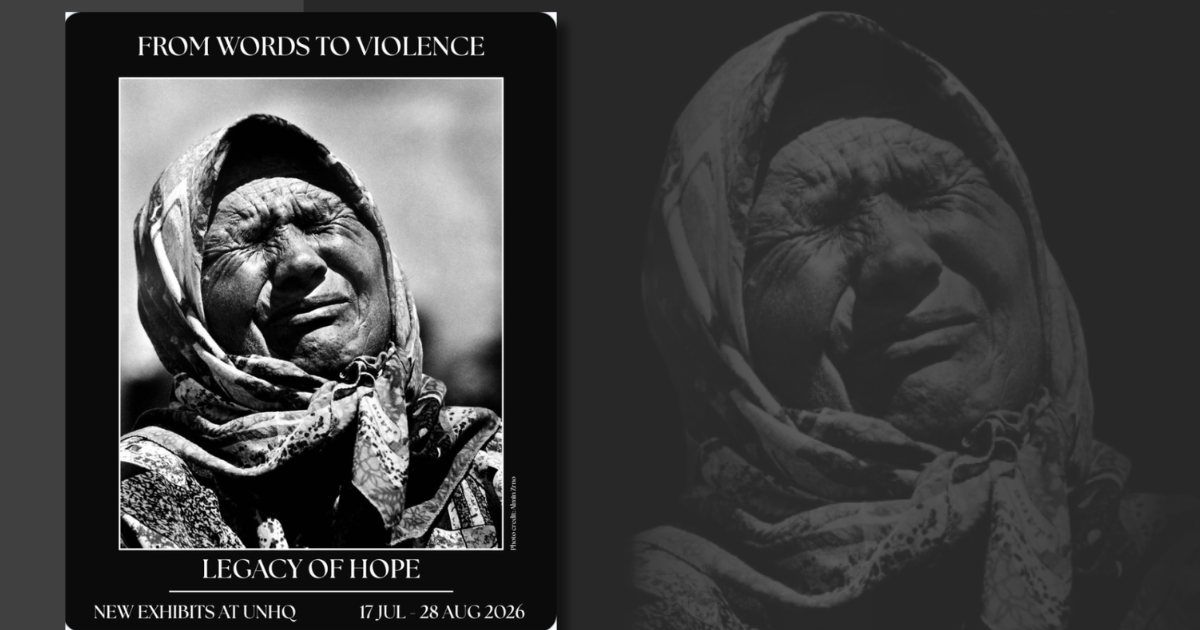
Those who have not yet visited the Srebrenica genocide exhibitions at United Nations Headquarters in New York still have a few days left. Two exhibitions, “From Words to Violence: Lives Behind the Fields of Death” and “Legacy of Hope After the 1995 Genocide in Srebrenica: A New Generation’s Journey,” have been on display since July 17 and will remain open through August 28, 2026, in the Visitors’ Lobby at United Nations Headquarters in New York City.
The exhibitions are free and open to the public.
From everyday objects to lives that were lost
“From Words to Violence” tells the story of the genocide committed against Bosnian Muslims in Srebrenica in July 1995 through photographs of ordinary personal belongings.
The objects themselves are simple, but the stories behind them are not.
They represent people who had families, homes, plans and everyday lives before war and genocide tore those lives apart. The exhibition places those individual stories at the center, rather than allowing the victims to be remembered only as numbers.
More than 8,000 Bosniak men and boys were killed after Bosnian Serb forces overran the UN-declared safe area of Srebrenica in July 1995. International courts later ruled the killings to be genocide.
But the exhibition also focuses on something that happened before the killings: words.
It examines how hate speech, dehumanizing language and indifference can create an environment in which violence becomes possible.
The United Nations describes hate speech as an important warning sign because language that portrays other human beings as inferior, dangerous or unworthy can gradually remove the moral barriers that normally prevent violence.
In its recent post about the exhibition, the United Nations said it offers a powerful look at the horrors of the Srebrenica genocide while highlighting the devastating consequences of hate speech and the cost of silence in the face of hatred.
A second exhibition looks toward the next generation
Beside the story of loss is another exhibition with a different focus.
“Legacy of Hope After the 1995 Genocide in Srebrenica: A New Generation’s Journey” tells the personal stories of eight young people who either survived the genocide as children or were born in its aftermath.
Through photographs and their own words, they describe what it means to grow up carrying the memory of Srebrenica while choosing to build lives centered on remembrance, compassion and peace.
Their stories bring another dimension to the exhibition.
Srebrenica is not only the story of what happened in July 1995. It is also the story of the people who survived, the families who spent decades searching for the remains of loved ones, and a new generation now working to make sure those lives are remembered.
The Flower of Srebrenica is also at UN Headquarters
Visitors to United Nations Headquarters can also see the permanent Flower of Srebrenica Memorial in the UN Garden.
The memorial, unveiled in November 2025, consists of 11 white marble petals surrounding a green center. The 11 petals represent July 11, the date the United Nations General Assembly designated as the International Day of Reflection and Commemoration of the 1995 Genocide in Srebrenica.
The white symbolizes the innocence of the victims, while the green represents hope, life and renewal.
Only a few days remain
Both temporary exhibitions close on Friday, August 28.
For those living in New Jersey or the New York metropolitan area who have wanted to see them but have not yet gone, there is still time.
The exhibitions are located in the Visitors’ Lobby at United Nations Headquarters in New York City and are intended not only as a memorial to those who were killed, but also as a lesson about what can happen when hatred is normalized and silence replaces resistance.
Thirty-one years after Srebrenica, the photographs, objects and testimonies carry a message that reaches far beyond Bosnia and Herzegovina:
Remembering the victims also means recognizing the warning signs that came before the violence.
Sources: United Nations, Srebrenica Memorial Center; United Nations / X (@UN)
By NJ RADAR Team