


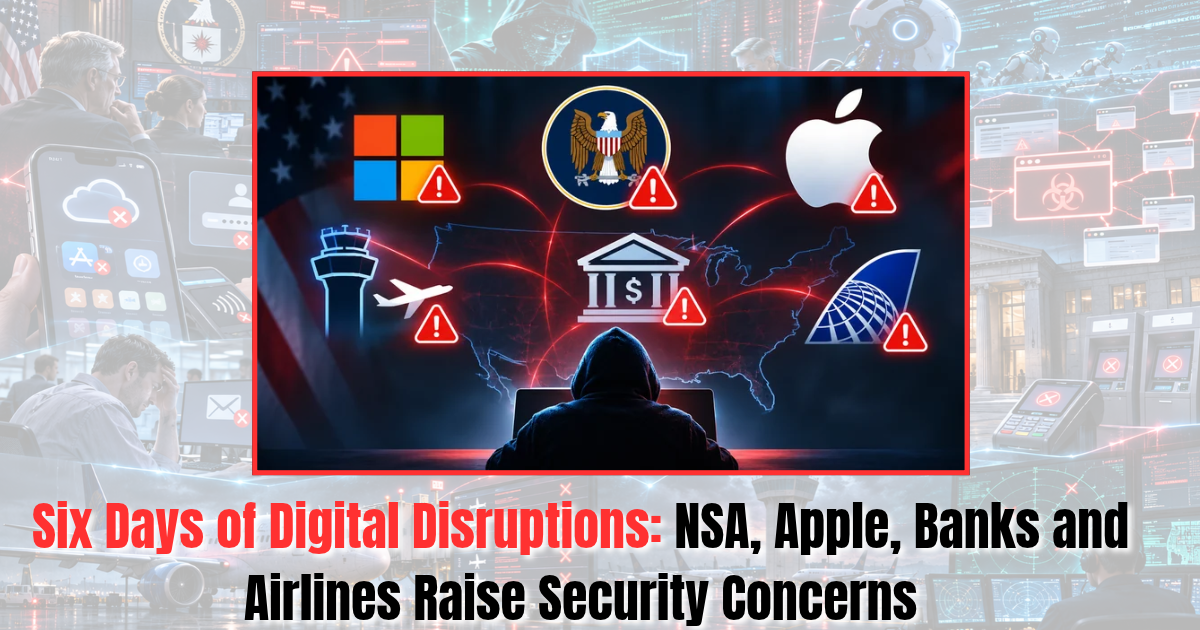
WASHINGTON, D.C. — November 17, 2026 — A remarkable series of technology failures and cybersecurity developments has unfolded in just six days, disrupting essential services across the United States and raising questions about the resilience of the country’s digital infrastructure.
From Microsoft and Apple outages to grounded aircraft, delayed banking transactions and problems with the National Security Agency’s classified communications network, the incidents have affected both private companies and government institutions.
At the same time, cybersecurity researchers have uncovered a genuine software supply-chain attack involving websites used by millions of people, while the FBI and Google have issued warnings about increasingly sophisticated AI-powered hacking tools.
The timing has fueled speculation about possible connections between the incidents. However, investigators have not established evidence of a coordinated attack linking the disruptions.
November 12–13: Microsoft and the FAA
The series began November 12, when Microsoft experienced a major disruption affecting Outlook, Teams and other Microsoft 365 services. Users across more than 70 countries reported problems accessing email and workplace communication tools.
The following day, a telecommunications failure involving Federal Aviation Administration systems triggered a nationwide ground stop, delaying or canceling thousands of flights.
Federal officials attributed the aviation disruption to technical problems involving network equipment and aging infrastructure, with no evidence of malicious activity.
November 16: Banks, Airlines and a Major Cyberattack
On Monday, November 16, customers of several major U.S. banks experienced difficulties accessing accounts and processing transactions.
JPMorgan Chase acknowledged a technical problem that delayed some transactions.
United Airlines experienced a separate system failure that temporarily interrupted departures across its network. The airline subsequently reported that operations had resumed.
But another development that day was fundamentally different from those operational failures.
Cybersecurity researchers discovered malicious JavaScript embedded in files distributed through Optimizely, a widely used website optimization platform.
Researcher Scott Helme and his team at Report URI identified 188 affected scripts associated with 178 organizations.
Websites associated with CNN, BBC, Zoom, Fox News, Salesforce and GitLab were among those affected.
Unlike the unexplained service disruptions, this incident involved an identified malicious software supply-chain attack.
The injected code was designed to steal cryptocurrency and payment information and potentially exploit vulnerabilities affecting Apple devices.
The number of visitors actually compromised, and the extent of any stolen information, have not been fully established.
November 17: NSA and Apple Experience Disruptions
On Tuesday, CNN reported that NSA Net, the highly classified internal communications network operated by the National Security Agency, had experienced an outage.
The network allows agency employees to exchange classified information.
Later reports from CBS News and the Associated Press indicated that the disruption occurred during routine system maintenance or software patching.
Officials reported no evidence of a cyberattack, and backup communications remained available for critical intelligence functions.
That same day, Apple experienced problems involving several of its services, including iCloud Account & Sign In, the App Store, Apple Music and AppleCare.
Apple acknowledged service disruptions through its official System Status page. Customers reported difficulties signing into accounts, accessing applications and using other services.
FBI and Google Warn About AI-Powered Cyberattacks
Alongside the service disruptions, federal authorities and cybersecurity researchers issued warnings about another developing threat.
The FBI described how hackers have used an open-source AI-powered tool called Artex to automate parts of cyberattacks, with some network intrusions reportedly taking less than three hours.
The bureau identified financial institutions, government agencies, technology companies and defense-related organizations among the sectors targeted by attackers using such tools.
Google’s Threat Intelligence Group also published findings on November 16 showing that malicious actors are increasingly using autonomous AI systems to identify vulnerabilities, exploit weaknesses and conduct multi-stage intrusions.
Google warned that more sophisticated, fully autonomous cyberattacks could emerge within months.
These findings concern the evolving cyber threat landscape. Neither warning establishes that AI-powered hackers caused the recent Apple, Microsoft, FAA, banking or NSA outages.
Coincidence, Cyberattacks or Infrastructure Weakness?
The concentration of incidents within six days has generated considerable public concern.
Some social media commentators have suggested that the disruptions could represent coordinated activity by criminal organizations or foreign governments. Others have circulated theories about deliberate operations intended to justify expanded control over artificial intelligence.
Neither scenario has been supported by verified evidence connecting the incidents.
The distinction matters.
The Optimizely incident was an actual malicious cyberattack. The FBI and Google reports document significant cybersecurity threats. But the NSA, Microsoft, aviation, banking and Apple disruptions have not been established as parts of the same operation.
A series of unrelated failures can still expose weaknesses in digital infrastructure.
Critical systems increasingly depend on complex software, third-party providers, telecommunications networks and automated processes. Errors in one component can interrupt services far beyond the original point of failure.
The events of the past six days raise an important public question: Are America’s most essential digital systems sufficiently prepared for technical failures and increasingly sophisticated cyber threats?
The answer requires transparent investigations, reliable technical evidence and effective safeguards—not assumptions about causes that have yet to be established.
For now, the confirmed facts are significant enough: essential systems have experienced repeated disruptions, a major software supply-chain attack has exposed vulnerabilities across prominent websites, and security agencies are warning that the tools available to cybercriminals are rapidly evolving.
Sources: CNN; Reuters; Associated Press; CBS News; BleepingComputer, November 16, 2026; TechCrunch, November 16, 2026; Google Threat Intelligence Group, November 16, 2026; Apple System Status; 9to5Mac.
By NJ RADAR Team