


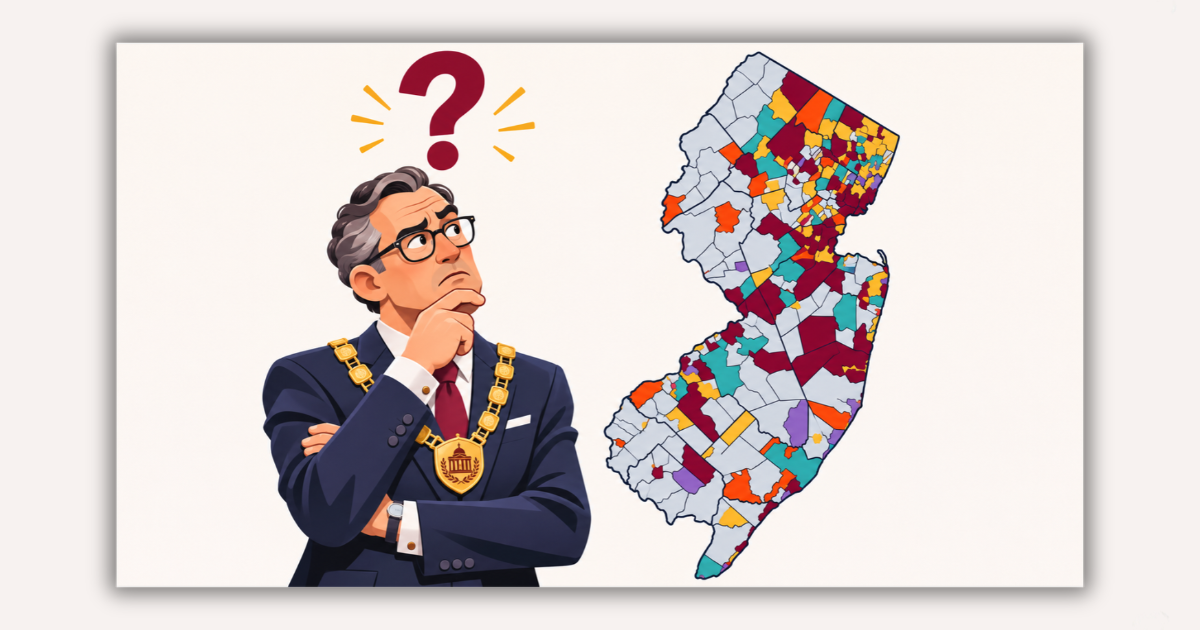
How Powerful Are New Jersey Mayors, Really? Does the title mayor always mean the same thing? What does it actually mean to be a mayor in New Jersey?
A map illustrating the legal powers of New Jersey mayors uses different colors to represent different levels of authority. But does legal authority necessarily translate into political influence? Can a mayor with extensive powers have little influence in practice? And can a mayor whose legal authority is limited become the most powerful person in town?
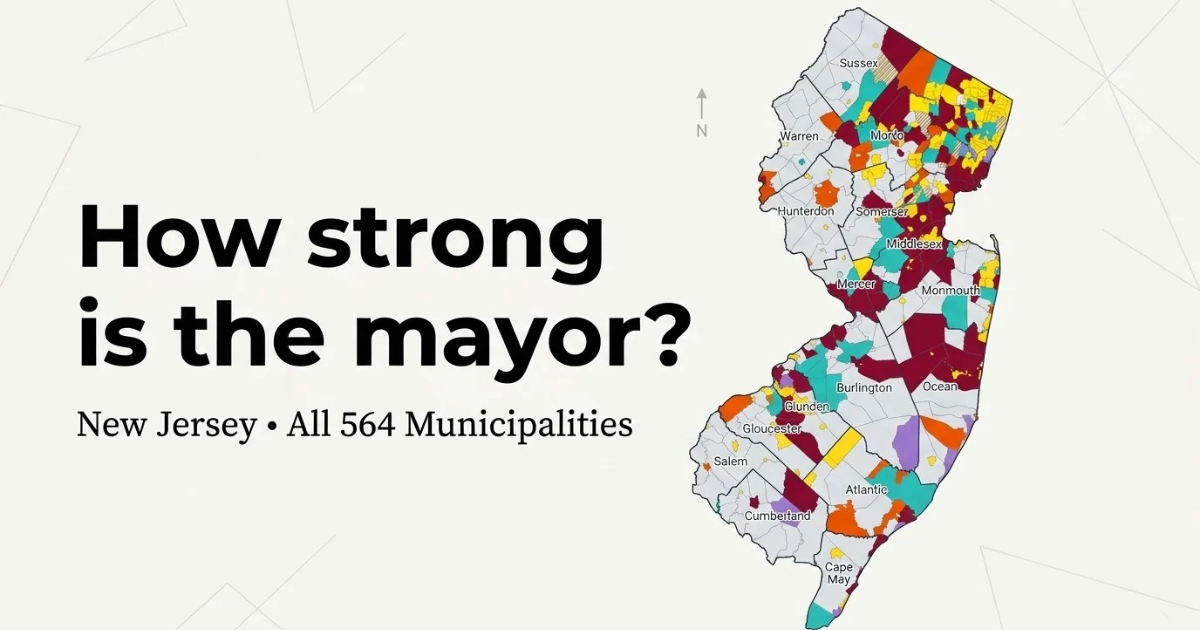
The complexity of New Jersey’s local government becomes apparent in its structure. The state has 564 municipalities across 21 counties, operating under different forms of government that determine how power and responsibility are divided among mayors, municipal councils, and administrators. Some mayors oversee municipal operations and have veto power, while others play a much more limited executive role. Yet the actual balance of power does not always follow those legal distinctions.
Knowing what the law allows is not enough. The real question is: Who actually makes the decisions?
Five Municipal Types, Twelve Forms of Government
New Jersey has 564 municipalities spread across 21 counties. Each is formally classified as a borough, township, city, town, or village, but those labels reveal little about how its government actually works.
According to the New Jersey State League of Municipalities, local governments operate under 12 different statutory forms. Two neighboring municipalities with the same designation may have entirely different divisions of power. The form of government determines who prepares and proposes the budget, appoints department heads, makes decisions about local projects, and carries them out.
The principal forms include:
- Faulkner Act Mayor-Council: The mayor has broad executive authority, oversees municipal administration, participates in preparing the budget, and can veto council decisions. Under certain conditions, the council can override that veto.
- Council-Manager: Day-to-day operations are handled by a professional manager appointed by the council. The mayor does not exercise the same executive authority as in the mayor-council model and generally serves a representative role, although political influence can extend beyond those formal responsibilities.
- Traditional Borough: Particularly common in Bergen County, this structure gives the mayor limited independent executive authority, while the council makes most major decisions.
- Commission Government: Executive and legislative responsibilities are shared among elected commissioners, one of whom serves as mayor.
This diversity reflects more than a century of changes to New Jersey’s municipal government system. The state has repeatedly revised the rules while preserving many older structures. The Walsh Act of 1911 introduced commission government, legislation passed in 1923 established a manager form, and the Faulkner Act of 1950 created additional options. Some municipalities still operate under special charters.
What Do the Colors on the Map Tell Us?
A map titled “How Strong Is the Mayor?”, shared on X, divides New Jersey’s 564 municipalities into seven categories based on the distribution of executive authority:
- Dark Red (71): The mayor has broad executive powers and directly oversees municipal administration.
- Orange (36): The mayor exercises executive responsibilities, but those powers are structured differently.
- Yellow (226): The mayor has limited authority, while most decision-making power rests with the council.
- Purple (30): Power is shared among elected commissioners responsible for different areas of government.
- Light Gray (141): Local government is collectively managed by a township committee rather than a single powerful executive.
- Turquoise (50): Day-to-day municipal operations are largely entrusted to a professional manager.
- Patterned Areas (10): Special charters and governing arrangements that do not fit the other categories.
Yellow dominates the map. About 40 percent of New Jersey municipalities fall into the “weak mayor, strong council” category, characteristic of the traditional borough form of government.
But the map shows only how authority is distributed under the law. Understanding how decisions are actually made requires a closer look.
How Did One State End Up With So Many Local Governments?
New Jersey’s municipal structure was never designed according to a single plan. Its municipalities emerged in different eras, separating from one another until the state’s administrative map began to resemble patches on an old coat.
Many communities wanted their own governments and greater control over schools, taxes, land use, and development. Rather than joining together, they often chose independence, dividing existing municipalities into increasingly smaller units.
The most famous example is “boroughitis,” which swept through Bergen County in the late 19th century. Throughout the 1890s, communities separated from larger municipalities to establish their own governments. In 1894 alone, 26 new boroughs were created in Bergen County. State laws governing schools and taxes provided additional incentives for these separations.
Today, Bergen County has 70 municipalities, more than any other county in New Jersey. They range from densely populated cities and suburbs to tiny communities with only a few dozen residents.
Similar patterns of incorporation, separation, and preservation of local independence shaped other parts of the state.
In New Jersey, apparently, you don’t need many residents to have your own municipal government. You just need a charter.
Municipalities With Fewer Residents Than a Large Family
- Tavistock (Camden County) has just three residents, according to 2025 population estimates. Covering roughly a quarter of a square mile, it consists largely of a golf course. The borough was established in 1921 so club members could play golf on Sundays without being subject to restrictions then in effect in neighboring Haddonfield. Those rules are long gone, but Tavistock still has its own government: a three-member commission whose members select the mayor from among themselves. The number of commission seats equals the municipality’s estimated population.
- Walpack Township (Sussex County) has eight residents, according to the same estimates. It wasn’t always so sparsely populated. When the federal government began purchasing land for a proposed dam on the Delaware River, residents moved away, and much of the property passed into public ownership. The dam was never built, but most residents never returned. The township government survived.
- Teterboro (Bergen County) had about 70 residents according to the 2010 census, yet its territory includes an airport, office buildings, and substantial commercial property. Its tax base depends far more on business real estate than on the number of people living there.
One municipality was created because of golf, another was nearly emptied by a dam that was never built, and a third is dominated by an airport rather than residential neighborhoods.
All three have retained their independence. They may share certain services with neighboring communities, but each maintains its own legal identity and local government.
The Municipality That Disappeared From the Map
New Jersey also offers an example of the opposite.
Pine Valley, in Camden County, had 21 residents according to the 2020 census. Established as a separate municipality around a famous golf course, it maintained its own government for more than a century.
On January 1, 2022, Pine Valley was absorbed into neighboring Pine Hill, a rare example of voluntary municipal consolidation in a state where local boundaries often endure for generations.
Eliminating a municipal government did not produce substantial savings. According to Pine Hill’s own financial report, the borough did not expect the merger to have a significant effect on its finances.
Why Do Residents Want to Keep Small Municipalities?
For residents of small municipalities, having their own local government is more than an administrative expense. It gives them a direct voice in decisions that shape their community.
In small towns, people often know their mayors and council members personally, can contact them easily, and can follow their work closely.
There are also practical interests at stake.
Who decides where new buildings can be constructed and how tall they can be? Will residential neighborhoods be converted into commercial areas? How will property tax revenue be spent?
Land use, zoning, and the distribution of tax revenue are among the most sensitive issues in local government. Under consolidation, some of those decisions would shift to a shared governing body, while residents would become part of a much larger municipality.
In Teterboro’s case, any discussion of consolidation would also have to address the distribution of revenue from commercial properties.
But smaller does not automatically mean better.
Close relationships with elected officials can make government more accessible, but they can also encourage longstanding political alliances and concentrate influence within a small circle. Larger municipalities may have more professional departments and greater resources, but their administrations can also be further removed from the everyday concerns of individual neighborhoods.
What supporters of consolidation see as unnecessary fragmentation, residents of small municipalities often see as the right to make decisions about their own communities.
That tension between reducing public costs and preserving local independence helps explain why New Jersey still has so many municipalities.
High Property Taxes and the Cost of 564 Local Governments
New Jersey has long had some of the highest property taxes in the United States.
That revenue pays for schools, police and fire departments, road maintenance, and other services, along with the administration needed to run them.
Each of the state’s 564 municipal governments has its own budget, legal obligations, and responsibility for public funds. Many administrative functions remain separate despite arrangements to share certain services and employees.
It is reasonable to ask how much money might be saved by combining operations or merging municipalities.
Research associated with Rutgers University has cautioned that consolidation does not guarantee lower taxes.
A large share of property tax revenue goes toward education, while the need for police protection, road maintenance, and other public services does not disappear when municipal boundaries change.
Combining administrative functions could generate savings, but the amount depends on the municipalities involved, their budgets, and how their services are organized.
Power That Isn’t Written Into Law
The law tells us who has the authority to make decisions. It doesn’t tell us who actually shapes those decisions, who initiates them, or whose support is needed to get them approved.
Behind the formal division of power lies something the map cannot show: public procurement, competitive bidding, municipal contracts, hiring, and appointments to boards and commissions.
Appointments are especially important.
Residents elect their mayors, but they do not directly elect the members of most municipal boards and commissions. Depending on the form of government, those members are appointed by the mayor, either independently or with council approval.
And these bodies are not merely administrative decoration. They make decisions about planning, zoning, housing, permits, and public institutions — matters that directly affect people’s daily lives.
Whoever selects the members of these bodies also selects the people who will make decisions.
Appointees often feel indebted to the person who placed them in office, support that person’s proposals, and steer decisions toward that person’s priorities. In this way, formally independent bodies can become channels of political influence.
A mayor does not need the final say to determine the outcome. It may be enough for the people who prepare, review, or vote on a decision to owe something to the mayor.
This kind of power appears in no statute and has no color on the map.
Strong on Paper, Weak Before the Council
The opposite can also happen.
A mayor may have broad executive powers, oversee municipal administration, prepare the budget, and possess veto authority, yet face a council that systematically rejects the mayor’s proposals.
Under the Faulkner Act, the mayor has significant executive authority, but the council retains legislative power and can override a mayoral veto with a two-thirds majority.
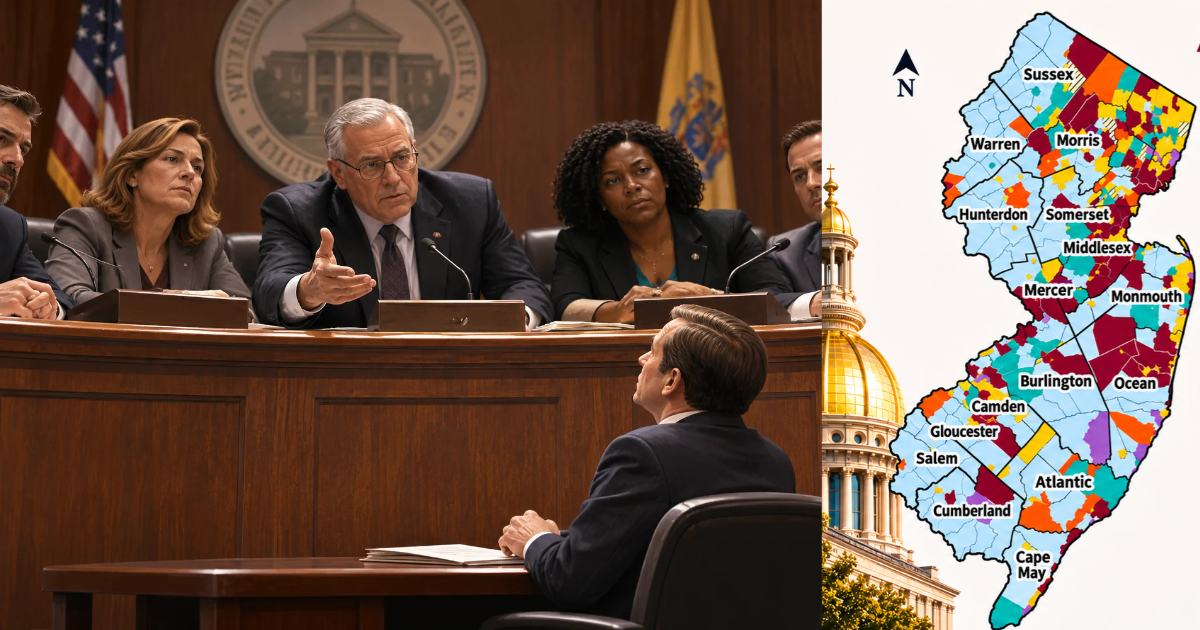
If the council majority consists of the mayor’s political opponents, proposals may fail, appointments requiring council approval can be blocked, and initiatives may stall before they even begin.
Veto power may not help much, either.
A mayor can reject a council decision, but if a stable two-thirds majority stands against the mayor, the council can override the veto and enact the measure anyway.
A cycle of confrontation develops.
The mayor proposes; the council rejects. The council adopts a measure; the mayor vetoes it. The council overrides the veto.
Instead of governing, local government becomes an arena of constant conflict and gridlock.
The mayor has not lost a single legal power, but has lost the practical ability to use those powers effectively.
This is the other side of the same story. Just as a mayor with limited authority can become highly influential through political support, a mayor with broad executive powers can be constrained by a council determined to stand in the way.
Weak on Paper, Powerful in Reality
A mayor does not need extensive legal authority to exercise real power.
The law establishes the framework, but what happens within it depends on people: how politically connected the mayor is, who stands behind the mayor, and how much weight the mayor’s word carries in town.
With a reliable council majority, a strong local party organization, longtime allies, and personal authority, a mayor’s influence can extend far beyond the powers formally granted by law.
This becomes particularly clear when the mayor and most council members have belonged to the same political group for years, run together in elections, and regularly support one another’s proposals.

Over time, close political and personal relationships develop, allowing important decisions to be negotiated long before they reach a public meeting.
The council formally has the authority to reject a proposal, but a stable majority may approve it without meaningful opposition.
That is why it is not enough to ask who voted for a particular decision. We should also ask who proposed it, where the agreement was reached, and whether any alternative was ever seriously considered.
Formally, council members make the decisions. They adopt budgets, approve contracts, confirm appointments, and vote on ordinances.
But a mayor who controls the local party organization, influences candidate selection, and determines the distribution of political positions can make opposition costly.
A council member who challenges the mayor may lose party support, a place on a future ballot, or a seat at the table during important negotiations.
All of that council member’s formal rights remain intact, but political influence disappears.
The pressure does not have to be spoken aloud.
There is no need for threats, direct orders, or public confrontations. It may be enough for everyone to know who put them on the ticket and who decides whether they will remain there.
When a small circle of political allies shapes decisions in advance, public voting becomes less a place where decisions are made than a formal confirmation of agreements already reached.
When the Mayor Changes but the Influence Remains
Many years in office bring more than experience. They create networks of allies, associates, and party relationships built over decades.
Those networks do not necessarily disappear when a mayor leaves office. A longtime associate may take over the position, while others from the same political circle retain important public roles.
One example is North Bergen, in Hudson County, which operates under the commission form of government.
Residents elect commissioners, and the commissioners choose the mayor from among themselves.
Nicholas Sacco entered local government in 1985 and became mayor in 1991. He also served as a New Jersey state senator, building influence beyond his municipality.
In October 2026, Sacco announced his retirement for health reasons and endorsed his longtime associate Hugo Cabrera, who had served as a commissioner since 1999.
Cabrera, in turn, supported the appointment of Sacco’s son, Nick Sacco Jr., the principal of Lincoln Elementary School, to the commission seat his father was leaving.
The transition took place on October 28, 2026. Cabrera became mayor, and Nick Sacco Jr. was appointed commissioner.
Those decisions were made by the commissioners, without a direct vote by residents.
The New Jersey Globe had reported as early as May on a possible plan for Sacco’s departure and the timing of his resignation, which would allow the vacant seat to be filled without a special election.
On the map, North Bergen is simply a municipality with commission government.
No color reveals the political network built over decades or its influence over who assumes the most important positions.
Englishtown: When Nearly the Entire Council Changes
North Bergen illustrates political continuity that survives a change of mayor.
Englishtown, a small borough in Monmouth County, offers a different example: a political conflict accompanied by the resignation of much of its municipal council.
Englishtown operates under the traditional borough form of government, in which the council holds substantial authority and the mayor has limited independent executive power.
During 2025, four council members resigned.
Mayor Daniel Francisco said he had asked two of them to step down because of a local incident that he could not publicly discuss for legal reasons.
Particular attention focused on his nomination of John Alite to one of the vacant council seats.
Alite had a controversial past and former ties to the Gambino crime family.
The appointment drew mixed reactions. Supporters pointed to his later work with young people and efforts to discourage drug use, while critics questioned placing someone with that background in public office.
The story took another turn in 2026.
Alite was arrested on June 19 and subsequently removed from his council position.
On October 30, authorities announced an indictment involving extortion, unlawful lending, money laundering, and other criminal offenses. The charges remain allegations that have yet to be proven in court.
The turmoil raises a broader question.
What happens to the balance of local government when most council members change within a short period and the vacant seats are filled by people already connected to the existing political structure?
Where the council holds substantial legal authority, its composition can determine how much real influence the mayor exercises.
If most council members are the mayor’s allies, the mayor may wield influence far beyond the formal powers of the office.
If the council opposes the mayor, the balance of power may be entirely different.
That is why knowing how powerful a municipal council is under the law is not enough.
It is equally important to know who serves on it, who influenced the selection of its members, and how independent they really are.
Hoboken and Bradley Beach: When the Council Limits the Mayor
The opposite balance of power can be seen in municipalities where the mayor has significant executive authority but faces a council unwilling to follow the mayor’s lead.
In Hoboken, Mayor Ravi Bhalla vetoed a measure in 2018 that would have allowed voters to decide whether to restore runoff elections for local offices.
He warned that runoff elections could lead to lower voter turnout and opportunities for vote buying.
The council overrode his veto, the referendum went forward, and voters approved the return of runoff elections that November.
In another dispute, however, the outcome was different.
The council attempted to limit the number of employees in the mayor’s office who were exempt from civil service requirements.
Bhalla vetoed the measure, and the council fell one vote short of the majority needed to override him.
The same mayor, the same council, two different outcomes.
A similar conflict occurred in 2023 in Bradley Beach, Monmouth County, which operated under the Faulkner Act’s Small Municipality form of government.
Mayor Larry Fox and the council clashed over appointments to certain administrative and professional positions.
The mayor argued that the council was interfering with executive authority, while the council insisted on its right to approve particular appointments.
The dispute reached the courts.
The court upheld the council’s authority to require approval for certain appointments while also protecting specific statutory powers of the mayor involving officials temporarily continuing in their positions.
The council subsequently voted 4–1 to amend a local ordinance that had allowed the mayor to repeat temporary appointments every 90 days.
These cases demonstrate that extensive legal authority does not guarantee political success.
A council can block a mayor’s agenda, while a mayor can use statutory powers to defend the authority of the office.
The real balance of power cannot be understood from the law alone.
It becomes visible through conflicts, voting records, court decisions, and political majorities that change over time.
What About the Professional Manager?
In some municipalities, day-to-day administration is not the mayor’s responsibility but that of a professional manager.
Under the council-manager form of government, residents elect a council that appoints a manager to oversee municipal operations, supervise departments, prepare the budget, and implement council decisions within the manager’s legal authority.
Residents do not elect the manager. The manager is primarily accountable to the council that made the appointment and evaluates the manager’s performance.
One advantage is more professional administration, particularly in budgeting, infrastructure, municipal operations, and long-term projects.
But that raises another question of accountability.
If the council adopts a program and the manager implements it, whom should residents hold responsible when the results are disappointing?
The council handles policy and oversight, while the manager handles operations. Yet that distinction is not always visible to the public.
A system in which the mayor is not the chief executive does not make the question of real political power any simpler.
It merely changes where we need to look.
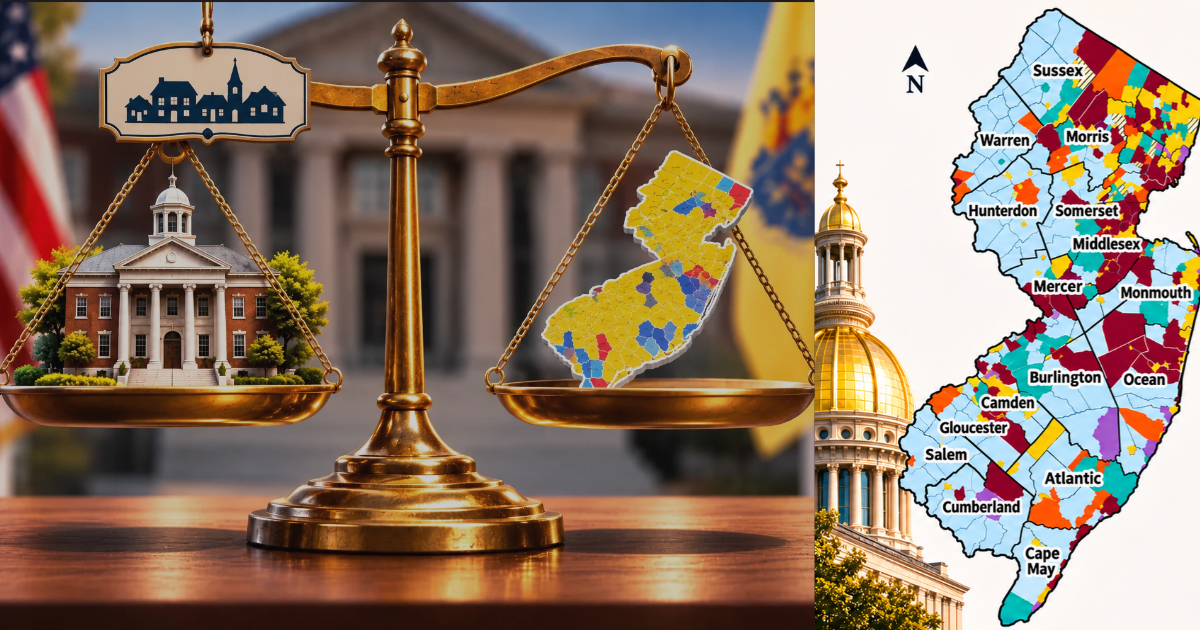
What Do These Cases Tell Us?
North Bergen, Englishtown, Hoboken, and Bradley Beach illustrate how actual political relationships can differ from what formal government structures suggest.
Legal authority establishes the rules, but political relationships often determine how those rules are used.
That is why residents need to know more than the form of government under which their municipality operates.
They need to follow council decisions, relationships among elected officials, appointments, public contracts, and the spending of taxpayer money.
How Can Residents Recognize a Mayor’s Real Power?
A mayor’s statutory authority is relatively easy to establish.
Measuring political influence over the council, public institutions, hiring, and municipal spending is much more difficult.
Still, certain indicators can help.
You do not need political connections or access to private meetings. Public meeting minutes, appointment records, contracts, municipal budgets, and voting records can reveal a great deal.
Who Sits on Boards and Commissions?
Start with planning and zoning boards and other bodies that make decisions affecting the public.
How long have members served? Who nominated and appointed them? Do the same names appear on multiple boards?
If one person serves on several important boards while the same political associates, close friends, or spouses of local officials repeatedly appear among other members, ask how open the appointment process is to other residents.
Examine how conflicts of interest are handled.
Do members recuse themselves from decisions involving personal, family, or financial relationships?
Who Gets Public Contracts, and How Much Competition Is There?
How long are public bidding opportunities open, and where are they advertised?
How many companies submit bids? Do the same firms win nearly every major contract year after year?
Pay particular attention to unusually short application deadlines.
If a bid opportunity is announced in the morning and closes just a few hours later, how could other potential bidders learn about it and prepare competitive proposals?
New Jersey establishes minimum time requirements for formal public bidding, while other types of contracting follow different rules. The first step is to identify the type of procurement involved and determine whether the process met the applicable legal requirements.
Look at contract values, subsequent amendments, extensions without new competition, and how frequently the same firms are hired.
How Does the Municipality Hire Employees?
Are job openings publicly advertised, and for how long?
Are the qualifications broad enough to attract multiple candidates, or do they appear tailored to one person’s experience?
Are members of the same family employed in multiple public positions?
Is there genuine competition for public jobs, or are some positions routinely filled without a visible selection process?
How many employees or appointees have connections to local political organizations?
Can the Council Change the Mayor’s Decisions?
How often are council votes unanimous?
Do council members propose amendments to the mayor’s initiatives?
Has anyone ever offered an alternative, requested additional documentation, or successfully stopped a measure supported by the mayor?
Who prepares the meeting agenda, and who has the authority to add items?
Have council members ever asked to place an issue on the agenda despite the mayor’s opposition, and were those requests approved?
Has any significant decision been amended, postponed, or rejected in recent years?
How Public Are Public Meetings, Really?
Are meeting materials available early enough for residents to review them?
Are minutes, individual voting records, and explanations of decisions published?
How often are important items added shortly before a meeting?
Are major decisions made without meaningful public discussion?
Do officials answer residents’ questions and provide access to public records?
Who Finances Political Campaigns, and What Connections Do Donors Have to Public Business?
Who are the largest donors to local politicians?
Do they include business owners whose companies work with the municipality, developers seeking zoning approvals, or individuals connected to major local projects?
Compare campaign finance reports with public contracts and development decisions.
How Much Independence Exists Outside the Governing Majority?
Do council members who disagree with the mayor, opposition representatives, and residents who criticize local government have a genuine opportunity to be heard?
Can they obtain the information they request?
Are public appointments open to people outside the governing political organization?
The question is not simply whether opposition exists, but whether it can actually exercise the rights the law provides.
When several of these patterns appear together, the same names serving on multiple boards, the same companies receiving contracts, spouses holding positions on several boards, limited competition, an almost entirely unanimous council, the concentration of political power becomes a matter of public interest.
All of these patterns may indicate concentrated political power or potential abuses, but their presence does not necessarily establish that wrongdoing has occurred.
The Mayor Who Never Hears “No”
Residents need to look beyond who the mayor is and how long that person has held office.
They should ask who proposes decisions, who changes them, who receives public contracts, who is appointed to boards and commissions, and who benefits.
Real power is measured not only by what the law allows a mayor to do, but also by what others can do without the mayor’s approval.
How independent are the council and public institutions when their positions conflict with the mayor’s wishes?
Can a council member reject a proposal without fearing for their political future?
Can a board make a decision the mayor opposes?
The map shows who holds authority under the law.
It cannot show who pulls the strings behind the scenes, whose phone rings when something important needs to be decided, or whether anyone can — or dares to — tell the mayor “no.”
Real power is not revealed only by the decisions that are made.
Sometimes it becomes clearer in proposals nobody has attempted to challenge, questions nobody has asked, and decisions that have never been seriously debated.
The map’s creator also points out that formal authority is not the same as political influence, and that observation may be more important than any color on the map.
Perhaps the greatest power a mayor can acquire is not the ability to make every decision personally, but the ability to ensure that almost no important decision can be made against the mayor’s political will.
Sources: Joe Martucci (@JoeMartWx), X, “How Strong Is the Mayor?” map; New Jersey State League of Municipalities; Bergen County Government; Rutgers University, Bloustein School; Township of North Bergen; New Jersey Globe; News 12 New Jersey; New Jersey Office of the Attorney General; City of Hoboken; The Coaster; New Jersey Election Law Enforcement Commission.
Aziza Smailović