


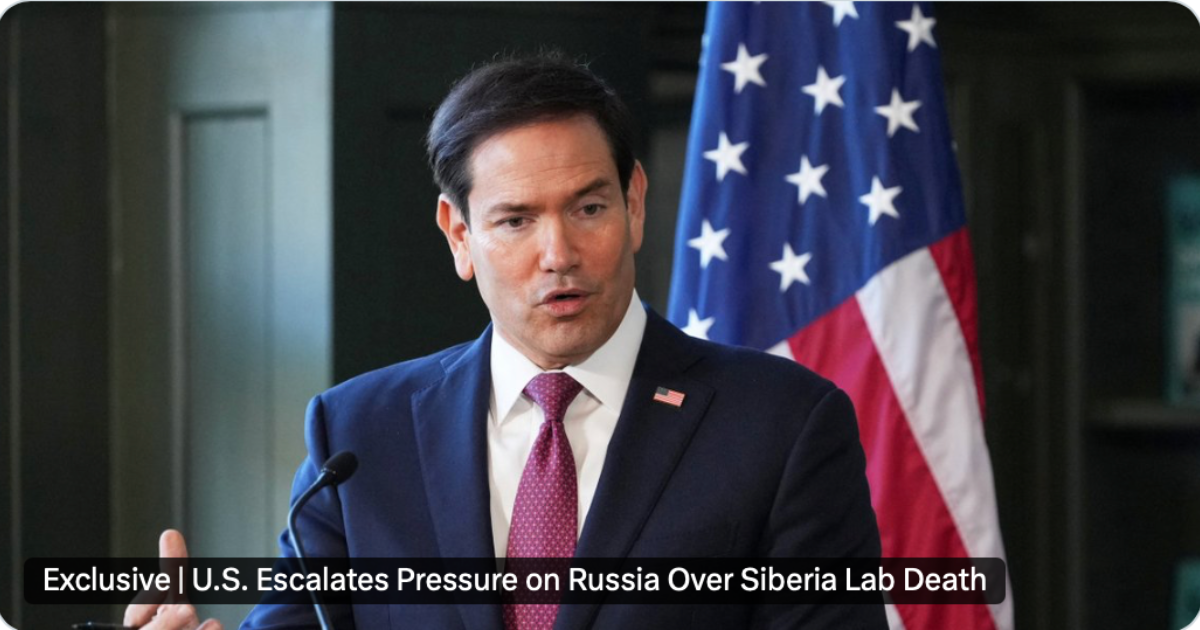
The mysterious death of a young laboratory worker at a Russian research institute specializing in dangerous infectious diseases has prompted an urgent investigation by U.S. officials, as the Trump administration seeks answers about a possible case of pneumonic plague.
According to CNN, American intelligence and public health officials are working to determine what caused the death of a 28-year-old woman employed at the Irkutsk Research Anti-Plague Institute in Siberia.
The incident has raised concerns in Washington, particularly because Russian authorities have provided limited information about the circumstances surrounding her death.
However, there is currently no confirmed evidence of a plague outbreak.
The death of a Russian lab worker at an institute dedicated to studying the plague has raised alarms throughout the Trump administration, prompting a race to compile intel and plot for a potential public health response, according to sources familiar with the matter. https://t.co/ih23kDH6x4— CNN (@CNN) October 7, 2026
What Happened at the Russian Laboratory?
The laboratory worker, identified by media reports as Darya Shipilova, died after developing pneumonia of an unknown origin.
She worked at a specialized research institute in the Irkutsk region that studies plague and other dangerous infectious diseases.
Following her death, Russian authorities introduced precautionary measures at the institute and nearby medical facilities.
Dozens of people were reportedly placed under observation or quarantine.
Russia’s public health agency, Rospotrebnadzor, stated that testing had not identified microorganisms associated with the woman’s laboratory work.
Nevertheless, the circumstances surrounding her death have attracted international attention.
Washington Demands Answers
According to CNN, the Trump administration has been attempting to gather intelligence about the incident while considering what public health measures might be necessary.
American officials have expressed frustration over the lack of detailed information from Moscow.
Secretary of State Marco Rubio said the United States was closely monitoring the situation and emphasized the importance of transparency.
President Donald Trump has also offered American assistance to Russia.
The United States is reportedly preparing a formal diplomatic request for additional information about the laboratory worker’s death.
What Is Pneumonic Plague?
Pneumonic plague is a severe bacterial infection caused by Yersinia pestis, the same bacterium responsible for historical plague epidemics.
Unlike bubonic plague, which primarily affects the lymphatic system, pneumonic plague attacks the lungs.
It can spread between people through respiratory droplets during close contact with an infected individual.
Without prompt treatment, the disease can progress rapidly and become fatal.
However, modern antibiotics can successfully treat the infection when administered early.
The disease remains rare, and isolated cases do not necessarily indicate the beginning of a larger outbreak.
WHO Says Global Risk Is Very Low
Despite the concerns expressed by American officials, the World Health Organization has urged caution in interpreting the available information.
WHO currently assesses the public health risk as low in Russia and very low internationally.
Russian authorities have reported that people who came into contact with the deceased laboratory worker are being monitored and that no additional confirmed infections have been identified.
The organization continues to communicate with Russian health officials.
Most importantly, the exact cause of the woman’s death remains unconfirmed.
Why the Incident Matters Beyond Russia
The case highlights the importance of international cooperation in monitoring dangerous infectious diseases.
Research laboratories studying potentially deadly pathogens operate under strict safety procedures, but incidents involving unexplained illnesses can trigger immediate international concern.
The central question is whether the laboratory worker died from an unrelated respiratory illness or whether her death involved exposure to a dangerous pathogen.
Until reliable medical findings become available, neither possibility can be established with certainty.
For now, health authorities are emphasizing surveillance, information sharing and preparedness rather than suggesting that a global health emergency is underway.
The incident remains under investigation.
Sources: CNN (October 6, 2026); Associated Press; Reuters; World Health Organization (WHO).
By NJ RADAR Team