


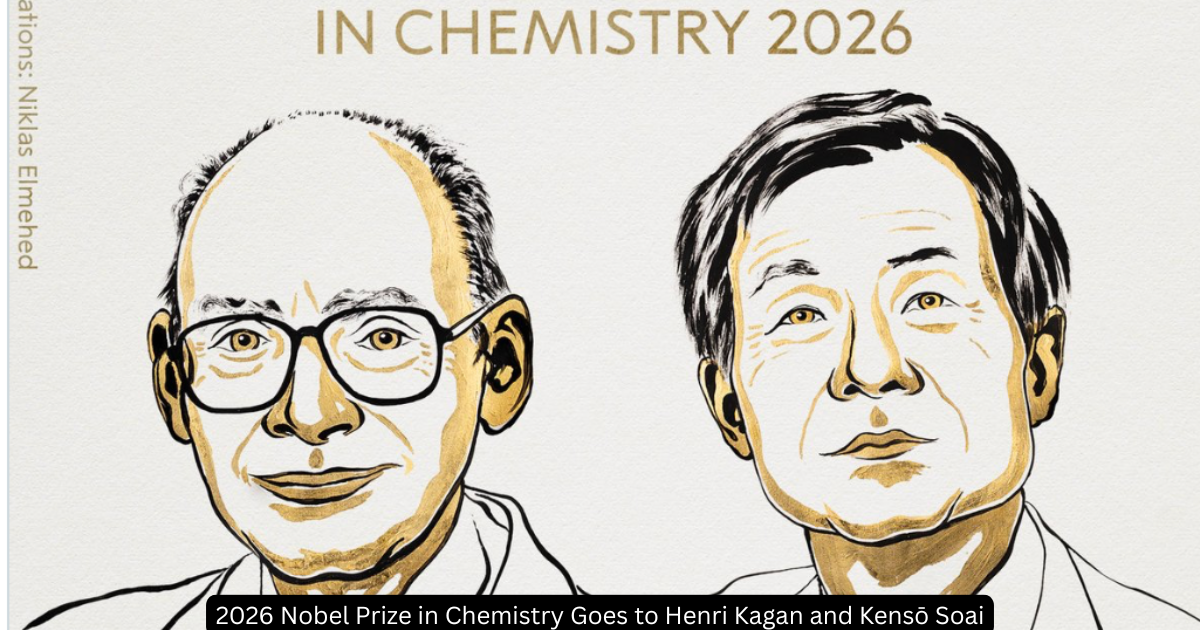
The 2026 Nobel Prize in Chemistry has been awarded to Henri B. Kagan and Kensō Soai for discoveries that transformed scientists’ understanding of how one molecular form can become strongly favored over its mirror image.
The Royal Swedish Academy of Sciences announced Wednesday that the two chemists will share the prize “for the discovery of non-linear effects and autocatalysis in asymmetric organic synthesis.”
Their work addresses one of the most fascinating features of chemistry: molecular handedness.
Many molecules can exist in two forms that are mirror images of each other, much like a left hand and a right hand. Chemists call this property chirality.
Although the two forms can have nearly identical chemical compositions, their biological effects can be very different.
That difference is especially important in medicine, where one molecular form may produce a desired therapeutic effect while the other may behave differently in the body.
Why Molecular Handedness Matters
Life itself is highly selective when it comes to molecular handedness.
For example, biological systems use predominantly one form of many amino acids and sugars.
Scientists have long asked how such a strong preference could emerge if nature initially produced both mirror-image forms in nearly equal amounts.
The work of Kagan and Soai helped provide an important part of the answer.
Kagan and the Non-Linear Effect
Henri Kagan made major contributions to asymmetric synthesis, a field focused on producing molecules in a preferred mirror-image form.
His research demonstrated what became known as the non-linear effect.
In simple terms, Kagan showed that even a relatively small imbalance favoring one molecular form can sometimes produce a much larger imbalance in the final chemical product.
That discovery changed how chemists understood asymmetric reactions and helped reveal that seemingly tiny molecular advantages can become dramatically amplified.
Soai and a Reaction That Amplifies Itself
Kensō Soai later discovered an even more remarkable phenomenon.
In what became known as the Soai reaction, the product of a chemical reaction acts as a catalyst for producing more of itself.
Even more importantly, if one mirror-image form has only a tiny initial advantage, the reaction can amplify that advantage again and again.
The result can be a product dominated overwhelmingly by one molecular orientation.
This type of process is known as asymmetric autocatalysis.
It provided scientists with a striking experimental model for how a very small initial imbalance in nature might eventually lead to a strong preference for one molecular “hand.”
Importance for Modern Chemistry
The discoveries of Kagan and Soai have had broad implications for organic chemistry.
Controlling molecular handedness is crucial in the production of pharmaceuticals, agricultural chemicals, fragrances and many other compounds.
Their work also connects laboratory chemistry with one of the biggest questions in science: why biological life on Earth developed such a strong preference for particular molecular forms.
The Nobel Committee emphasized that their discoveries revealed mechanisms capable of amplifying extremely small initial asymmetries into large chemical differences.
Two Scientists, One Fundamental Question
Kagan, a French chemist, became one of the leading figures in asymmetric catalysis.
Soai, a Japanese chemist, became internationally known for discovering the first highly effective example of asymmetric autocatalysis.
Their work was carried out over decades, but the two discoveries are closely linked by the same central idea: small molecular imbalances can become much larger through chemical processes.
That concept now plays an important role in understanding both synthetic chemistry and possible explanations for the origins of biological chirality.
The 2026 Nobel Prize in Chemistry recognizes not only a major achievement in organic synthesis but also research that helped scientists better understand how complex molecular order can emerge from extremely small beginnings.
Sources: The Royal Swedish Academy of Sciences; NobelPrize.org; Reuters
By NJ RADAR Team