


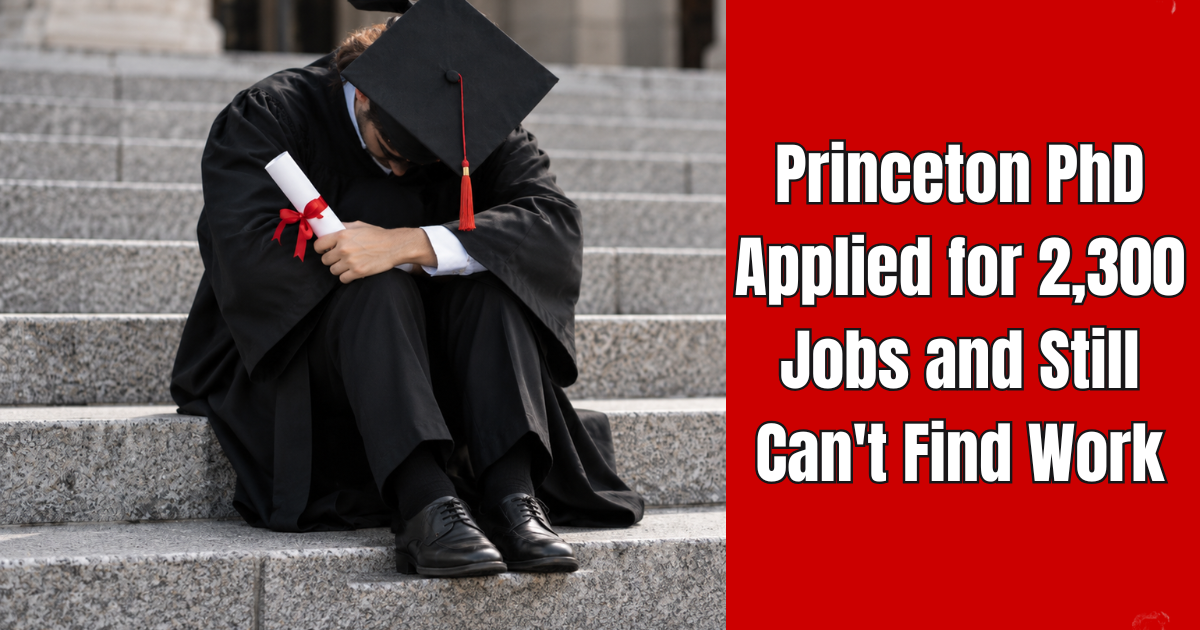
New Jersey – October 25, 2026. A scientist with a Ph.D. in chemical engineering from Princeton University has become the focus of a growing conversation about the difficulties facing highly educated job seekers in the United States.
Jack Weis, 30, graduated from Princeton in 2024. His research on ice formation was cited by the Nobel committee, yet two years later, he remains unable to secure stable employment despite submitting more than 2,300 job applications.
His story, originally reported by The Wall Street Journal, highlights a troubling reality: even advanced degrees from prestigious universities no longer guarantee employment.
From Princeton Research to Thousands of Job Applications
After completing his doctorate, Weis initially applied for positions in pharmaceutical research and national laboratories, hoping to continue working in scientific fields related to his education.
When those applications failed to produce results, he expanded his search to software engineering and other technical positions.
Eventually, he began applying for jobs far outside his qualifications, including food preparation at a company selling frozen crab cakes.
He was unsuccessful there as well.
According to the report, Weis now lives in his parents’ basement in Salt Lake City, Utah.
His mother expressed disbelief at the situation, describing how difficult it was to understand why someone with his educational background could not find employment.
Research Recognized by the Nobel Committee
During his academic career, Weis worked on research involving the formation of ice, a subject with applications in chemistry, materials science, and engineering.
His work was cited by the Nobel committee in connection with the 2024 Nobel Prize in Physics.
Although Weis was not a Nobel Prize recipient, the reference demonstrated the scientific relevance of his research.
Yet even that academic recognition has not translated into a permanent job.
A Job Market Where Companies Are Reluctant to Hire
Economists describe the current American labor market as a “low-hire, low-fire” environment.
Companies are holding on to existing employees while remaining cautious about hiring new workers, leaving job seekers competing for a limited number of openings.
The problem is particularly difficult for recent graduates and people attempting to enter specialized professional fields.
Artificial intelligence is also changing the hiring process. Many companies now use automated systems to screen applications, making it harder for candidates to reach human recruiters.
However, the precise role such screening systems played in Weis’ unsuccessful applications has not been established.
Even Highly Educated Workers Face Uncertainty
Weis briefly found contract work training artificial intelligence systems in early 2026, earning approximately $70 per hour. However, that assignment ended in March.
He has since considered alternative career paths, including studying law and starting a business involving AI-powered drones designed to remove invasive plants.
His experience has drawn attention because it challenges the assumption that advanced education and strong academic credentials automatically lead to professional success.
For New Jersey, home to Princeton University and numerous research institutions, the story also raises broader questions about opportunities for graduates entering the workforce.
Weis’ experience illustrates the growing gap between academic achievement and the realities of the American job market.
Sources: The Wall Street Journal, Entrepreneur.
By NJ RADAR Team