


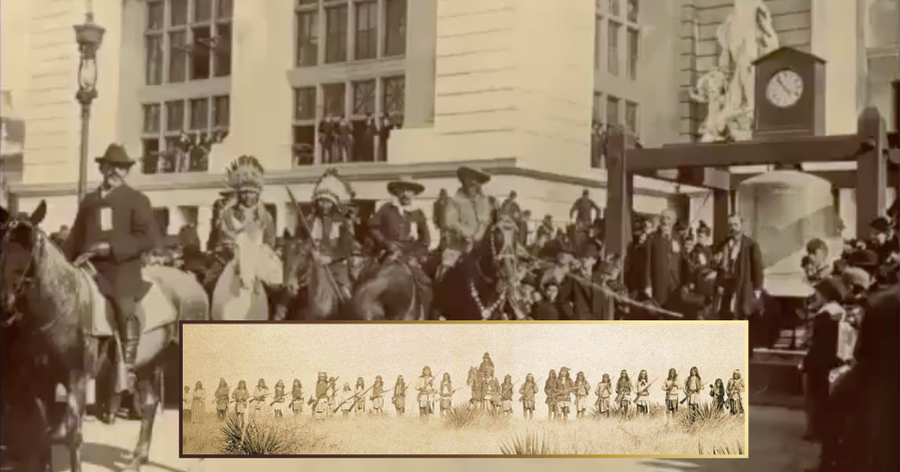
On September 4, 1886, Geronimo and a small group of Chiricahua Apache followers surrendered to U.S. forces in Skeleton Canyon, Arizona Territory, bringing one of the longest and most famous chapters of Native American resistance in the Southwest to a close.
Geronimo was born around 1829 and became one of the best-known Apache leaders of the 19th century. He was not a tribal chief in the conventional sense, but a respected warrior and spiritual leader who became famous for resisting attempts by Mexican and U.S. authorities to confine the Chiricahua Apache to reservations.
His resistance was deeply personal as well as political. In 1858, members of his family were killed by Mexican soldiers, an event that shaped much of his later life. Over the following decades, Geronimo participated in raids and conflicts across what is now Arizona, New Mexico and northern Mexico.
By the 1870s, the U.S. government was forcing Apache groups onto reservations. Geronimo repeatedly left the reservation system, arguing that the conditions were restrictive and that his people had been removed from their traditional homeland.
His final escape came in May 1885, when he left the reservation with roughly 135 to 150 followers, including women and children. For more than a year, the group moved through the rugged mountains of the U.S.-Mexico borderlands while being pursued by thousands of American troops, Mexican forces and Apache scouts working with the U.S. Army.
At one point, about 5,000 U.S. soldiers — nearly one-quarter of the standing U.S. Army — were involved in the campaign against Geronimo and his followers.
Geronimo briefly agreed to surrender to General George Crook in March 1886, but fled again before the agreement was completed.
General Nelson A. Miles then took command of the campaign.
After months of pursuit and negotiations involving Lt. Charles Gatewood, Geronimo finally met Miles at Skeleton Canyon. On September 4, the two sides finalized the surrender agreement. Geronimo and his followers became prisoners of the U.S. government.
But surrender did not mean they were allowed to return home.
Geronimo and other Chiricahua Apache — including Apache scouts who had assisted the U.S. Army — were eventually transported far from the Southwest as prisoners of war, first to Florida and later to Alabama. Many were ultimately relocated to the area around Fort Sill in present-day Oklahoma.
Geronimo would never again be allowed to live freely in his ancestral homeland.
In later years, he became an internationally recognized figure. He appeared at fairs and exhibitions, participated in President Theodore Roosevelt’s 1905 inaugural parade and dictated an autobiography. Yet despite his fame, his request to return with his people to their homeland in the Southwest was denied.
Geronimo died at Fort Sill on February 17, 1909, after spending the final 23 years of his life as a prisoner of war.
His surrender is often described as marking the end of the major Apache wars in the Southwest. But today, his story is also remembered as part of the much larger history of forced removal, reservation policies and Native American resistance to the loss of land and independence.
More than 140 years later, Geronimo remains one of the most recognizable — and complex — figures in American history.
Sources: U.S. National Park Service; HISTORY
By NJ RADAR Team