


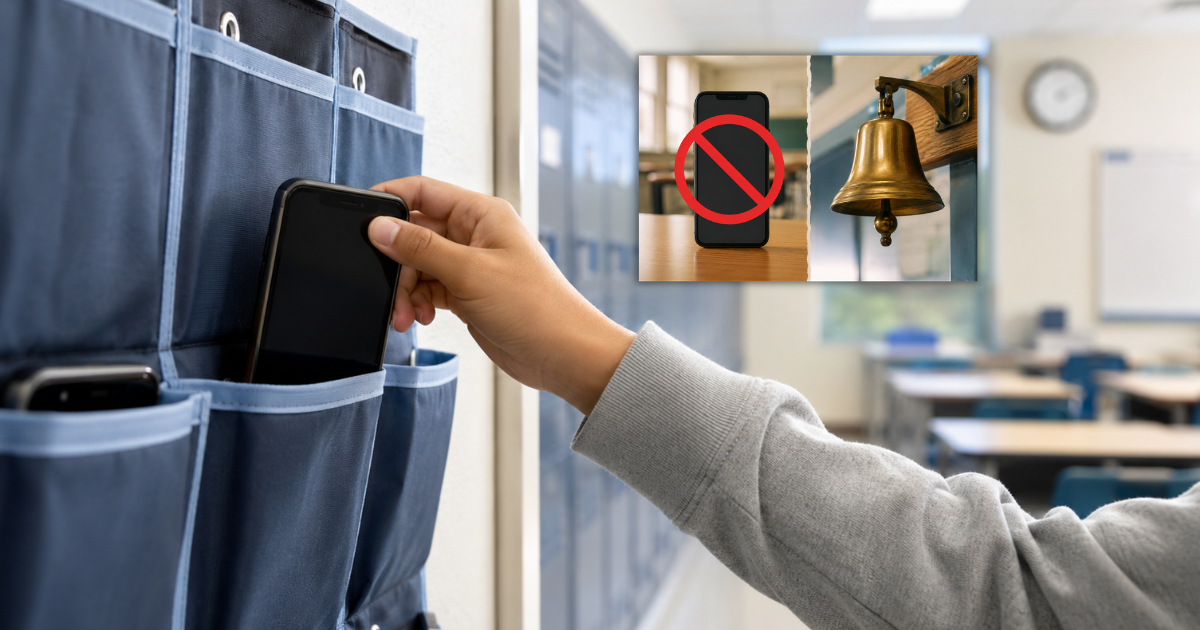
Students across New Jersey will face a major change when they return to public schools for the 2026–27 academic year: personal cell phones and other internet-enabled devices will be restricted from the opening bell through dismissal.
Under P.L. 2025, c.195, every New Jersey public school district, charter school and renaissance school project is required to adopt and implement a “bell-to-bell” policy beginning this school year. The New Jersey Department of Education says the minimum requirement is that students in kindergarten through 12th grade may not use personal internet-enabled devices during the entirety of the regular school day.
That means the restriction is not limited to classroom instruction. Depending on district policy, phones and similar devices must remain unavailable during passing periods, study halls and lunch as well.
Teaneck Families Receive New Policy Information
Teaneck Public Schools is among the districts now notifying families about the statewide change.
Interim Superintendent Angela Davis sent information to Teaneck Public Schools families explaining that the new requirement will take effect for the 2026–27 school year.
The Teaneck announcement is part of a much broader wave of districts across New Jersey finalizing their local rules before students return to school.
Neptune: Different Storage Rules by Grade
Neptune Township School District has announced that its bell-to-bell policy will take effect September 1.
Elementary students will be required to keep devices turned off and stored in backpacks. Middle school students must turn them off and secure them in assigned lockers, while high school students may store them in backpacks or lockers.
Devices must remain away not only during classes, but also during passing periods and lunch. Parents who need to reach their children during the school day are directed to contact the school office.
Randolph Requires Devices to Be Powered Off and Stored
Randolph Township Schools will begin enforcing its new policy on September 2.
The district says students must keep personal internet-enabled devices powered off and stored throughout the school day. Randolph has also published information for families explaining the new state requirement and how it will be implemented locally.
Plainfield Launches “Phones Down, Minds Up”
Plainfield Public Schools has created its own districtwide initiative called “Phones Down, Minds Up.”
The initiative was presented to the Board of Education in July as Plainfield prepared to implement the statewide bell-to-bell requirement.
District officials said the policy is intended to support student learning, engagement and well-being while complying with the new state law.
Elizabeth Also Adopts Full-Day Restrictions
Elizabeth Public Schools notified families in August that its updated electronic-device policy will restrict unauthorized student access to personal electronic devices during the entire school day.
The policy covers cell phones, tablets, smartwatches and other connected devices and was adopted in response to the same statewide requirement.
West Essex Includes Lunch and Study Halls
West Essex Regional School District adopted an updated policy on August 19.
For students in grades 7 through 12, the district defines bell-to-bell as the full period from the opening bell until dismissal, including passing periods, study halls and lunch.
West Essex is going somewhat further by restricting both internet-enabled and certain non-internet-enabled personal devices during the school day.
Monroe Also Preparing Students for the Change
Monroe Township schools are also notifying families ahead of the new academic year.
An August 24 notice to families explained that New Jersey’s new bell-to-bell requirement applies beginning in 2026–27 and outlined different expectations for students in grades K–4, 5–8 and 9–12.
What Devices Are Covered?
The state guidance applies broadly to personal internet-enabled devices, including smartphones, tablets, smartwatches, smart glasses and other devices capable of connecting to the internet or accessing online content.
School-issued technology used for educational purposes is treated differently.
Districts retain considerable flexibility in deciding where phones will be stored. The NJDOE lists several possible approaches, including locked pouches, lockers, bins, classroom storage stations or simply requiring students to keep devices turned off inside backpacks or lockers.
Exceptions Are Required
The statewide policy is not absolute.
Schools must provide exceptions in certain circumstances, including when a device is required under an IEP or Section 504 plan, for documented medical needs and for other situations covered by state guidance.
Districts may also establish procedures for emergencies and for communication between students and their families.
One Statewide Rule, Different Local Approaches
The basic rule is now the same across New Jersey: personal internet-connected devices are to remain out of use from the beginning of the school day until dismissal.
But how schools accomplish that will vary considerably.
Some districts will rely on backpacks. Others will use lockers, bins or more controlled storage systems. Some are extending restrictions beyond smartphones to additional electronic devices.
What is clear is that when New Jersey students return to school this fall, the phone rules many families were accustomed to will no longer be simply a matter of individual classroom policy.
For the first time, bell-to-bell restrictions will be a statewide requirement across New Jersey public schools.
Source: 6abc Action News / X
By NJ RADAR Team