


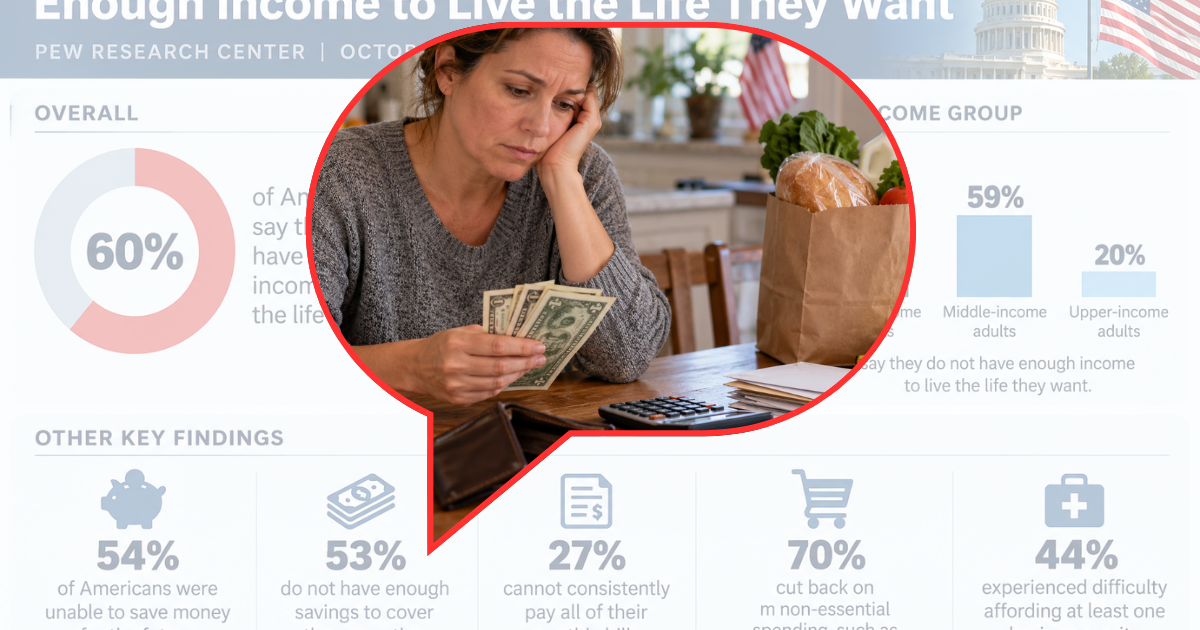
A new Pew Research Center study reveals that financial insecurity is affecting Americans across political and income groups. Even among Republicans, a majority say their earnings are insufficient to support the kind of life they want.
For millions of Americans, financial stability increasingly means more than having a job or being able to pay the rent. It means having money left after the bills, building savings, preparing for emergencies, and feeling confident about the future.
Yet a new Pew Research Center report, published October 14, 2026, suggests that many households are struggling to achieve even that basic sense of security.
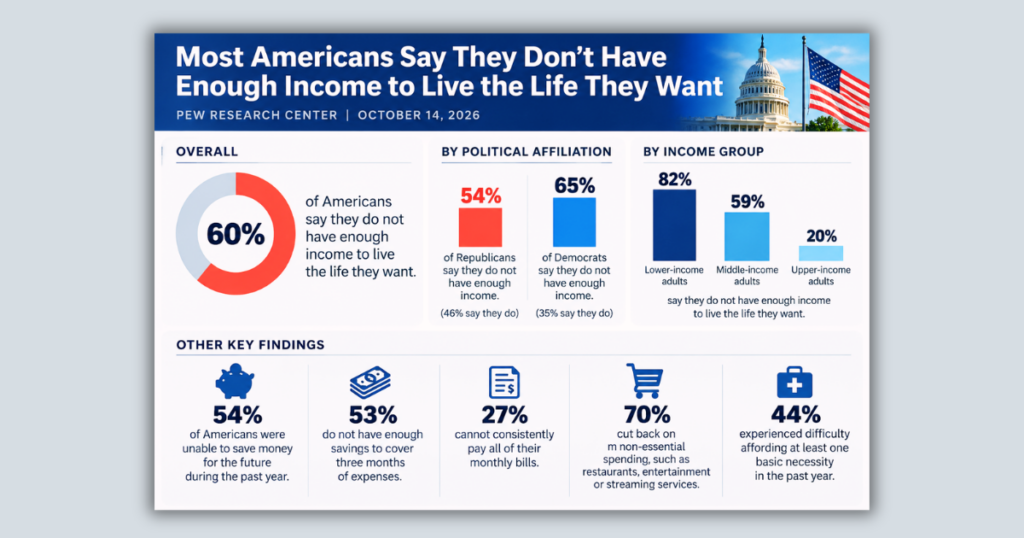
According to the study, 60% of American adults say they do not have enough income to live the kind of life they want. More than half lack sufficient emergency savings, while more than one in four cannot consistently pay all their monthly bills.
The findings offer a troubling picture of household finances at a time when economic affordability has become a central issue in American public life.
Financial Pressure Crosses Political Lines
One of the most revealing findings concerns political affiliation.
Among Republicans and Republican-leaning independents, 46% say they have enough income to live the life they want. Among Democrats and Democratic-leaning independents, the figure is just 35%.
That means 54% of Republicans and 65% of Democrats say their incomes fall short of their expectations.
Republicans generally report somewhat better financial circumstances. For example, 78% say they can typically pay their monthly bills in full, compared with 69% of Democrats.
Republicans are also more likely to have saved money during the past year and to have emergency funds available.
These differences may partly reflect the demographic and economic characteristics of each party’s supporters. They do not, by themselves, establish which political policies are responsible for household finances.
What stands out is the broader agreement: financial dissatisfaction extends well beyond traditional party divisions.
Political debates may focus on competing explanations for the economy, but households across the political spectrum are reporting pressure on their budgets.
The Middle Class Is Feeling the Strain
Financial hardship is understandably greatest among lower-income Americans.
Pew found that 82% of lower-income adults say they lack sufficient income for the life they want.
But the findings also reveal considerable pressure on the middle class.
Among middle-income Americans, 59% say their earnings are insufficient, 52% lack emergency savings covering three months of expenses, and 22% cannot consistently pay all their monthly bills.
These figures challenge the assumption that financial insecurity is primarily a problem for households with the lowest incomes.
A middle-income family may be employed, housed, and able to meet most immediate obligations while still being vulnerable to an unexpected medical expense, a car repair, or a temporary loss of income.
Financial security depends not only on what a household earns but also on how much remains after essential expenses.
When Basic Necessities Become Difficult to Afford
The survey reveals that financial pressure extends beyond discretionary spending.
Approximately 44% of American adults reported difficulty affording at least one basic necessity during the previous year.
Among the specific challenges identified:
- 28% experienced difficulty paying for medical care.
- 22% struggled with daily transportation expenses.
- 21% had difficulty paying rent or a mortgage.
- 20% obtained food from a food bank or food pantry.
The differences across income groups are substantial.
Among lower-income adults, 71% experienced difficulty with at least one of these necessities. The corresponding figures were 39% for middle-income adults and 13% for upper-income adults.
Healthcare is particularly significant because medical expenses can arrive unexpectedly and may be difficult to postpone.
Housing presents a different challenge. Rent and mortgage payments are recurring obligations, leaving households limited flexibility when other costs rise.
Together, these expenses can gradually reduce the financial cushion that families depend on during emergencies.
Americans Are Changing How They Spend
The pressure is also visible in everyday spending decisions.
Seven in ten adults reported cutting back on extras during the previous year, including restaurant meals, entertainment, and streaming services.
More importantly, 54% said they had been unable to save money for the future.
Reducing unnecessary expenses can be a sensible response to financial pressure. But when households repeatedly sacrifice discretionary spending without building meaningful savings, the problem may be more fundamental than individual budgeting choices.
It can indicate that income is being absorbed by essential costs.
This matters beyond individual households.
Consumer spending supports restaurants, entertainment businesses, retailers, and other parts of the economy. When large numbers of Americans reduce spending simultaneously, businesses may experience weaker demand.
The Pew survey does not measure the broader economic impact of these cutbacks, but it shows how widespread the behavior has become.
The Difference Between Economic Growth and Financial Security
One of the most important questions raised by the findings is why people can feel financially insecure even when they are working and participating in the economy.
National economic indicators and personal financial experiences measure different things.
Employment statistics, economic growth, stock market performance, and inflation rates help describe the economy as a whole. They do not reveal how comfortably a particular household can pay its bills.
Even when inflation slows, prices do not necessarily return to previous levels.
A family may therefore continue paying significantly more for groceries, housing, insurance, and transportation than it did several years earlier.
Wage increases can help, but their effect depends on whether earnings rise faster than household expenses.
A worker receiving a raise may still feel worse off if rent, health insurance, utilities, and transportation costs increase by an even greater amount.
The central issue is purchasing power: how much a household can actually afford with the money it earns.
What the Findings Mean for New Jersey
The results are particularly relevant to New Jersey, where housing, property taxes, utilities, transportation, and healthcare are major household expenses.
A family living in Bergen, Hudson, or Essex County may face financial pressures that differ from those in less expensive regions of the country.
For commuters, transportation costs can represent a significant monthly obligation. For homeowners, property taxes and maintenance expenses add to housing costs. Renters face their own challenges in a competitive housing market.
Recent concerns over electricity prices have added another dimension to the cost-of-living debate.
However, Pew’s survey measures American adults nationwide. It does not establish that New Jersey residents experience these problems at exactly the same rates.
What it does offer is a national context for issues that many New Jersey households are already discussing.
The question of affordability cannot be separated from the local cost of maintaining a home, traveling to work, obtaining medical care, and supporting a family.
Financial Anxiety Ahead of the Midterm Elections
The report comes just weeks before the November 3 congressional elections.
Affordability has emerged as an important political issue, with voters expressing concern about household budgets and their ability to maintain financial stability.
A separate Reuters/Ipsos poll published October 19 found widespread dissatisfaction with the administration’s handling of the economy.
Nevertheless, economic frustration does not automatically translate into support for a particular political party.
People may agree that their financial circumstances are difficult while disagreeing about the causes and the policies that could improve them.
The Pew findings underscore the importance of distinguishing political loyalty from financial experience.
A person’s party identification does not necessarily determine whether that person feels economically secure.
A Country Living With Financial Uncertainty
Perhaps the most revealing aspect of the study is not simply how many Americans struggle to afford the life they want, but how many lack protection against the unexpected.
More than half of adults do not have enough emergency savings to cover three months of expenses.
About 41% are not confident they will have sufficient income in the future to support their desired standard of living.
Yet the study also finds that many Americans remain hopeful about their financial circumstances.
That combination of concern and optimism reflects a complicated reality. People continue working, planning, and looking for opportunities even when their financial resources are limited.
For policymakers, the challenge goes beyond improving economic statistics.
The more meaningful test is whether households can afford necessities, save for emergencies, and make plans without persistent financial anxiety.
The American economy may be measured in trillions of dollars, but for most families, financial well-being is measured by a much simpler question: After paying everything they owe, how much is left?
Sources: Pew Research Center, October 14, 2026 | New York Post, October 16, 2026 | Reuters/Ipsos, October 19, 2026
By NJ RADAR Team