


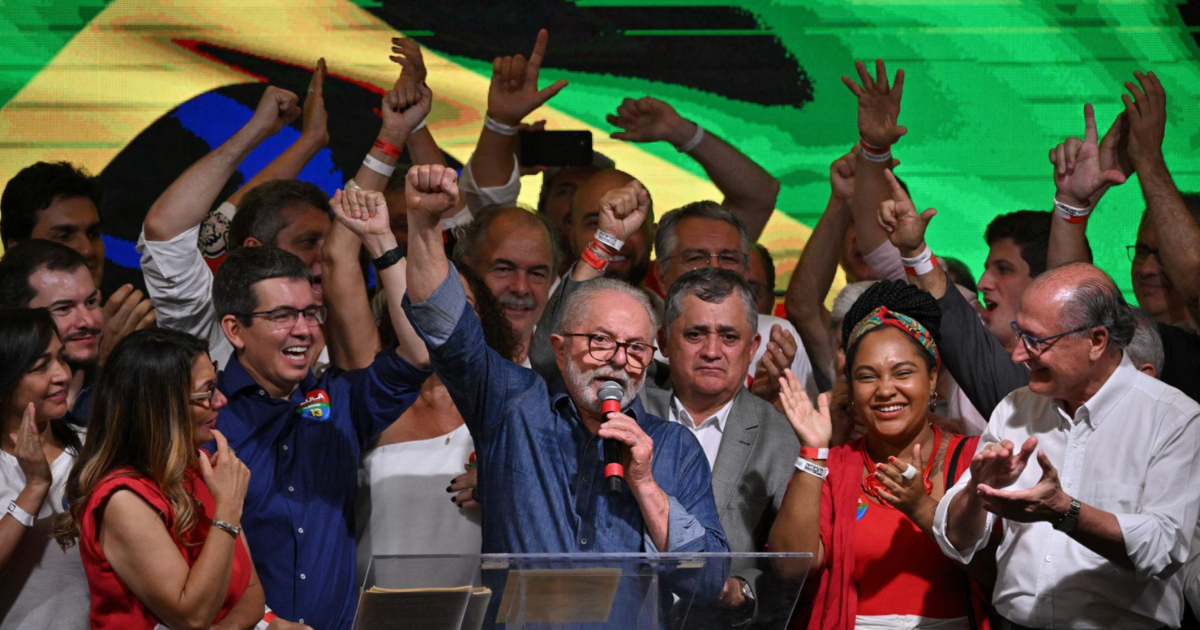
From factory worker and union leader to president, prisoner and president again, Luiz Inácio Lula da Silva has completed another remarkable chapter in Brazilian political history. On Sunday, October 25, he won a fourth presidential term, defeating Flávio Bolsonaro, the son of his longtime political rival, former President Jair Bolsonaro.
According to Brazil’s electoral authorities, Lula received approximately 51.8% of the vote, compared with 48.2% for his conservative opponent.
The result was particularly significant because Flávio Bolsonaro had finished ahead in the first round on October 4. Lula managed to reverse that result in the runoff, something no Brazilian presidential candidate had achieved since the country returned to direct presidential elections in 1989.
But the narrow victory also revealed how deeply divided Brazil remains.
From Poverty to the Presidency
Lula’s political career began far from the presidential palace in Brasília.
Born into a poor family in northeastern Brazil, he moved to São Paulo, worked in the metal industry and became a labor union leader during the country’s military dictatorship.
In 1980, he helped establish the Workers’ Party, which would become one of Brazil’s major political forces.
He first became president in 2003 and served two consecutive terms until 2010.
During those years, Brazil experienced economic growth, and social programs helped millions of families improve their living conditions.
Supporters continue to associate Lula with poverty reduction, workers’ rights and expanded access to education. Critics, however, question aspects of his economic policies and point to corruption scandals involving his party.
Prison, Political Comeback and Another Victory
Lula’s career has also been marked by major controversy.
He was convicted on corruption charges and spent approximately 19 months in prison before Brazil’s Supreme Court annulled his convictions in 2021.
The court found that the cases had been handled by a court lacking proper jurisdiction, while another ruling found judicial bias in one of the proceedings.
The decisions restored his political eligibility.
In 2022, Lula returned to power by defeating then-President Jair Bolsonaro in a closely contested election.
Four years later, he faced another member of the same political family.
This time, his opponent was Jair Bolsonaro’s son Flávio, a senator who sought to return the Bolsonaro political movement to the presidency.
Two Different Visions of Brazil
The election reflected contrasting approaches to Brazil’s future.
Lula, representing the left-wing Workers’ Party, emphasized social programs, employment, poverty reduction and an independent foreign policy.
Flávio Bolsonaro represented a conservative movement that stresses public security, traditional values, criticism of the political left and closer political ties with the United States.
The campaign unfolded amid concerns about living costs, crime, corruption and the direction of the Brazilian economy.
Lula’s victory does not mean those divisions have disappeared. Nearly half of participating voters supported his opponent, leaving the president facing the challenge of governing a politically polarized country.
What Does Lula’s Victory Mean for Trump?
The election also has international implications.
Jair Bolsonaro has long been politically aligned with Donald Trump, and his son campaigned as a supporter of stronger relations with Washington.
Lula, by contrast, has repeatedly criticized American pressure on Brazil, including trade measures introduced under the Trump administration.
He has emphasized Brazil’s sovereignty and maintained relationships with countries such as China while participating in the BRICS group of emerging economies.
His reelection suggests that Brazil will continue pursuing a foreign policy that seeks greater independence from Washington.
However, the United States remains an important economic partner, and cooperation between the two countries will continue to matter.
Why Are Some Activists Celebrating?
Lula’s victory has been welcomed by parts of the international labor movement and by left-wing and progressive political organizations.
His background as a factory worker and union organizer gives him particular symbolic importance among labor activists.
Some supporters also view the result as a rejection of far-right politics and American influence in Latin America.
Lula has been a vocal critic of Israel’s military actions in Gaza and has supported Palestinian statehood, making his victory significant to some pro-Palestinian activists as well.
But these international reactions should not be confused with the reasons every Brazilian voted. Domestic questions, including food prices, wages, security and corruption, played central roles in the election.
A Fourth Term and a Divided Nation
Lula will begin his new term on January 5, 2027.
At 80, he has achieved something unprecedented in modern Brazilian politics: winning four presidential elections.
His journey from poverty to the presidency, through imprisonment and back to political power, is extraordinary regardless of political affiliation.
But his latest victory also brings considerable challenges.
Brazil remains divided over the economy, public security, government spending and its place in the world.
For Lula, winning another election may prove easier than bringing those divisions together.
For Brazil, the next four years will test whether a country split almost evenly between two political movements can find common ground.
Sources: Reuters | Associated Press | Brazil’s Superior Electoral Court (TSE) | Agência Senado | Folha de S.Paulo
By NJ RADAR Team