


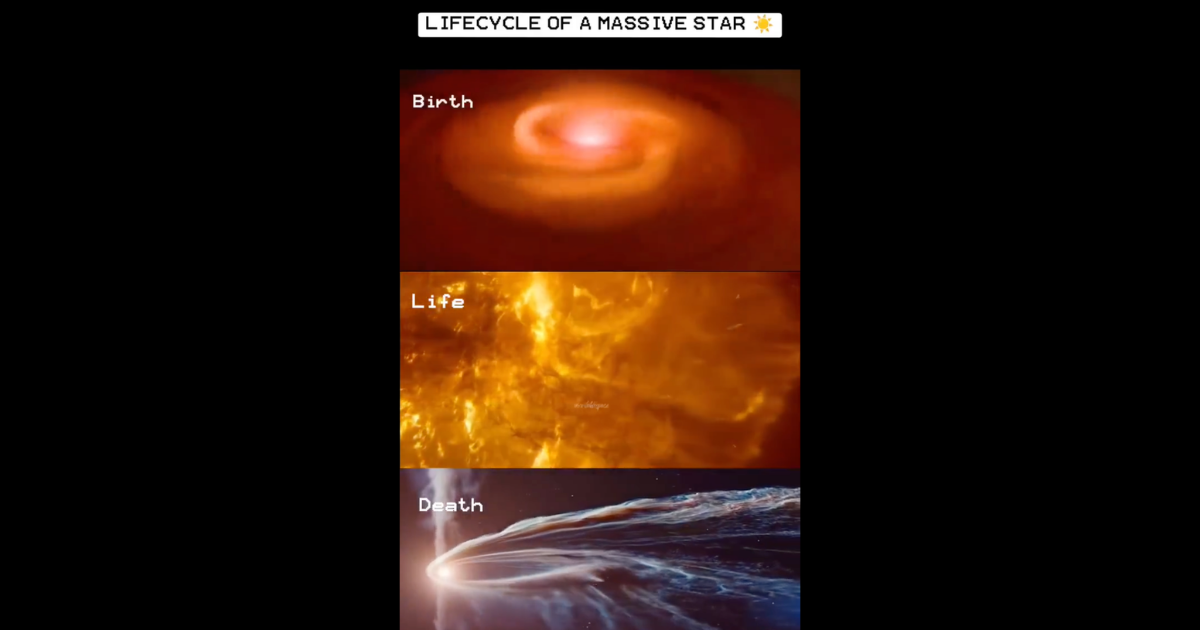
Stars may appear almost permanent when we look at the night sky, but they are born, they change, and eventually they die. For the most massive stars, that journey can end in one of the most powerful events in the universe — a supernova.
A star begins its life inside an enormous cloud of gas and dust known as a nebula. Gravity gradually pulls some of this material together, forming an increasingly dense and hot region. Eventually, conditions at the center become extreme enough for nuclear fusion to begin. Hydrogen atoms start fusing into helium, releasing enormous amounts of energy.
At that moment, a star is born.
For most of its life, a star exists in a delicate balance. Gravity constantly tries to pull its material inward, while the energy produced by nuclear fusion creates pressure pushing outward. Astronomers call this balance hydrostatic equilibrium.
But how long a star lives depends greatly on its mass.
Massive stars have far more fuel than stars like our Sun, but they consume it much faster. Some complete their lives in only a few million years. During their evolution, they can begin fusing progressively heavier elements in their cores.
Hydrogen becomes helium. Later stages of fusion can produce carbon, neon, oxygen, silicon and eventually iron.
And iron changes everything.
Fusion normally releases energy that helps a star resist the crushing force of its own gravity. But producing heavier elements from iron requires energy rather than releasing it. Once a massive star develops an iron core and can no longer generate enough energy to support itself, the balance that sustained it disappears.
Gravity wins.
The core can collapse extraordinarily quickly — in less than a second — while the resulting shock contributes to an enormous stellar explosion: a supernova. NASA notes that the initial flash from such an explosion can become bright enough to outshine the star’s entire host galaxy.
What remains after the explosion?
The answer again depends largely on mass.
The collapsed core of a massive star may become a neutron star, an extraordinarily compact object containing more mass than the Sun compressed into an area roughly comparable in size to Manhattan.
If the remaining core is massive enough, however, gravity continues the collapse. The result is a black hole, where gravity becomes so intense that even light cannot escape.
But the death of a star is also part of a new beginning.
Supernova explosions scatter material created during the star’s life and explosion across space. That material can later become incorporated into new clouds of gas and dust, new stars and eventually new planetary systems. Many of the elements found on Earth were produced through processes associated with generations of stars that lived and died long before our solar system existed.
In that sense, the life cycle of a massive star does not simply end with a spectacular explosion.
Its material returns to space — where another cosmic story can begin.
Source: NASA – The Lives, Times, and Deaths of Stars
By NJ RADAR Team