


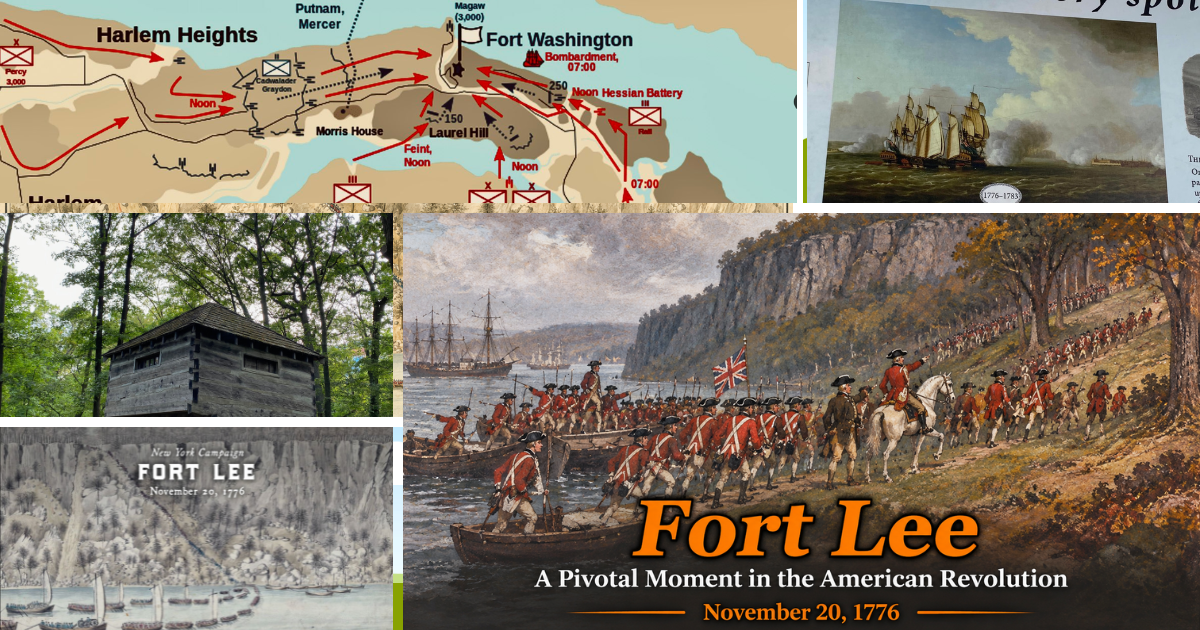
FORT LEE, NJ — November 20, 2026 — Exactly 250 years ago today, British troops crossed the Hudson River and advanced toward Fort Lee, forcing General George Washington and the Continental Army to abandon their position on the New Jersey Palisades. The retreat that followed marked the beginning of one of the most difficult chapters of the American Revolution.
What happened in Fort Lee on November 20, 1776, was a military defeat, but the decision to withdraw helped preserve the Continental Army at a time when the future of American independence was uncertain.
Today, Fort Lee is known for the George Washington Bridge, its proximity to New York City, its diverse community, and its pioneering role in the American film industry. Yet long before the bridge connected New Jersey and Manhattan, the cliffs overlooking the Hudson River played an important role in the struggle that led to the founding of the United States.
Fort Lee’s Strategic Importance in 1776
During the Revolutionary War, Fort Lee, originally called Fort Constitution, stood on the New Jersey side of the Hudson River, directly across from Fort Washington in Manhattan.
The two forts were built as part of an American defensive system intended to prevent British warships from freely navigating the Hudson, an important transportation route connecting New York with the interior of the colonies.
Fort Lee was later renamed in honor of General Charles Lee, who served in the Continental Army. General Hugh Mercer supervised construction of the fortifications, and by November 1776, General Nathanael Greene commanded the American garrison.
Although the elevated position offered a clear view of the river, it also presented a problem. The fort’s artillery was positioned high above the water, making it difficult to stop British ships passing below.
The American defenses were increasingly vulnerable as British forces consolidated their control over New York.
On November 16, 1776, British troops captured Fort Washington after a major battle, taking nearly 3,000 American soldiers prisoner.
The defeat left Fort Lee isolated and exposed.
Washington and Greene understood that the position could no longer be defended effectively and began preparing to remove troops and military supplies.
On November 18, Greene reported that he was sending supplies away as quickly as wagons could be obtained. He also sent messengers to Newark to arrange boats.
But the British moved before the evacuation could be completed.
November 20, 1776: British Troops Land North of Fort Lee
During the night of November 19 and the early morning of November 20, British and Hessian troops commanded by General Charles Cornwallis crossed the Hudson River in flat-bottomed boats.
Historical accounts place the invading force at approximately 4,000 to 6,000 soldiers.
They landed at Lower Closter Landing, near present-day Alpine, about six miles north of Fort Lee.
The location was carefully chosen. By landing north of the fort rather than attacking it directly from the river, Cornwallis hoped to advance overland and trap the American soldiers between the Hudson and Hackensack rivers.
The British received assistance from local residents loyal to the Crown.
Among them were John Aldington and Isaac Perkins, associated with the Fort Lee area, and Joseph Hawkins of Weehawken.
According to the Bergen County Historical Society, these men guided British and Hessian troops up the steep Palisades and toward the road leading to Fort Lee.
Their involvement reveals another aspect of the Revolutionary War: the conflict divided communities and families, including those living in what is now Bergen County.
Not everyone living in New Jersey supported independence. Some residents remained loyal to Britain and assisted its military operations.
The Evacuation of Fort Lee
When Greene learned that British troops were advancing, the American garrison faced the possibility of being surrounded.
Washington and Greene chose to withdraw rather than risk losing another large part of the Continental Army.
The evacuation was hurried.
Although much of the gunpowder had already been removed, soldiers were forced to abandon valuable military supplies.
Historical accounts describe the loss of approximately 50 cannons, 1,000 barrels of flour, hundreds of tents, tools, blankets, baggage, and other equipment.
These losses were particularly serious for an army already struggling with shortages.
British troops entered Fort Lee during the afternoon of November 20, encountering little resistance.
The Americans had escaped before Cornwallis could complete his attempt to surround them.
The event became known as the Battle of Fort Lee, although it involved relatively little direct fighting at the fort itself.
Its importance lies primarily in the British maneuver and the American withdrawal that followed.
The Bridge That Saved Washington’s Army
The retreat led Washington’s soldiers through Bergen County toward the Hackensack River.
One of the most important locations along the route was New Bridge, near present-day River Edge and New Milford.
The crossing allowed the Continental Army to escape from the narrow area between the Hudson and Hackensack rivers before British troops could cut off its route.
The site later became known as the “Bridge That Saved a Nation.”
Had Cornwallis successfully surrounded the Americans, Washington might have lost thousands more soldiers only four days after the disaster at Fort Washington.
Instead, the surviving troops crossed the Hackensack River and continued their withdrawal toward Newark.
The British captured Fort Lee and much of its equipment, but Washington preserved the army he needed to continue the war.
From Fort Lee to the Victories at Trenton and Princeton
The withdrawal from Fort Lee marked the opening of the New Jersey Campaign of 1776.
During the following weeks, British forces pursued Washington’s soldiers across the state.
The Continental Army faced severe shortages of food, clothing, and equipment. Many soldiers were exhausted, enlistments were expiring, and morale was declining.
Public confidence in the Revolution had also weakened following months of British victories.
Washington eventually led his remaining troops across the Delaware River into Pennsylvania.
The retreat had been costly, but the army survived.
Only weeks later, Washington returned to New Jersey.
On Christmas night, December 25, 1776, he led his soldiers across the Delaware River and launched a surprise attack against Hessian troops stationed at Trenton.
The American victory on December 26, followed by another success at Princeton on January 3, 1777, helped restore confidence in the revolutionary cause.
The army that had been forced to abandon Fort Lee was now demonstrating that it could still defeat British and Hessian forces.
The Words That Captured the Crisis
The difficult retreat through New Jersey also became closely associated with one of the most famous writings of the American Revolution.
Thomas Paine, who experienced the Continental Army’s withdrawal, described the uncertainty facing the revolutionary cause in The American Crisis, published in December 1776.
He opened with the words:
“These are the times that try men’s souls.”
Paine’s message reflected the hardships faced by the soldiers and encouraged Americans not to abandon the struggle for independence.
His words remain closely connected to Washington’s retreat and the victories that followed.
Fort Lee’s Place in American History
Two and a half centuries later, Fort Lee Historic Park preserves part of the landscape where these events unfolded.
Located on the Palisades near the George Washington Bridge, the park contains reconstructed military structures, artillery positions, historical exhibits, and educational displays.
From the cliffs, visitors can still look across the Hudson River toward the former location of Fort Washington.
Although the surrounding area has changed dramatically, the geography helps explain why Fort Lee was important to both armies.
The steep Palisades provided a natural defensive position, while the roads and river crossings connecting northern New Jersey created opportunities for military movement.
The historical significance of Fort Lee also extends beyond the fort itself.
The British landing near Alpine, the evacuation through the surrounding communities, and the crossing at New Bridge are all parts of the same story.
Bergen County’s roads, cliffs, and waterways shaped the events of November 20, 1776, and the retreat that followed.
250 Years Later, a History Worth Remembering
Fort Lee and Bergen County are marking the 250th anniversary with historical programs and reenactments from November 20 through November 22, including activities at Fort Lee Historic Park and Historic New Bridge Landing.
The anniversary is part of the broader America 250 commemoration of the nation’s founding.
Beyond the commemorative events, November 20 offers an opportunity to recognize Fort Lee’s contribution to American history.
The evacuation was not a victory on the battlefield. American troops lost an important fort, valuable supplies, and their remaining position along the Hudson River.
But Washington and Greene made a decision that helped prevent a much greater loss.
By withdrawing before the British could surround their forces, they preserved the soldiers who would continue fighting through New Jersey and later win important victories at Trenton and Princeton.
The outcome of the Revolution was still far from certain in November 1776. Independence had been declared only four months earlier, and the Continental Army was facing one of its greatest crises.
Fort Lee was where that crisis entered a new stage.
The events of November 20, 1776, remain an important reminder that Fort Lee’s contribution to American independence was not a battlefield victory, but a retreat that helped keep the Continental Army alive.
Sources: American History Central — Battle of Fort Lee; Bergen County Historical Society — Loyalists in Bergen County and New Bridge in the American Revolution; American Battlefield Trust — Fort Lee Battle History; U.S. Army Center of Military History — The New Jersey Campaign, 1776–1777; George Washington’s Mount Vernon; Palisades Interstate Park Commission.
Image source: Thomas Davies, The Landing of the British Forces in the Jerseys on the 20th of November 1776 (1776), New York Public Library Digital Collections.
By NJ RADAR Team